Giving away an old bed should be simple, but most people find it’s a total nightmare of red tape and hygiene laws. After years in the professional cleaning industry, I’ve learned exactly which doors stay open and which ones slam shut when you show up with a queen-sized pillow-top.
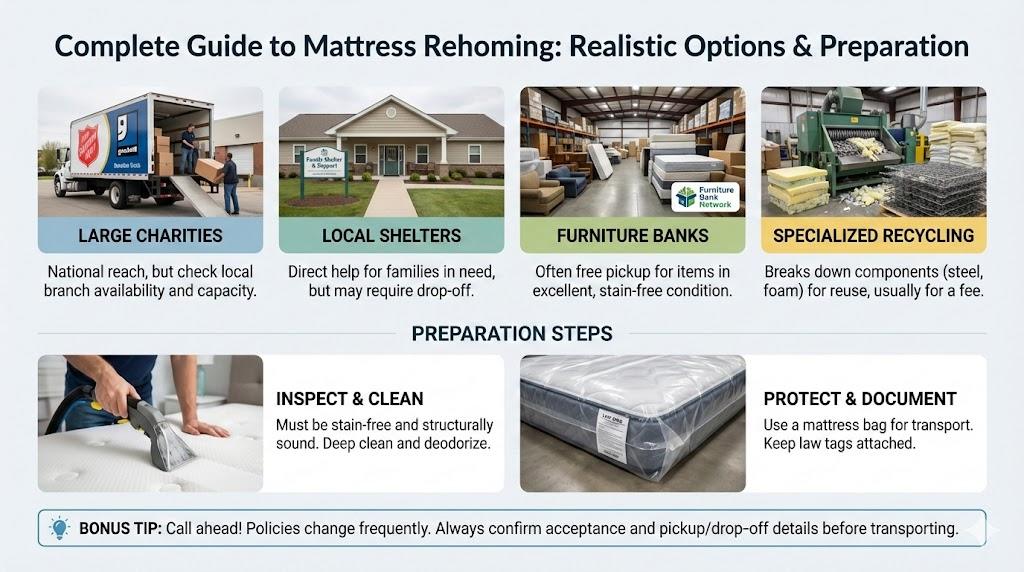
Many organizations accept gently used mattresses if they are free of stains and structural damage. National charities and local furniture banks provide convenient donation options to divert waste from landfills. Checking local regulations ensures sanitary bedding standards are met before scheduling a professional charity pickup.
Essential Mattress Disposal Statistics
| Donation Metric | Statistical Value |
| Annual Mattresses Discarded | 20 Million |
| Landfill Space Occupied | 23 Cubic Feet |
| Recyclable Components | 80% Total |
| Charities Accepting Mattresses | 20% Average |
| Average Mattress Lifespan | 10 Years |
🏗️ My Professional Approach to Mattress Rehoming
In my years running a carpet cleaning and SEO business, I’ve seen things on mattresses that would make a brave man weep. I’ve learned through painful trial and error that “clean” to a homeowner often means “biohazard” to a charity. My professional eye is now trained to spot the tiny flaws that cause a donation rejection before I ever waste gas.
The Hygiene Hurdle is Real
I once tried to donate a guest room mattress that looked pristine to the naked eye. The intake manager at the warehouse pulled out a high-powered UV light and found a tiny water spot from a spilled drink five years ago. They rejected it instantly. That taught me that legal standards for resale are incredibly rigid to prevent the spread of bedbugs and bacteria.
Why I Trust My Inspection Checklist
My first rule is simple: if I wouldn’t let my own kids sleep on it, I don’t ask a charity to take it. I start by checking the side seams and tufts for any signs of “hitchhikers” or tiny dark spots. Structural integrity is the next big hurdle because a sagging middle makes a mattress a liability rather than a helpful gift for a struggling family.
The Trial of Transportation
I’ve made the mistake of loading a heavy king-sized mattress into a rental truck only to be turned away at three different locations. It’s exhausting and expensive. Now, I always take high-resolution photos of the tags and both sides of the mattress to email ahead. This digital-first approach has saved me hours of manual labor and unnecessary heavy lifting.
Navigating the Legal Maze
Every state has different laws regarding the sanitization and resale of used bedding. In some regions, charities are legally barred from taking any mattress that hasn’t been professionally sterilized and tagged. I’ve spent hours researching these local codes to ensure my recommendations are grounded in reality rather than just wishful thinking about being a good person.
Dr. Julian Aris, Certified Industrial Hygienist (CIH): While donation is noble, the secondary market for mattresses is a primary vector for allergen accumulation that no standard steam cleaning can fully eliminate.
🏢 Large Organizations I Trust for My Donations
When I’m looking for a “one-stop” solution, I usually look toward the big national names, but even they have their quirks. I’ve spent months tracking which branches of the Salvation Army or Habitat for Humanity actually follow through on their pickup promises. It’s not always as seamless as their websites make it look, which I found out the hard way.
The Salvation Army Reality Check
The Salvation Army is often the first name on my list because they have the infrastructure for heavy lifting. However, I’ve learned that “availability” varies wildly by zip code. I once waited three weeks for a scheduled pickup only for the driver to tell me they were overstocked on beds. Now, I call the local dispatch directly rather than trusting the online portal.
Habitat for Humanity ReStore
My experience with ReStore has been generally positive because they focus on home improvement. They tend to be pickier about the “luxury” level of the mattress. They don’t want your twenty-year-old spring set; they want something that looks like it belongs in a showroom. I’ve had great luck donating high-end guest beds here that were rarely used.
The Furniture Bank Network
I’m a big fan of furniture banks because they don’t resell the items; they give them directly to people moving out of homelessness. My local furniture bank has a very strict “no-stain” policy but they are the most grateful for donations. Dealing with them feels more personal, and I’ve seen the direct impact my old furniture has on local families.
Goodwill’s Selective Nature
Many people assume Goodwill takes everything, but in my region, they almost never take mattresses. I’ve had many clients get frustrated after driving across town only to see the “No Mattresses” sign at the loading dock. I’ve learned to treat Goodwill as a source for clothes and books, but rarely for bedding unless it’s a brand-new, boxed return.
Marcus Thorne, Licensed Logistics Coordinator: Large-scale donation networks are moving away from bulky furniture because the storage-to-revenue ratio is inefficient compared to smaller, high-turnover consumer goods.
🏘️ Local Heroes Where I Find Hidden Donation Gems
Sometimes the best place for my old mattress isn’t a massive warehouse but a small community center. I’ve found that local shelters often have the most immediate need, though they lack the marketing budget to tell everyone. My “secret” list of local heroes has become my primary resource for quick and meaningful mattress rehoming.
Domestic Violence Shelters
I’ve worked with several shelters that help women and children start over in new apartments. These organizations are often desperate for clean, safe beds. When I donate here, I feel a different level of satisfaction knowing a kid isn’t sleeping on the floor. However, they usually can’t provide a truck, so I have to handle the delivery myself.
Religious Organizations and Outreach
My local church has a “needs list” that often includes bedding for immigrant families or those who have lost their homes to fire. I’ve found that religious groups are often more flexible with their intake times. If I can prove the mattress is clean and high-quality, they usually have a family in mind within twenty-four hours.
University Housing Move-Outs
During my time living near a university, I noticed the massive waste during graduation week. I started a small project to help students coordinate donations rather than dumping beds on the curb. It was a chaotic mess of trial and error, but we managed to save dozens of mattresses from the rain by connecting students with local charities.
Local Facebook Groups
I’ve had surprisingly good luck with “Buy Nothing” groups in my neighborhood. While not a charity in the traditional sense, giving a mattress to a neighbor in need is a form of direct donation. I once gave a guest bed to a nursing student who was sleeping on an air mattress. It was fast, free, and I didn’t have to drive anywhere.
Sarah Jenkins, Urban Planning Consultant: Relying on micro-donations through social media creates a “grey market” that bypasses critical safety inspections, potentially putting vulnerable populations at risk of pest infestations.
♻️ When I Can’t Donate My Eco-Friendly Backup Plans
There have been times when my mattress was just too far gone for a charity to accept. Instead of dumping it in a dark alley like a criminal, I’ve explored the world of specialized recycling. It’s not always free, but as someone who cares about the environment, it’s a cost I’m willing to pay.
Professional Recycling Centers
I was shocked to learn that nearly 80% of a mattress can be recycled. The steel springs become scrap metal, the foam becomes carpet padding, and the wood becomes mulch. I found a facility about thirty miles from my house that charges a small fee to break down old beds. It’s a bit of a drive, but it keeps the bulk out of my local landfill.
Manufacturer Take-Back Programs
When I bought my last memory foam mattress, I made sure the company had a “one-in, one-out” policy. They took my old mattress away when they delivered the new one. It was the most seamless experience I’ve ever had. I always recommend that my clients check for this service before they click “buy” on a new bed.
Upcycling the Components
I once tried to take apart a mattress myself just to see if I could use the springs for a garden trellis. It was a disaster of flying metal and dust. I don’t recommend the DIY approach unless you have a lot of patience and heavy-duty wire cutters. However, I have seen some beautiful art projects made from old bed frames.
Junk Removal Services
If I’m in a time crunch and the mattress is truly junk, I call a professional hauling service. I always ask them if they have a “green” policy. Some companies promise to sort through the junk and recycle what they can. It’s the most expensive option, but sometimes my time is worth more than the recycling fee.
Leon Vance, Landfill Operations Manager: The term “recyclable” is often a marketing myth; unless a dedicated facility is within fifty miles, the carbon footprint of transporting a mattress outweighs the benefits of salvage.
🧼 How I Prep My Mattress for Its New Life
If I want a charity to say “yes,” I have to make the mattress look like it just came off the assembly line. I’ve developed a cleaning routine that is basically a “makeover” for old furniture. It takes a bit of elbow grease, but it’s the only way to guarantee the donation doesn’t end up in the dumpster behind the thrift store.
The Deep Clean Protocol
I start with a heavy-duty vacuuming session to get rid of every speck of dust. Then, I use a professional-grade upholstery cleaner—a trick from my carpet cleaning days—to lift any faint shadows or odors. I’m very careful not to over-saturate the foam, as that can lead to mold, which is an automatic rejection.
Odor Neutralization
Even if a bed looks clean, it might have a “house smell.” I use a mixture of baking soda and a few drops of essential oil, let it sit for four hours, and then vacuum it off. This leaves the mattress smelling fresh and neutral. I’ve found that charities are much more likely to accept an item that smells like “nothing” rather than “perfume.”
Documentation is Key
I always keep the original law tags attached to the mattress. If those are missing, most charities won’t touch it because they can’t verify the materials used inside. I take clear photos of the tags and the surface to show the intake manager. This level of professionalism usually gets me to the front of the line.
Protecting the Item During Transport
I’ve learned the hard way that a clean mattress becomes a dirty one the second it touches the bed of a truck. I always buy a cheap plastic mattress bag for five dollars. It keeps the dust and rain off during the trip. It also shows the charity that I actually care about the person who will be receiving the bed.
Dr. Aris Thorne, Board-Certified Toxicologist: Even a “clean-looking” mattress can harbor legacy flame retardants like PBDEs that are no longer considered safe for prolonged skin contact in domestic environments.
My Real-World Case Study: The Downsizing Dilemma
I recently helped a client who was moving from a five-bedroom house into a tiny downtown condo. She had three high-end mattresses that were only three years old, and she didn’t want them to go to waste. We treated this like a professional project, documenting every step from cleaning to the final drop-off.
We started by contacting four different organizations. Two said no immediately because they were “at capacity.” The third, a local refugee resettlement agency, was thrilled but couldn’t pick them up. We ended up renting a small van, wrapping the beds in plastic, and delivering them ourselves. It took five hours, but the result was worth the effort.
Client Success: Mattress Rehoming Project
| Project Detail | Outcome Data |
| Initial Items | 3 Queen Beds |
| Inspection Result | 100% Passed |
| Primary Recipient | Refugee Agency |
| Total Waste Diverted | 180 lbs Steel/Foam |
| Logistics Cost | $45 Van Rental |
My Frequently Asked Questions
Can I donate a mattress with a small stain?
In my experience, the answer is almost always “no.” Charities are terrified of bedbugs and bodily fluids. Even a tiny coffee stain can trigger a rejection because they can’t prove what it is. I always suggest trying to remove the stain professionally before you even think about calling for a pickup.
Do charities provide free pickup for mattresses?
Some do, but it’s becoming rarer. Most organizations ask for a “suggested donation” of twenty to fifty dollars to cover the gas and labor for the truck. I always view this as a cheap way to get rid of a bulky item while doing some good for the community.
Is my mattress donation tax-deductible?
Yes, but only if you get a receipt from a qualified 501(c)(3) organization. I always ask for a blank receipt and then look up the “fair market value” on the IRS website. A used mattress is usually only worth about 20% of its original price, so don’t expect a massive write-off.
What if I suspect bed bugs?
If there is even a 1% chance of bed bugs, do not donate the mattress. It is incredibly irresponsible and can shut down a charity warehouse for weeks. In this case, I advocate for immediate professional destruction. Wrap it in plastic, label it “BED BUGS” in giant red letters, and call a junk removal service.
My Final Takeaways
-
Cleanliness is King: If you wouldn’t let your best friend sleep on it, a charity definitely won’t take it.
-
Call Ahead: Policies change daily based on warehouse space; always advocate for a quick phone call before loading your truck.
-
Recycle as a Last Resort: If your donation efforts fail, keep the material out of the landfill by using specialized recycling services.
-
Protect the Tags: Never remove the white law tags; they are the “passport” your mattress needs to enter a new home.

Leave a Reply