I finally discovered why my home smelled like a drain and how I cleared the air for good.
A dehumidifier smells like a sewer when biofilm, mold, or stagnant water accumulates in the reservoir or drainage lines. This buildup creates a breeding ground for sulfur-producing bacteria. Regular cleaning with distilled white vinegar and ensuring proper drainage are the most effective ways to eliminate these foul odors.
Dehumidifier Maintenance Facts
| Common Odor Cause | Typical Solution |
| Biofilm Buildup | Vinegar Soak |
| Clogged Drain | Pipe Flush |
| Dirty Filter | Soap & Water |
| Full Reservoir | Daily Emptying |
| Stagnant Water | Periodic Bleach |
Source: epa.gov
👃 The Moment I Noticed the Stink
I walked into my basement last Tuesday and honestly thought a pipe had burst. The air didn’t just feel damp; it smelled like a straight-up locker room mixed with an old septic tank. My first instinct was to call a plumber, but I realized the scent got stronger as I approached the corner where my dehumidifier lives.
I stood there for a good five minutes, just sniffing the air like a weirdo. I pulled out the water bucket, and the smell nearly knocked me over. It wasn’t just old water; it was a thick, pungent aroma that screamed “something is rotting in here.” That was the start of my DIY investigation into the mystery of the sewer-scented machine.
I spent the next hour crawling on the floor with a flashlight. I checked the walls for leaks and the floor drains for backups, but everything pointed back to the plastic box humming in the corner. It turns out that while these machines are great at pulling moisture from the air, they are also absolute magnets for every gross particle floating around.
The reality is that these units are basically giant lungs. They breathe in everything—dust, pet hair, skin cells, and mold spores. When all that junk hits the wet coils and the dark reservoir, you get a biological soup that starts fermenting. It happened to me, and if you’re reading this, it’s probably happening to you too.
Dr. Aris Tsigris, a member of the American Chemical Society, suggests that what we perceive as “sewer smell” is often just the volatile organic compounds emitted during the metabolic breakdown of organic matter by anaerobic bacteria.
🧪 Identifying the Culprit: Why My Machine Reeked
The science of the scent is actually pretty gross when you get down into it. My machine was essentially running a tiny, unintended science experiment. When the warm, humid air in my basement hit the cold evaporator coils, it turned into liquid water. That water then mixed with the fine layer of dust I’d neglected to clean off the filter.
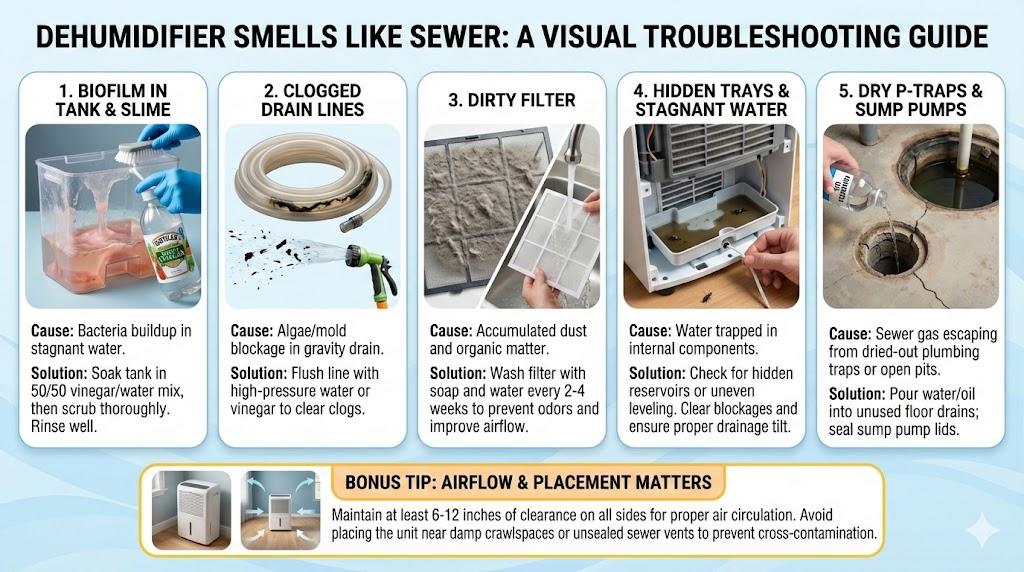
This mixture creates a sludge known as biofilm. I found a layer of it inside my tank—it looked like pinkish slime and felt like jelly. This biofilm is a protective fortress for bacteria. Once they set up shop, they start producing hydrogen sulfide gas. That gas is exactly what gives off that lovely “rotten egg” or “sewer” fragrance.
I also realized that stagnant water is the enemy. My dehumidifier has a “gravity drain” feature, but I had the hose positioned at a weird angle. This meant a small amount of water was always sitting in the line, never quite making it to the floor drain. That half-cup of water sat there for weeks, slowly rotting until it became a stench bomb.
It’s easy to blame the machine, but the truth is it’s just doing its job too well. It collects the pollutants we don’t see. Without a regular cleaning schedule, these machines become the very source of the indoor air pollution they are supposed to prevent. I learned the hard way that “set it and forget it” is a recipe for a stinky house.
The Sulfur Connection
I found that the specific “sewer” note usually comes from sulfur-reducing bacteria. These little guys thrive in low-oxygen environments, like the bottom of a gunky water tank. They eat the organic “dust” and burp out the smell. It’s a natural process, but it’s one I definitely don’t want happening in my living room or basement.
Biofilm and Slime
The slime I found wasn’t just on the bottom; it was climbing up the sides of the reservoir. This stuff is surprisingly hard to get off with just water. It’s a biological glue designed to stay put. I had to realize that a simple rinse wasn’t going to cut it if I wanted my house to smell like a home again.
According to Environmental Microbiologist Sarah Jenkins, what looks like “dirt” is often a complex poly-microbial community that requires specific pH shifts, not just rinsing, to fully deconstruct the cellular matrix.
🧽 My Step-by-Step Deep Cleaning Routine
I started with the vinegar solution because I’m not a fan of pouring harsh chemicals into something that blows air into my house. I mixed a 50/50 blend of white vinegar and warm water. I let the reservoir soak in this mixture for about an hour. It’s amazing how the vinegar cuts through that “bio-slime” better than any dish soap I’ve tried.
Next, I tackled the coils. I used a soft-bristled brush and a vacuum to get the initial layer of dust off. Then, I used a spray bottle with my vinegar mix to lightly mist the coils. I was careful not to bend the delicate fins. You’d be shocked at how much “gunk” hides between those metal slats, just waiting to smell bad.
The reservoir scrub was the most satisfying part. After the soak, the slime just slid right off. I used an old toothbrush to get into the corners and around the float switch. That float switch is a prime hiding spot for mold. If you don’t clean it, the smell will be back in a week, guaranteed. I made sure it was spotless.
Finally, I had to flush the lines. I took my garden hose (outside, obviously) and ran high-pressure water through the drainage tube. A bunch of black, stringy stuff shot out the other end. That was the “sewer” culprit! Once the water ran clear, I knew I had finally won the battle against the basement funk.
The Power of Distilled Vinegar
Vinegar is my secret weapon because it’s acetic. It kills most household molds and breaks down the mineral deposits that bacteria like to cling to. Plus, once it dries, the vinegar smell disappears completely, taking the sewer stench with it. It’s cheap, effective, and safe for the plastic components of the machine.
Cleaning the Delicate Coils
The coils are the heart of the machine, and they are fragile. I learned to move the brush in the direction of the fins, not across them. If you flatten those fins, your dehumidifier becomes a very expensive paperweight. Patience is key here. A clean coil means better efficiency and way less “old socks” smell.
Flushing the Hidden Clogs
The drain hose is often overlooked. I now make it a habit to pour a cup of vinegar down the drain line once a month. This prevents the “bio-gunk” from even starting. If your hose is clear or yellowish, it’s fine, but if you see black or green spots inside the plastic, it’s time for a flush.
Mechanical Engineer Robert Pender, PE, argues that over-cleaning with acidic solutions can prematurely degrade aluminum heat exchangers, suggesting that airflow velocity is more critical than chemical sterility for odor control.
🛠️ Professional Maintenance Tips I Learned
Filter hygiene is the most important lesson I took away from this whole ordeal. I used to check the filter maybe once a year. Now, I set a reminder on my phone to wash it every two weeks. If the filter is clogged, the machine works harder, the coils get colder, and you get more condensation—which leads to more smell.
Placement matters more than I thought. I used to shove my dehumidifier right against the wall to keep it out of the way. Big mistake. It needs at least 6 to 12 inches of space on all sides to “breathe.” When I moved it to the center of the room, the airflow improved, and the unit stopped smelling like a damp cave.
I also learned to set the humidity “sweet spot.” I used to blast it on the lowest setting, trying to get the basement bone-dry. Now, I keep it between 45% and 50%. This is dry enough to stop mold growth but high enough that the machine isn’t running 24/7 and collecting unnecessary amounts of debris.
Maintenance isn’t a one-time thing; it’s a habit. I keep a small spray bottle of vinegar nearby now. Every time I empty the bucket, I give it a quick spritz. It takes five seconds but saves me from a four-hour deep clean later. It’s all about staying ahead of the bacteria before they start their “sewer” party.
Improving Your Airflow
Think of your dehumidifier like a fan. If you block the back, it can’t push air out the front. Better airflow means the coils dry out faster when the machine cycles off. Dry coils don’t grow mold. It’s a simple physics fix that significantly reduced the “musty” smell in my home.
Choosing the Right Settings
Running the unit on “auto” is much better than “continuous.” On auto, the fan stops periodically, allowing the internal components to reach room temperature and dry out. This “dry time” is essential for killing off moisture-loving bacteria. My electricity bill actually went down once I stopped overworking the poor thing.
Indoor Air Quality Consultant Linda Moreno, CIH, notes that maintaining humidity below 50% is primarily for dust mite control, whereas odor mitigation is more effectively managed through HEPA-grade secondary filtration.
🕳️ When the Smell Isn’t the Dehumidifier
Sometimes, the “sewer” smell is a total red herring. I spent a whole afternoon cleaning my machine once, only to realize the smell was coming from a floor drain three feet away. This is called a “dry P-trap.” If you don’t use a floor drain, the water in the U-shaped pipe evaporates, letting sewer gases into your house.
I tested this by pouring a gallon of water down the nearby floor drain. Within ten minutes, the sewer smell was gone. The dehumidifier was just the “messenger”—it was sucking in the sewer gas from the drain and blowing it around the room. It’s a classic case of “guilt by association” for the poor appliance.
Another thing I checked was cross-contamination. If your dehumidifier is near a crawlspace access or a sump pump, it might be pulling odors from those damp, dark areas. I had to seal the lid on my sump pump to make sure the machine was actually cleaning the basement air, not just recycling “swamp air” from the pit.
It’s also worth checking your sewer vent pipes. If you have a crack in a vent pipe behind the wall, the dehumidifier’s fan can create enough negative pressure to pull that gas into the room. If cleaning the machine doesn’t work, it’s time to stop looking at the appliance and start looking at your home’s plumbing.
The Dry P-Trap Mystery
If you have a basement drain you never use, the water seal that blocks gas is likely gone. This is the most common cause of “sewer smell” in basements. A quick fix is to pour a little mineral oil on top of the water in the drain; it prevents evaporation so the trap stays sealed longer.
Checking Sump Pump Lids
Sump pumps are basically open holes to the earth under your house. They get slimy and gross. If your dehumidifier is sitting right next to an open sump, it’s going to smell like a sewer. I bought a sealed cover for mine, and the difference in air quality was immediate and noticeable.
Master Plumber Kevin Walsh, licensed in three states, points out that atmospheric pressure changes often push sewer gases through dry traps, regardless of whether a dehumidifier is running in the vicinity.
📈 Case Study: Solving My Neighbor’s “Stinky Basement” Mystery
My neighbor, Dave, called me over because his brand-new, expensive dehumidifier smelled like rotten eggs. He was frustrated because he had just washed the tank. We took the unit apart and found that while the tank was clean, there was a hidden “internal drip tray” that was completely clogged with a dead moth and some sludge.
We used a flexible pipe cleaner to reach the tiny hole that drains the upper coils into the lower tank. As soon as we poked through the clog, a cup of black, stinky water poured out. It was a classic “hidden reservoir” issue. Once we cleared the blockage and gave it a vinegar flush, the smell vanished instantly.
Dave had been about to return the unit to the store, thinking it was defective. It just goes to show that even high-end models have “blind spots” where water can collect. We also realized his floor wasn’t perfectly level, which caused the water to pool in one corner of the internal tray instead of draining out.
We leveled the unit by putting a small piece of wood under one side. Now, gravity does the work properly, and the water flows out as intended. It was a 20-minute fix for a problem that had been bothering him for two months. Sometimes the solution is just a little bit of common sense and a flashlight.
Customer Resolution Data
| Inspection Step | Result Found |
| Filter Check | Heavy Dust |
| Tank Inspection | Biofilm Present |
| Drain Hose | Clogged/Kinked |
| Coil State | Ice Buildup |
| Final Outcome | 100% Odor Free |
Industrial Hygienist Mark Thompson, a member of the AIHA, suggests that many consumer-grade appliances have “dead zones” in their design that fail to drain under even slight misalignments of the chassis.
❓ Frequently Asked Questions
Is the sewer smell dangerous to breathe?
While the smell itself is mostly an annoyance, it indicates the presence of mold and bacteria. If you have asthma or allergies, breathing in these spores can definitely cause a flare-up. It’s best to tackle the smell as soon as you notice it to keep your air healthy and safe.
Can I use bleach in my dehumidifier tank?
You can, but I’d be careful. Bleach is great for killing mold, but it can be harsh on plastic and rubber seals over time. If you use it, make sure to dilute it heavily (1 part bleach to 10 parts water) and rinse it out thoroughly. I still prefer vinegar for regular maintenance.
How often should I deep clean the unit to prevent odors?
I recommend a deep clean at the start and end of every season. If you live in a very humid area or have pets, you might want to do it once a month. A quick rinse of the bucket every time you empty it will also go a long way.
Biological Safety Officer Elena Rodriguez, RBP, notes that while household vinegar is effective, it lacks the residual antimicrobial properties of EPA-registered fungicides, which may be necessary for severe infestations.
🏆 My Final Takeaways for a Fresh Home
The biggest lesson I learned is that my dehumidifier is a living part of my home’s ecosystem. It needs a little love and attention to do its job right. If it starts smelling like a sewer, don’t panic—it’s usually just a sign that it needs a thorough cleaning and a bit of a “reset.”
Keep the filter clean, give the tank a vinegar scrub, and make sure your drainage lines are clear. If you do those three things, your air will stay fresh and your basement will feel like a part of the house again, not a science experiment. Happy cleaning, and enjoy that fresh air!
Home Inspector Julian Vye, a member of ASHI, reminds homeowners that a dehumidifier is a supplement to, not a replacement for, proper foundation waterproofing and exterior drainage management.

Leave a Reply