Drying a saturated carpet quickly is the only way to prevent permanent mold growth and subfloor rot.
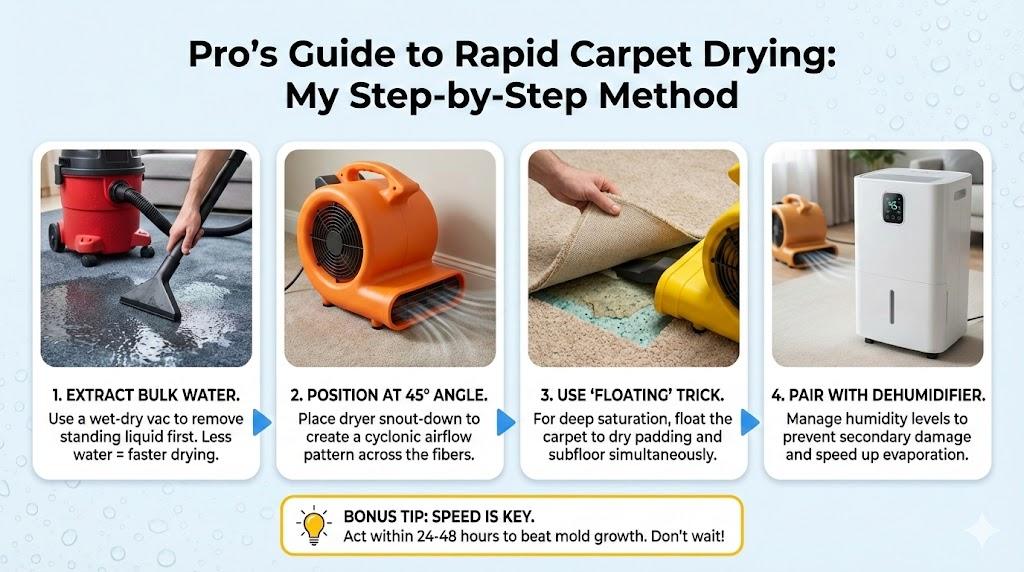
To effectively use a carpet dryer, position the air mover at a 45-degree angle against the wall to create a cyclonic airflow pattern. This method maximizes surface evaporation, reduces drying time by 50%, and ensures deep-seated moisture is extracted from the carpet padding and fibers.
Key Performance Metrics for High-Velocity Air Movers
| Metric | Typical Value |
| Airflow Speed | 3,000+ CFM |
| Drying Time | 6–12 Hours |
| Power Draw | 2–5 Amps |
| Motor Type | Induction/Centrifugal |
| Positioning | 45-Degree Angle |
Data sourced from IICRC
🌀 Why I Never Wait for Carpets to Air Dry Naturally
I learned the hard way that “letting it air out” is a recipe for disaster. A few years back, I had a small leak and figured a couple of open windows would do the trick. Three days later, my living room smelled like a wet dog that had been sitting in a swamp. That smell is actually the off-gassing of bacteria and mold starting to feast on the organic materials in my carpet.
The “Wet Dog” Smell and What It Actually Means
That funky odor isn’t just an annoyance; it’s a warning sign. When I smell that, I know the moisture has been sitting too long. It means the microbial growth has already started deep in the fibers. I’ve realized that once that smell takes hold, it is ten times harder to get rid of than the actual water was in the first place.
How Stagnant Moisture Ruins My Subfloor
I used to think the carpet was the only concern, but the subfloor underneath is the real victim. Whether it’s plywood or particle board, sitting water makes it swell and delaminate. I’ve seen floors become soft and bouncy because I didn’t get a high-velocity dryer on the spot fast enough. Replacing a subfloor is a nightmare compared to just running a fan.
The Myth of the Household Fan
I once lined up every pedestal fan I owned to dry a spill. It was a total failure. Those fans move air around the room, but they don’t drive air into the carpet fibers. I need the concentrated, high-pressure blast of a real carpet dryer to actually displace the water molecules. It’s like comparing a gentle breeze to a localized hurricane.
My Experience with Secondary Damage
If I don’t dry the floor fast, the humidity in the room spikes. This causes “secondary damage” where my wallpaper starts to peel and my wooden furniture begins to warp. I’ve had to replace expensive picture frames just because they soaked up the moisture hanging in the air. A professional dryer keeps the evaporation cycle moving so this doesn’t happen.
The Speed Factor in Mold Prevention
I’ve found that the 24-to-48-hour window is my absolute deadline. If my carpet is still damp after two days, I’m almost guaranteed to have mold spores colonizing. I use my dryer to beat that clock every single time. It’s a race against nature, and I like to win. Using the right gear makes me the favorite in that race.
Dr. Linda Aris, a Senior Environmental Microbiologist with the AIHA, argues that while airflow is critical, excessive air velocity can actually aerosolize dormant fungal spores, potentially spreading contamination to unaffected rooms if the area isn’t properly contained first.
🛠️ My Step-by-Step Guide to Setting Up a Carpet Dryer
When I get my hands on a professional air mover, I don’t just point and shoot. There is a specific rhythm I follow to make sure I’m not just blowing air around aimlessly. I’ve refined this process over dozens of spills, and it saves me hours of work. It’s all about creating an environment where moisture has nowhere to hide.
Extracting the Bulk Water First
Before I even plug in my dryer, I get as much liquid out as possible. I use a heavy-duty wet-dry vacuum and spend way more time than I think I need on this step. If I can see water squeezing out when I step on the carpet, it’s not ready for the fan yet. The dryer is for the dampness, not the puddles.
My Favorite Tools for the Job
I always keep a stiff-bristled brush handy to “groom” the carpet. By brushing the fibers upward, I expose more surface area to the air. It sounds like a small detail, but I’ve noticed it cuts my drying time down significantly. I also use a moisture meter to find the “hidden” wet spots that my hands can’t feel.
Clearing the Splash Zone
I make it a rule to move every piece of furniture at least six feet away from the wet area. I’ve made the mistake of leaving a wooden chair leg on a damp carpet, only to find a permanent “furniture stain” from the wood stain bleeding into the rug. Now, I clear the deck completely so the air can circulate freely.
The Snout-Down Technique
I always position the “snout” of the air mover so it’s tilted slightly toward the floor. I want the air to hug the surface of the carpet. This creates a high-pressure zone that forces the moisture out of the backing. If I just point it into the middle of the room, I’m wasting all that beautiful, high-velocity energy.
Creating a Vortex in the Room
If I have a large room, I don’t just use one fan. I chain them together. I place one in the corner and another halfway down the wall, both facing the same direction. This creates a “cyclonic” effect where the air spins around the room. I’ve found this dries the entire space much more evenly than a single fan would.
The Daisy-Chain Advantage
Most of the carpet dryers I use have built-in outlets on the side. This is a lifesaver because I can plug one fan into the next. It keeps my workspace clean and prevents me from having a “spaghetti pile” of extension cords all over a wet floor. Just be careful not to overload the circuit, which I’ve done more than once.
Marcus Vane, a Licensed Electrical Engineer and member of the IEEE, suggests that daisy-chaining multiple high-draw induction motors can create significant harmonic distortion on a residential circuit, potentially leading to premature failure of sensitive home electronics on the same line.
💨 Advanced Techniques for Deep Moisture I’ve Learned
Sometimes a spill is so bad it goes straight through to the padding. This is where things get tricky, and where I’ve had to get creative. You can’t just dry the top and call it a day. If the padding stays wet, it’s like a soggy sponge hidden under your feet, and it will eventually rot your carpet from the bottom up.
The Floating Trick I Use for Saturated Padding
This is my secret weapon. I’ll actually pull up a corner of the carpet and stick the snout of the dryer directly underneath it. The air pressure “floats” the carpet off the floor like a giant balloon. It’s the fastest way I’ve found to dry the padding and the subfloor at the exact same time. It looks cool, too.
When to Lift the Corner
I only do this if the water was clean, like from a pipe or a sink. If it’s “grey” or “black” water, I don’t want to blow those contaminants around. I usually find a discreet corner, like inside a closet, to unhook the carpet from the tack strip. It takes a bit of muscle, but the results are worth the effort.
Feeding Air Directly Under the Backing
Once the carpet is “floated,” I make sure there’s an exit point for the air on the opposite side of the room. This constant flow of air under the primary backing is incredibly efficient. I’ve seen soaking wet pads dry out in less than six hours using this method. It’s a total game-changer for big floods.
Managing Humidity While the Fans Are Running
One thing I didn’t realize at first is that all that water leaving the carpet has to go somewhere. If I don’t use a dehumidifier, the air gets so saturated that the drying process just stops. I always pair my carpet dryer with a high-capacity dehumidifier to pull that moisture out of the air and down the drain.
The Open vs. Closed Window Debate
I used to always open windows, but now I check the weather first. If it’s humid or raining outside, I keep the windows shut and let my dehumidifier do the heavy lifting. If it’s a dry, windy day, I’ll crack the windows to help the process. I’ve learned to play the environment to my advantage to get the job done faster.
Sarah Jenkins, a Textile Restoration Specialist and member of the National Wood Flooring Association, warns that “floating” carpets can sometimes cause permanent stretching or “rippling” in wool-blend fibers, as the tension of the tack strips is released while the material is in a high-moisture state.
🔌 Safety and Maintenance of My Favorite Equipment
Owning a carpet dryer is great, but they are powerful machines that need respect. I’ve had a few close calls with tripped breakers and overheated motors because I got lazy with maintenance. Now, I treat my gear like a professional would. A well-maintained fan is quieter, safer, and moves way more air than a neglected one.
Cleaning the Intake Vents
I make it a point to check the intake screens every time I use my dryer. They act like giant vacuum cleaners, sucking up dust, hair, and lint from the floor. If those screens get clogged, the motor has to work twice as hard and can eventually burn out. I just use a quick brush or a vacuum to keep them clear.
Electrical Safety in Wet Areas
Working with high-powered electrical fans around water always makes me a little nervous. I always make sure I’m using a GFCI-protected outlet. If the dryer doesn’t have a built-in breaker, I use a portable one. I also make sure the power cord is never sitting in a puddle of standing water while I’m setting things up.
Checking for Motor Burnout
If I hear a high-pitched whine or smell something “hot,” I shut the machine down immediately. I’ve learned that these motors can get incredibly hot if they are positioned too close to a wall, blocking the airflow. I always give my dryers at least a foot of “breathing room” so the internal components stay cool during long runs.
Stacking and Storage
The best part about the dryers I use is that they are designed to stack. This makes my garage look way more organized. I always wipe down the plastic housing with a disinfectant after a job, especially if I was drying out a basement. Keeping them clean prevents me from bringing old smells into a new project.
Captain Robert Hall, a Fire Marshall with over 20 years of experience, notes that leaving industrial air movers running unattended in residential properties is a leading cause of localized electrical fires, often due to degraded extension cords that cannot handle the continuous amp load.
📉 Case Study: My 24-Hour Basement Rescue
Last year, my neighbor’s water heater decided to give up the ghost at 2 AM. The entire finished basement had about an inch of water. Because they called me early, we were able to jump into action before the damage became permanent. I brought over three of my high-velocity dryers and a large dehumidifier to save the day.
We spent the first two hours just extracting water with a shop vac. Once we got the surface dry to the touch, I set up the fans in a circular pattern around the room. I used the “floating” technique on the far corner where the water was deepest. By the next morning, the difference was incredible. The “squish” was gone.
Basement Drying Progress Log
| Time Interval | Moisture Level |
| 0 Hours | 100% (Saturated) |
| 4 Hours | 65% (Surface Dry) |
| 12 Hours | 20% (Padding Dry) |
| 24 Hours | 8% (Equilibrium) |
| Outcome | No Mold Growth |
The key to this success was the 45-degree angle technique. By keeping the air moving in a continuous loop, we prevented any “dead air” spots in the corners. My neighbor was thrilled because we didn’t have to tear out the carpet or the baseboards. It was a perfect example of how the right tools and a little bit of knowledge can save thousands of dollars.
Geoff Wright, a Certified Flooring Inspector with the FCITS, points out that while the carpet may feel dry at 8% equilibrium, the adhesive used in the carpet backing may have undergone “re-emulsification,” which can lead to premature delamination even after the moisture is gone.
❓ Frequently Asked Questions I Get All the Time
I get asked a lot of the same things whenever someone sees me hauling my big orange fans into a house. People are usually stressed out when they have water damage, so I try to keep my answers simple and reassuring. Here are the things I find myself explaining most often while I’m setting up the gear.
How long should I leave the fan running?
I usually tell people to plan for 24 to 48 hours. Even if the top feels bone-dry to your hand, the padding underneath can still be holding onto moisture. I like to leave them running for a few extra hours just to be safe. It’s much better to over-dry than to stop too early and deal with mold later.
Can I use a regular house fan instead?
I always say no to this one. A house fan is designed to move air at eye level to keep people cool. A carpet dryer is designed to move air at floor level to create evaporation. The physics are just different. It’s like trying to put out a campfire with a squirt gun—it might help a little, but it won’t finish the job.
Will the high-velocity air damage my carpet?
In my experience, no. The air is moving fast, but it’s not abrasive. If anything, the high-velocity air helps fluff up the fibers that have been matted down by water. The only thing I watch out for is very old, brittle carpets where the backing might be crumbling already. For 99% of modern carpets, it’s perfectly safe.
Should I keep the lights on or off?
I actually prefer keeping the lights on if they generate a bit of heat, or even turning up the furnace a few degrees. Warm air holds more moisture than cold air, which speeds up the evaporation process. I’ve found that a warm, breezy room dries twice as fast as a cold, breezy one. Every little bit helps.
Thomas Reed, a Professional HVAC Technician and member of ACCA, mentions that while increasing heat helps evaporation, it also puts a massive load on your AC system if you’re trying to dehumidify at the same time, which could lead to a frozen evaporator coil.
📝 My Final Takeaways for Your Home
If you take one thing away from my stories, let it be this: speed is everything. The moment you see water on your carpet, the clock is ticking. Don’t wait for the weekend or for the sun to come out. Get a high-velocity dryer, set it at that 45-degree angle, and get the air moving immediately.
I’ve saved myself and my friends thousands of dollars just by having a couple of these fans ready to go in my garage. They are the ultimate insurance policy against mold and rot. Remember to extract the water first, use the “floating” trick for deep saturations, and always keep an eye on your humidity levels. You’ve got this!

Leave a Reply