Request Your Instant Estimate
When water enters a building, the “mould clock” begins a 48-hour countdown. As IICRC-certified technicians and Licensed Building Practitioners (LBP), Carpet Cleaning Force provides a surgical response to water ingress. We don’t just “dry carpets”—we stabilize the building’s bones to prevent secondary damage and structural degradation.
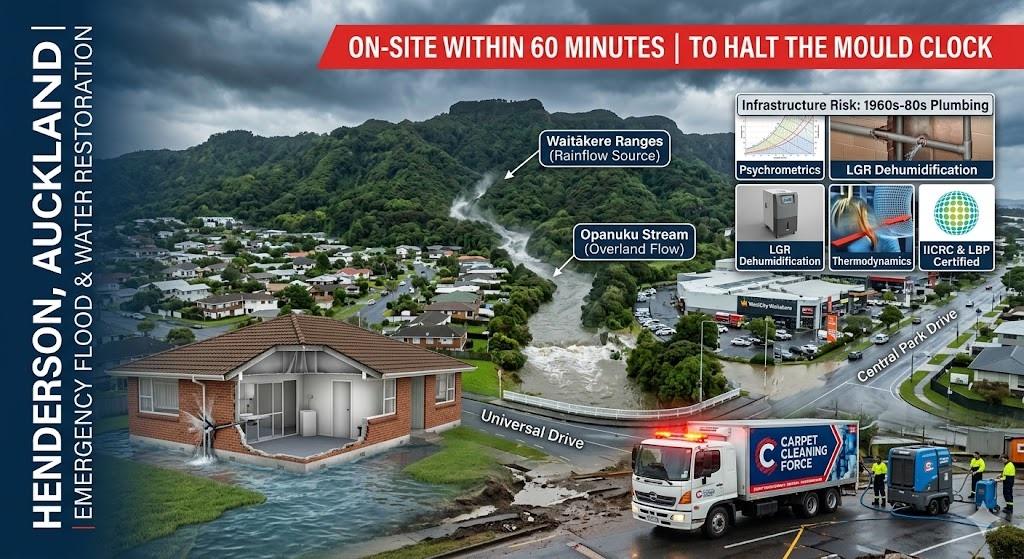
Geographic Risk Profile: The Waitākere Runoff & Hydrostatic Pressure
Henderson’s geography makes it a high-velocity catchment zone. Positioned at the base of the Waitākere Ranges, heavy North-Westerly rain events result in rapid, silt-heavy runoff.
-
Environmental Threat: When the Opanuku or Oratia Streams breach their banks, properties near Central Park Drive or Universal Drive face high-risk “Category 3” (Black Water) intrusions.
-
Sub-Surface Intrusion: Henderson’s dense clay soils prevent natural drainage, creating immense hydrostatic pressure that forces groundwater under your floorboards and into the wall cavities, saturating the “wicking zone” of your internal linings.
Infrastructure Archaeology: 1960s–80s Plumbing Vulnerabilities
Henderson’s housing stock features specific era-based risks that dictate our restoration strategy.
-
The Dux Quest Factor: Many homes in the residential pockets near Henderson South School were built during the late 70s and early 80s. These often contain Dux Quest (Polybutylene) piping, which is prone to sudden, catastrophic splits.
-
Galvanized Pipe Fatigue: In older 1960s bungalows, original galvanized lines are often corroding from the inside out. A “pinhole leak” behind a vanity can run for weeks, causing the timber framing to reach its Fiber Saturation Point (FSP) before you ever see a damp patch.
-
Capillary Suction: In modern builds on concrete pads, we monitor the capillary action that draws moisture into the timber sole plates and deep into the structural materials of the home.
Technical ‘Surgical’ Process (IICRC S500 Standards)
We follow a strict physics-based flow path to restore your property: High-Volume Extraction -> Psychrometric Stabilization -> Clinical Sanitization.
1. High-Lift Bulk Water Extraction
We utilize truck-mounted vacuum systems to perform sub-surface extraction. This pulls bulk water from the underlay and the floor-wall junction, removing the thermal mass of the water to immediately speed up the evaporation phase.
2. Scientific Drying (LGR Dehumidification)
We manage the Grains Per Pound (GPP) of the air to force moisture out of dense structural components like native Rimu framing or MDF cabinetry.
-
LGR (Low Grain Refrigerant) Units: These extract moisture in low-humidity environments where standard units fail.
-
Vapor Pressure Management: By creating a “controlled drying envelope,” we prevent the warping or “checking” of timber materials.
3. Clinical Sanitization
For storm-related flooding, we apply broad-spectrum antimicrobials. This halts microbial proliferation and ensures the air quality remains safe for your family or employees.
Loss Adjuster Support: Insurance-Ready Documentation
As an LBP-led firm, we speak the language of your insurer. We provide the comprehensive “Paperwork of Proof” required by AA, State, or Tower to approve your claim without friction.
-
Infrared (IR) Thermography: High-resolution thermal maps showing the exact “moisture footprint” behind wall linings.
-
Moisture Encounter Logs: Daily readings of %MC (Moisture Content) in timber and RH (Relative Humidity) in the air.
-
Psychrometric Charts: Evidence that the drying environment met IICRC S500 benchmarks for the duration of the project.
Localized Trust: Henderson’s Emergency Response
Whether you are managing a flooded commercial warehouse on Lincoln Road or a residential villa near the Henderson Train Station, we are your local rapid-response unit.
Local Case Study: Universal Drive, Henderson “After the Opanuku Stream flooded, our ground floor was saturated. Carpet Cleaning Force arrived in under 60 minutes. Their thermal cameras revealed water had traveled 300mm up the internal studs—something we couldn’t see. They saved our cabinetry and cleared the insurance claim within days.” — Mark T., Henderson Homeowner
FAQ: Henderson Property Owners
1. My street flooded near WestCity; is the water dangerous? Yes. If water has traveled over the ground (overland flow), it is Category 3 (Black Water). It contains bio-contaminants. Professional extraction and sanitization are mandatory to protect the health of occupants.
2. Can you dry my house without removing the skirting boards? Our high-pressure “injectidry” systems can often dry wall cavities through small, non-invasive access points, avoiding the need for a full “strip-out” of your 1970s trim and Gib board.
3. How long does the drying process take in the Henderson climate? Given Auckland’s high ambient humidity, a scientific dry-down typically takes 3 to 5 days. Our LGR dehumidifiers are essential here to drop the humidity low enough for the building materials to release deep-seated moisture.
4. Will my insurance cover the cost of your services? In most cases, yes. We provide exact, IICRC-standard documentation and equipment runtime records. This gives your loss adjuster the exact technical data they need to quickly approve your claim for internal leaks or storm damage.
Stop the damage now. Call Carpet Cleaning Force for 60-minute emergency dispatch in Henderson. [Call 021-877-504]
\n