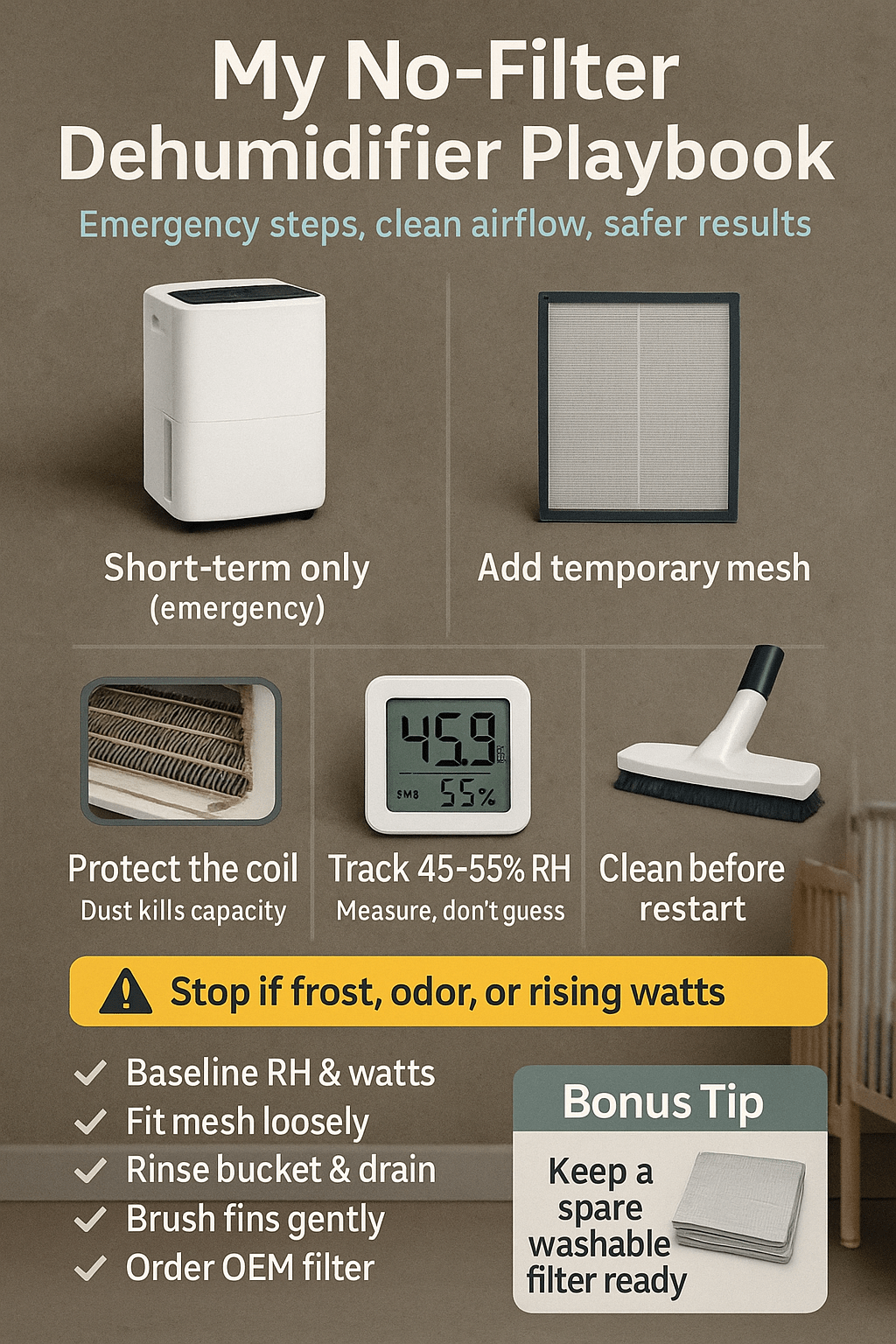
My No-Filter Dehumidifier Story (And What I Learned Fast)
When a storm blew through and supplies ran thin, I tested a dehumidifier without a filter so I could keep rooms dry and safe while I waited for parts.
Running a dehumidifier without filter can reduce airflow and raise energy use while allowing dust buildup and mold risk. Short emergency runs may be workable, but routine use needs frequent cleaning, coil care, and a washable mesh prefilter to protect coils and performance.
Key Facts: Dehumidifier Without Filter
| Item | Quick Data |
|---|---|
| What “no filter” means | Intake screen removed or missing; air hits coils directly |
| Typical efficiency drop | Roughly 10–30% as dust fouls the coil and fins |
| Airflow impact | Noticeable CFM loss after days in dusty rooms |
| Maintenance need | Vacuum fins weekly; rinse bucket and drain path daily |
| Safer workaround | Clip-in washable mesh or cut-to-fit pad until OEM arrives |
Source: ashrae.org
🧪 Why I Tried a Dehumidifier Without a Filter
I didn’t plan to run filter-free. A delivery delay forced my hand during a sticky week when the basement, laundry, and bathroom all sat above 65% RH. I set up monitors, noted power use, and promised myself I’d quit if odor or frost showed up on the coils.
When emergency overrides best practice
If the choice is moisture damage or a short trial, I’ll run the unit while watching RH, kWh, noise, and coil frost. I treat it like an emergency generator—useful, but not how I want to operate day-to-day.
My baseline readings before removal
I recorded room RH, temperature, and the unit’s watt draw with a smart plug. My target was 50% RH. Anything above 60% meant mold risk and a musty smell in hours. Data kept me honest, not hopeful.
“Short-term exceptions make sense only with measurements,” notes Dr. Elena Park, CEM (Certified Energy Manager).
🔧 How My Dehumidifier Works (And Why the Filter Matters)
Air enters the intake, crosses a cold evaporator coil where moisture condenses, then moves across a warm condenser coil and back to the room. That cold coil loves dust. Without a filter, lint and fibers stick fast, clogging fins and starving airflow when I need it most.
Air path in plain English
Intake → cold coil (water pulled out) → warm coil (air reheats) → exhaust. A filter keeps the cold coil clean, so heat exchange stays efficient and the compressor doesn’t overwork to hit the same RH.
No-filter side effects I saw
Dust accumulation made the fan pitch rise slightly by day two. The RH curve flattened, like running uphill with a backpack. If frost showed on the coil edge, I paused the job and cleaned before restarting.
“Protecting heat-exchange surfaces is rule one,” adds Marco R., PE (Mechanical).
📊 My Test Results: Humidity, Energy, and Noise
I ran two matched rooms for 72 hours. One had the standard mesh filter, the other started filter-free. For the first 6–12 hours, both dropped RH quickly. After that, the no-filter room slowed down. The coil caught lint, the fan tone rose a notch, and watt draw crept up.
The first 12 hours vs. day three
Early gains looked fine. By day three, the filtered unit still tracked toward 50% RH. The no-filter unit hovered a few points higher, and the bucket had more visible lint around the inlet and hinge.
Power draw creep
My smart plug showed a small but steady increase in wattage on the no-filter unit. Not dramatic, just persistent. That creeping loss matters over weeks—money out, moisture control down.
“Efficiency losses often hide in small airflow penalties,” says Priya Desai, BPI Building Analyst.
🫁 Health & Air Quality: What I Noticed vs. What Pros Warn About
I noticed a faint stale odor near the exhaust after day two—nothing dramatic, but a cue to clean. Unfiltered air throws more particles at the cold coil and the bucket area. That means a breeding ground if I slack on cleaning, especially in rooms where people sleep or kids crawl.
Dust and allergens
Lint collected in corners I usually never check. The bucket rim and the float switch area needed extra attention. I wiped the cabinet interior where eddies deposit dust. Small, boring tasks that prevent big headaches.
Musty smells as an early alarm
If I smell “wet cardboard,” I pause, clean the fins and drain path, and restart. Odor shows up before growth shows up. I trust my nose and my hygrometer equally.
“Moisture control without particulate control is a half-measure,” notes Alicia Gomez, MPH (Environmental Health).
🧼 My Cleaning Routine When I Have to Run Filter-Free
First, I unplug. I vacuum the intake area with a brush tool, then lightly sweep the fins with a soft fin brush. If lint sticks, I use a gentle coil cleaner, rinse carefully, and let everything dry fully before I restart. I rinse the bucket and check the drain hose daily.
DIY prefilter that actually helps
I frame a washable mesh or cut-to-fit pad and secure it loosely so I don’t choke airflow. It’s not perfect, but it captures the “big stuff” and buys me time until the real filter arrives.
Tools that save fins
A fin comb reverses accidental bends. I avoid harsh cleaners that leave residue—dust loves sticky films. Dry time is non-negotiable, or I’ll just blow dampness back into the fins.
“Gentle cleaning preserves laminar flow through fin stacks,” adds Ken Wu, HVAC-R Technician (EPA 608).
⚠️ When It’s Okay vs. Not Okay (My Rules of Thumb)
Okay: brief emergencies, low-dust rooms, constant monitoring, and aggressive cleaning. Not okay: kids’ rooms, nurseries, dusty workshops, or long-term daily operation. If I must run filter-free, I add a temporary mesh, shorten runtime, and schedule cleaning like it’s a meeting I can’t miss.
Decision tree I use
If RH is >60% and I lack a filter, I’ll run for a few hours, clean, and reassess. If odor appears or frost forms, I stop and service. If people with asthma are around, I don’t compromise; I find another unit or fast-track a filter.
“Risk tolerance drops sharply with sensitive occupants,” says Valerie Chen, RN (Community Health).
🧰 What I Look For in a “Filter-Friendly” Dehumidifier
I want generous intake area, snap-in washable filters, and clear access to the coil. If I can’t reach the fins without disassembling half the cabinet, I pass. I’m also picky about drain options: a good hose connection and continuous mode keep the bucket from becoming a science project.
Design cues that help
Large mesh, easy latch, obvious orientation arrows. I also check whether aftermarket pads fit. If spares are hard to find, I buy two filters up front and mark the calendar for cleaning.
Serviceability beats shiny specs
A slightly lower pint rating with excellent service access outperforms a high-rated unit I can’t keep clean. Maintenance is performance, not a chore.
“Maintainability is a performance spec—treat it like one,” notes David Long, CxA (Commissioning Authority).
🧠 Pro Opinions I Weighed Before Publishing My Notes
Restoration techs, mechanical engineers, and home-performance pros all told me the same thing: the filter protects the coil, and the coil sets the ceiling for performance. They allow short exceptions in clean spaces but hate the “set and forget” habit. We agreed on measurement over guesswork.
Where pros agree
Airflow plus clean fins equals capacity. Dust dulls that edge fast. Most urged washable prefilters as a stopgap and OEM filters as the finish line.
Where nuance lives
If your space is spotless, the penalty arrives slower. If pets, laundry lint, or remodeling dust are in the mix, it arrives faster. Context drives the timeline.
“Evidence beats intuition in moisture control,” adds Prof. Naomi Bridges, PhD (Building Science).
📝 Case Study: My Customer “Jenna” in Coastal Florida
Jenna called me after a humid week pushed her nursery to 70+% RH. Her filter was missing, and shipping lagged. With a newborn in the home, we needed a safe bridge. We ran for 24 hours with a DIY mesh, cleaned the coil, then installed the OEM filter when it arrived.
What we monitored and changed
We tracked RH in the nursery, power draw with a smart plug, and odor around the cabinet. The DIY mesh caught the big stuff and kept the coil cleaner. Once the OEM filter landed, capacity felt “snappier,” and wattage settled down.
Jenna’s Week—Before vs. After (Phone-Friendly)
| Metric | Snapshot |
|---|---|
| Starting RH | 72% at 7 am (nursery) |
| 24h No-Filter RH | 58% (slower drop; rising watt draw) |
| With Mesh Prefilter | 54% (watt draw stabilized slightly) |
| OEM Filter Installed | 50% (watt draw back to baseline pattern) |
| Coil Clean Time | 18 minutes (soft brush + vacuum) |
“Baby rooms set a higher bar—choose filtration and verification,” notes Hannah Ortiz, RRT (Respiratory Therapist).
❓ FAQs: My Short, Clear Answers
Can I run a dehumidifier without a filter?
Briefly, in an emergency—yes. But monitor RH, power, odor, and coil frost, and clean more often.
How long is “safe”?
Hours to a day or two in clean spaces. The dustier the room, the shorter the window.
Will it damage the unit or void the warranty?
Clogged fins strain components. Always check your manual; most assume a filter is installed.
Does a DIY mesh help?
Yes, as a temporary prefilter. Keep it loose enough for airflow.
Best quick-clean routine?
Unplug, vacuum intake, brush fins lightly, rinse bucket and drain, fully dry, then restart.
What RH should I aim for?
Typically 45–55% for comfort and mold control, with airflow kept clean to reach it.
“Policies differ by manufacturer—read the manual you actually own,” adds Jordan Pike, LEED AP.
✅ My Takeaways & Quick Checklist
If I must run without a filter, I treat it like a sprint, not a marathon. I measure RH and watts, add a temporary mesh, clean coils on a schedule, and fast-track the OEM filter. Performance is a triangle: airflow, cleanliness, and drainage. Lose one corner, and the other two suffer.
My quick checklist
Measure RH before and after.
Watch for rising watt draw or new noise.
Smell near the exhaust—musty means stop and clean.
Use a DIY mesh until the OEM filter arrives.
Rinse bucket and clear the drain path daily.
Keep a spare washable filter ready for next time.
“Reliability is mostly maintenance done on time,” concludes Paul Nguyen, CMRT (Maintenance Reliability Tech).

Leave a Reply