1. Executive Summary & Incident Overview: Flash Flooding in Auckland’s Industrial Corridor
1.1 The Penrose–Mt Wellington Commercial Inundation Event
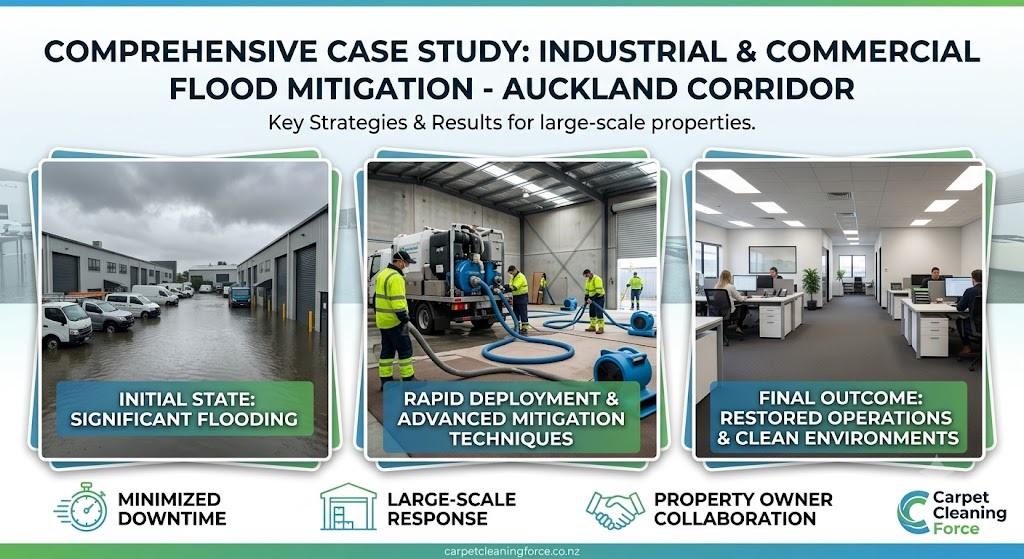
In early 2026, a high-intensity meteorological event delivered localized flash flooding across Auckland’s primary industrial catchments, heavily impacting low-lying commercial zones within Penrose, Ellerslie, East Tamaki, Mt Wellington, and Rosebank Road (Avondale). Over a 6-hour window, stormwater infrastructure exceeded capacity, causing rapid surface water runoff to breach the structural perimeters of multiple commercial facilities.
This case study reviews the structural triage and psychrometric stabilization of a 4,500 m² multi-tenant commercial facility located in the Mt Wellington industrial zone. The facility comprises a ground-floor retail showroom, open-plan corporate offices, and a contiguous inventory warehouse. The inward migration of surface water was classified as Category 2 (Greywater) under IICRC S500 standards, carrying elevated levels of chemical and organic contaminants from surrounding asphalt and industrial yards.
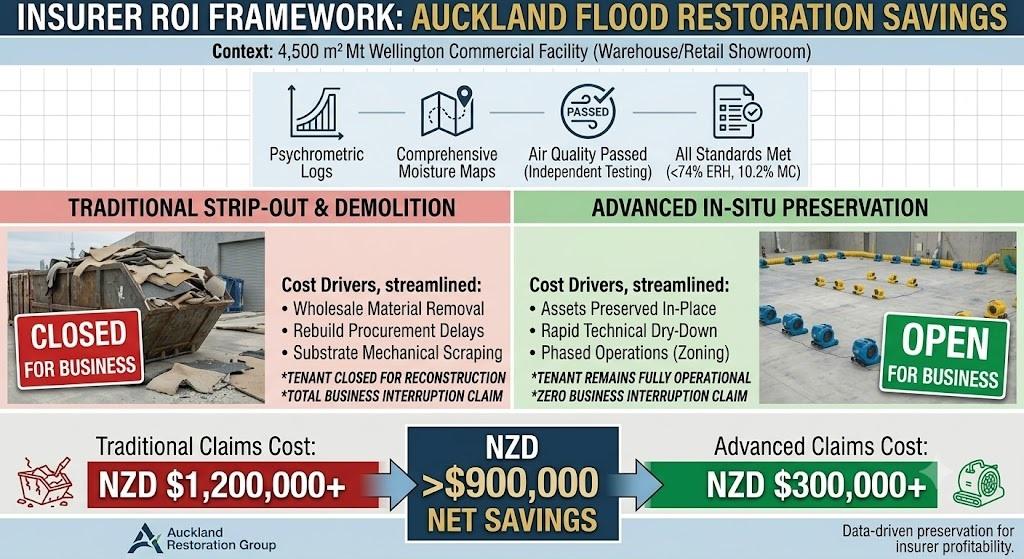
Delayed mitigation threatened to trigger massive Business Interruption (BI) liabilities for the insurer, with projected tenant displacement penalties averaging $25,000 NZD per day. The immediate deployment objective was to stabilize the indoor microclimate, halt capillary action within porous structural elements, and implement an in-situ drying framework to avert wholesale asset demolition.
1.2 Building Profile: Concrete Tilt-Slab Warehouses & Open-Plan Corporate Substrates
The facility’s structural envelope is typical of Auckland commercial architecture, utilizing pre-cast concrete tilt-slab perimeter walls tied to a slab-on-grade concrete foundation. The internal layout consists of galvanized steel and timber-framed partitioning walls sheeted with standard 13mm plasterboard. The flooring substrate across the showroom and corporate offices consists of direct-stick, glued-down commercial carpet tiles bonded directly to the concrete slab via water-based acrylic adhesives.
From a structural perspective, this configuration presents several critical drying challenges:
-
Capillary Suction in Tilt-Slabs: Concrete is highly porous, acting as a capillary network that draws liquid water upward into the core of the tilt-slab panels.
-
Adhesive Hydrolysis: Sustained exposure to liquid water induces hydrolysis in floor adhesives, permanently destroying the polymer bond and generating volatile organic compounds (VOCs).
-
Vapor Barrier Inversion: Glued-down carpet tiles act as a semi-impermeable layer, trapping moisture within the upper zone of the concrete slab and slowing down natural evaporation.
-
Perimeter Drywall Wicking: Plasterboard partitions in contact with the wet concrete slab wick water vertically up to 300mm within hours, compromising structural integrity and providing an ideal environment for mold germination.
📋 Key Insurance Takeaway
Traditional structural restoration advocates for immediate, destructive strip-out of all affected floor coverings and drywall assemblies. In a commercial footprint of this scale, such an approach incurs catastrophic capital expenditure (CapEx) costs and triggers extended business closure. Advanced in-situ psychrometric engineering offers a legally compliant, data-verified alternative that preserves building components and minimizes overall claim indemnity.
2. Initial Assessment, Triage & Multi-Point Moisture Mapping
2.1 Rapid Fleet Mobilization & Immediate Stabilization Protocol
Within two hours of receiving authorization, a specialized commercial restoration fleet mobilized to the Mt Wellington site. The immediate priority was the extraction of standing water to stop further lateral migration. Heavy-duty, truck-mounted extraction units equipped with weighted sub-surface tools were deployed across the 4,500 m² footprint, removing approximately 18,000 liters of liquid water from the carpet tiles and concrete substrate.
Simultaneously, an initial psychrometric profile was established to assess the indoor air mass. Baseline readings showed an ambient temperature of 18°C, an ambient Relative Humidity (RH) of 88%, and a humidity ratio (specific humidity) of 82 Grains Per Pound (GPP). Under these conditions, the indoor air mass was near saturation, completely suppressing the evaporation rate of bound structural moisture.
To prevent immediate secondary damage—such as the warping of architectural joinery and widespread microbial growth—high-capacity air filtration devices (AFDs) fitted with HEPA and activated carbon filters were deployed alongside an initial deployment of desiccant dehumidifiers. This stabilized the environment, dropping the ambient RH to <60% within the first 12 hours and establishing control over the indoor microclimate.
2.2 Advanced Diagnostics & Concrete Substrate Profiling
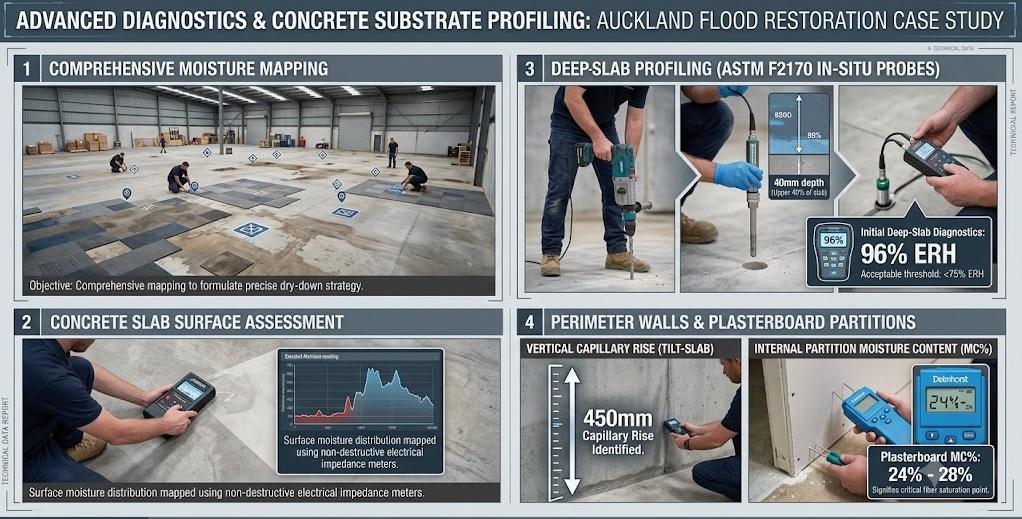
To formulate a precise dry-down strategy, comprehensive moisture mapping was executed across all affected zones. Technicians utilized non-destructive electrical impedance meters to map surface moisture distribution across the concrete slab. This was cross-referenced with invasive diagnostics using in-situ relative humidity probes drilled to a depth of 40mm (representing the upper 40% of the slab thickness) in accordance with ASTM F2170 guidelines.
Initial deep-slab diagnostics revealed an Equilibrium Relative Humidity (ERH) of 96% within the concrete substrate, far exceeding the acceptable dry threshold of <75% ERH. Vertical moisture profiles of the perimeter tilt-slab walls were documented using pinless radio frequency meters, identifying a capillary rise of 450mm above floor level. Plasterboard internal partitions showed direct moisture content (MC%) readings of 24% to 28%, well into the fiber saturation point where structural rot and microbial colonization become inevitable.
🛠️ Technical Compliance Note
In accordance with IICRC S500 Section 12.1.2, all drying goals must be quantified through daily comparative monitoring against unaffected control materials within the same structure. For this project, a dry standard for timber framing elements was established at <12% MC based on BRANZ technical recommendations for New Zealand commercial buildings.
3. Structural Mitigation Strategy: Desiccant Drying vs. Catastrophic Strip-Out
3.1 The Economic Impact of Conventional Strip-and-Rip Demolition
The standard industry response to Category 2 water intrusion under glued-down commercial carpet tiles often involves the wholesale demolition of internal partitions up to 600mm, mechanical scraping of the concrete slab to remove hydrolyzed adhesive, and landfill disposal of thousands of square meters of floor coverings.
For an enterprise located in the Auckland industrial corridor, this approach introduces extensive logistical friction:
-
Landfill Levies & Waste: Disposal of 4,500 m² of contaminated carpet tiles and contaminated plasterboard conflicts with corporate environmental mandates and incurs heavy tipping fees.
-
Supply Chain Delay: Procuring and installing commercial-grade floor coverings and specialized partitioning systems introduces a projected 4-to-6 week procurement lag.
-
Compounded Business Interruption: During this reconstruction window, the tenant cannot trade, forcing the insurer to absorb severe BI losses alongside the direct property damage costs.
3.2 Deploying Heavy-Duty Desiccant Air Dehumidification Packages
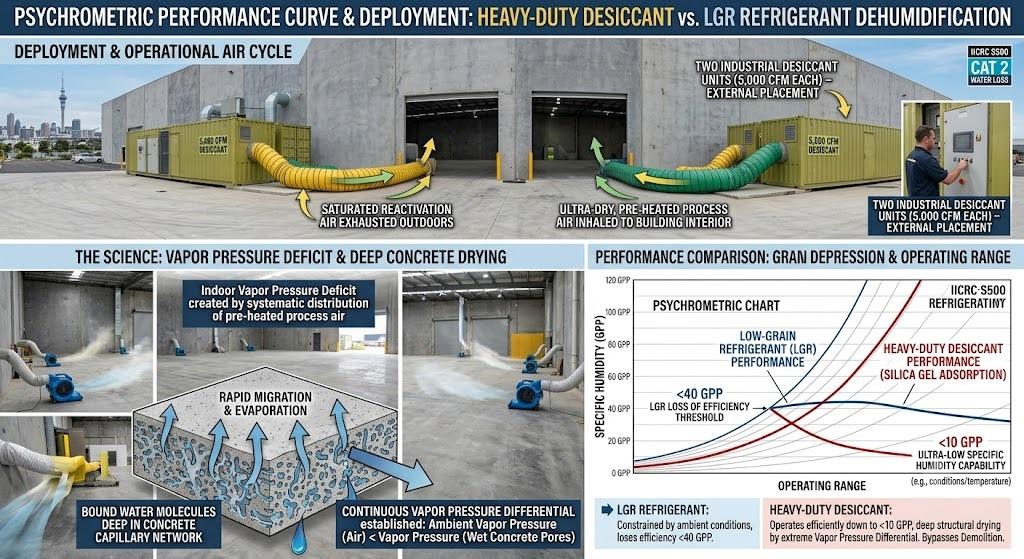
To bypass the demolition cycle, a targeted structural drying methodology was implemented. Standard Low-Grain Refrigerant (LGR) dehumidifiers are constrained by ambient temperatures and lose operational efficiency when the humidity ratio drops below 40 GPP. In contrast, heavy-duty desiccant dehumidifying packages utilize a rotating silica gel wheel to mechanically adsorb moisture from the air, making them capable of producing ultra-low specific humidity down to <10 GPP.
Two industrial-scale desiccant units, each rated at 5,000 CFM (Cubic Feet per Minute), were positioned externally. Saturated air (reactivation air) was continuously drawn out of the building envelope and exhausted outdoors, while ultra-dry, pre-heated process air was ducted into the building interior.
This process air was systematically distributed across the concrete floor plate, maintaining an indoor vapor pressure deficit. By dropping the ambient air’s vapor pressure significantly below the vapor pressure within the wet concrete pores, a continuous vapor pressure differential was established. This physical imbalance forced the bound water molecules deep within the concrete capillary network to migrate rapidly to the surface, where they were evaporated and captured by the desiccant cycle.
| Project Metric | Traditional Strip-and-Rip Demolition | Targeted Advanced Structural Drying |
| Direct Material Replacement Cost | $285,000 NZD (Carpet, Plasterboard, Adhesives) | $12,500 NZD (Targeted consumables/skirting) |
| Landfill Waste Volume | ~42 Tonnes | <1.5 Tonnes |
| Project Duration (On-site) | 32 Days (Demolition, Dry-out, Re-build) | 6 Days (Continuous structural dry-down) |
| Tenant Operational Downtime | 28 Days (Total operational suspension) | 0 Days (Phased, continuous operation) |
| Business Interruption Claim Outlay | $700,000 NZD | $0 NZD |
| Total Estimated Insurer Indemnity | $985,000 NZD | $78,500 NZD |
4. Microclimate Engineering: High-Velocity Laminar Flow & Continuous Commercial Operations
4.1 Establishing the “Cyclone Effect” via Strategic Air Mover Arrays
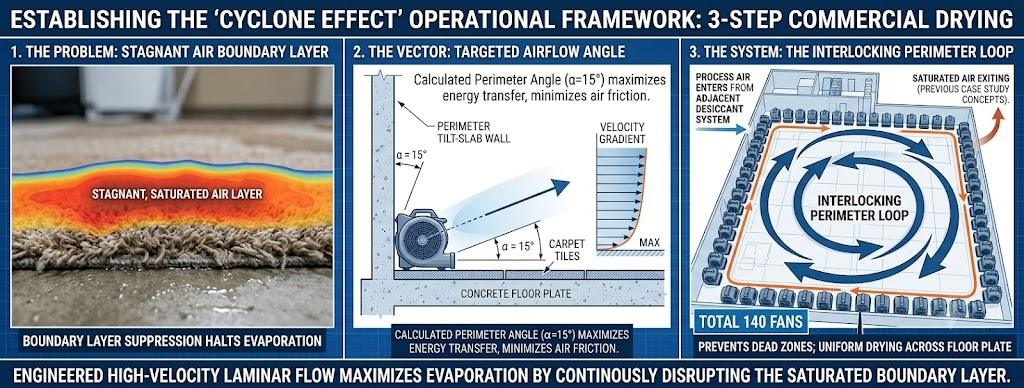
To maximize the evaporation rate at the surface-to-air interface, the boundary layer of stagnant, saturated air residing directly above the carpet tiles had to be continuously disrupted. This was achieved by engineering a high-velocity laminar flow across the entirety of the open floor plates.
Technicians calculated the required air mover density using IICRC S500 Class 2 water loss calculations, factoring in complex internal partitioning. A total of 140 industrial axial air movers and cyclone velocity fans were systematically deployed.
Instead of pointing fans randomly at walls, they were configured in a continuous, interlocking perimeter loop—the “cyclone effect.” The air streams were angled at exactly 15° relative to the floor and perimeter walls, generating a high-velocity vortex that minimized air friction and maximized energy transfer to the wet substrates. This setup kept air moving rapidly across the floor, accelerating the transition of liquid water to water vapor without creating dead zones where humidity could pool.
4.2 Seamless Business Continuity via Low-Decibel Night-Mode Execution
A key hurdle of commercial restoration is maintaining tenant operations during mitigation. To guarantee zero operational downtime for the corporate tenants, a dual-mode operational framework was designed.
During standard business hours (07:00 to 18:00), the drying system transitioned into “Day Operations Mode.” High-velocity axial fans located within active workspace zones were temporarily powered down or relocated to confined containment zones. The desiccant dehumidification packages maintained full-capacity air exchange through overhead containment ducting, operating at low decibel thresholds within occupied office spaces.
To ensure safety and comfort, heavy-duty 150-micron poly-tension containment walls were erected, separating active drying zones from operational staff. These barriers served a dual purpose: they maintained high-temperature, low-humidity microclimates within the target drying zones while preventing dust or noise from disturbing the corporate spaces.
At 18:00, the site switched to “Night-Mode Configuration.” Technicians re-activated the full array of high-velocity air movers to maximize evaporation when the building was vacant. To comply with Auckland Council commercial noise bylaws, desiccant exhaust streams were fitted with acoustic silencers, ensuring noise emissions at the site boundary remained strictly <55 dB(A).
5. Compliance, Quality Assurance, & Insurer Sign-Off Frameworks
5.1 Adherence to Local and Global Structural Standards
All drying processes were bound by rigorous compliance protocols to ensure the building’s long-term structural durability was maintained, in line with Clause B2 of the New Zealand Building Code (NZBC).
Because the structure utilized timber structural components within its interior partitions, specialized oversight by a Licensed Building Practitioner (LBP) was integrated into the monitoring cycle. The target drying goal for these structural timber framing elements was fixed at <12% MC, preventing the development of fungal decay or structural wood-boring organisms common in poorly restored New Zealand properties.
For the concrete tilt-slab panels and foundation base, drying was continued until deep-core ASTM F2170 in-situ probes registered <75% ERH. Reaching this verified threshold ensures that any remaining moisture within the concrete matrix will not cause osmotic blistering or adhesive failure when new finish layers are applied.
📝 Technical Compliance Note
Microbial remediation protocols were executed alongside the drying cycle. Because the inundation involved Category 2 greywater, a broad-spectrum, hospital-grade biocidal sanitizer was pressure-sprayed onto all affected structural surfaces prior to air mover activation. This step eliminated volatile biological pathogens without altering the material equilibrium or leaving behind toxic chemical residues.
5.2 Verification, Drying Documentation, and Final Handover
On day six of continuous operation, psychrometric telemetry confirmed that all affected structural materials had achieved their predetermined drying goals. A final comprehensive inspection was completed to verify the success of the restoration.
Psychrometric Profile at Project Close:
- Ambient Temperature: 22°C
- Ambient Relative Humidity (RH): 34%
- Specific Humidity: 38 GPP
- Concrete Substrate: <74% ERH (Verified via ASTM F2170)
- Internal Timber Wall Framing: 10.2% MC (Verified via pin-meter core penetration)
To finalize the project, a comprehensive technical close-out package was generated for the insurance loss adjuster. This data package contained:
-
Daily Psychrometric Logs: Chronological data sheets tracking temperature, RH, GPP, and vapor pressure differentials, proving a steady, mathematically consistent drying curve.
-
Comprehensive Moisture Maps: A final grid map illustrating that all 4,500 m² of flooring and concrete substrates had reached acceptable dry standards.
-
Post-Mitigation Air Quality Documentation: Results from independent airborne mold sampling and surface ATP swab testing, confirming the complete absence of abnormal Aspergillus/Penicillium concentrations.
By prioritizing advanced structural drying over traditional demolition, this targeted methodology preserved the property’s assets, maintained full tenant operations, and saved the insurer over $900,000 NZD in potential indemnity payouts.