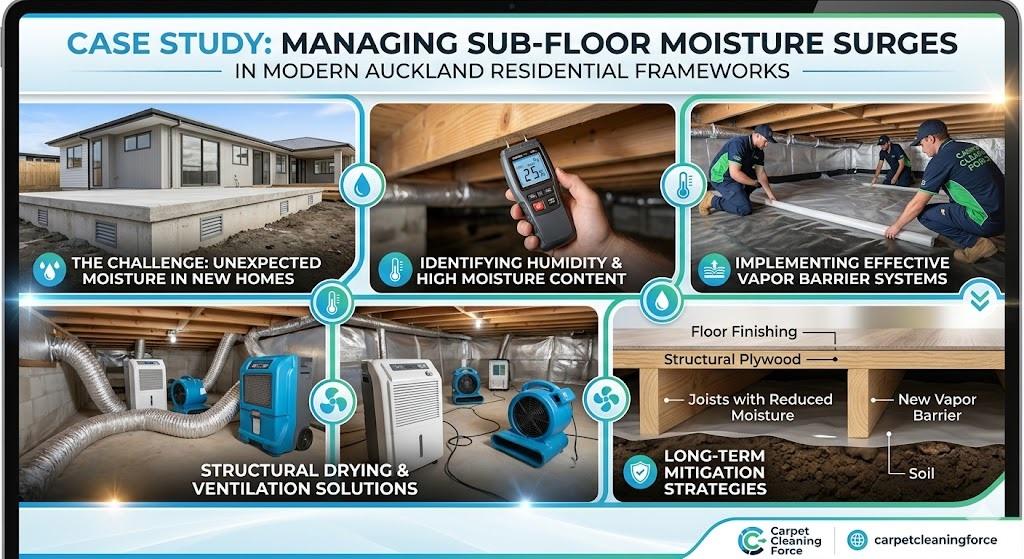
Executive Summary: Managing Sub-Floor Moisture Surges in Modern Auckland Residential Frameworks
Contextualizing Flood Vulnerabilities in Flat Bush, Albany, Westgate, Takanini, and Silverdale
Auckland’s rapid suburban expansion across areas like Flat Bush, Albany, Westgate, Takanini, and Silverdale has yielded thousands of high-density residential assets built over the last two decades. These developments are predominantly defined by slab-on-grade foundations. The architectural envelope typically pairs a poured concrete slab with brick veneer, monolithic plaster cladding, or horizontal weatherboard.
During acute weather events, these low-lying suburban catchments experience rapid overland water flow and localized stormwater pooling. When surface water levels rise, floodwaters breach door sills and the weep holes built into brick veneer cavities. This creates an immediate, severe structural problem: water bypasses the external flashing systems and pools directly against the perimeter edge of the concrete slab foundation.
The Insurance Imperative: Surface-Dry Fallacies vs. Deep-Slab Liability
The primary technical challenge in these modern builds is the deceptive nature of concrete moisture retention. To an untrained inspector or a property owner using basic surface testing equipment, a flooded lounge or hallway may appear completely remediated once carpets are removed and air movers have run for 48 hours. The surface feels dry, and ambient relative humidity might return to normal ranges.
However, this creates a false sense of security. Concrete is a dense, porous material that absorbs water deeply into its core structure. If floor coverings like luxury vinyl tiles (LVT), engineered timber, or carpet are reinstalled over a slab with high internal moisture, a strong vapor drive will occur over the following weeks and months. As this trapped moisture tries to escape upward, it breaks down flooring adhesives, warps expensive timber, and causes widespread mold growth beneath the floor.
For insurance underwriters and loss adjusters, signing off on a claim based only on surface-level dryness leads to a high risk of secondary claims. These subsequent claims for mold remediation and replacing ruined floors often cost significantly more than the initial flood mitigation.
Forensic Inspection Methodology: Advanced Moisture Mapping and Deep-Wall Diagnostics
Beyond Non-Invasive Metrics: Deploying Deep-Wall Resistance Probes
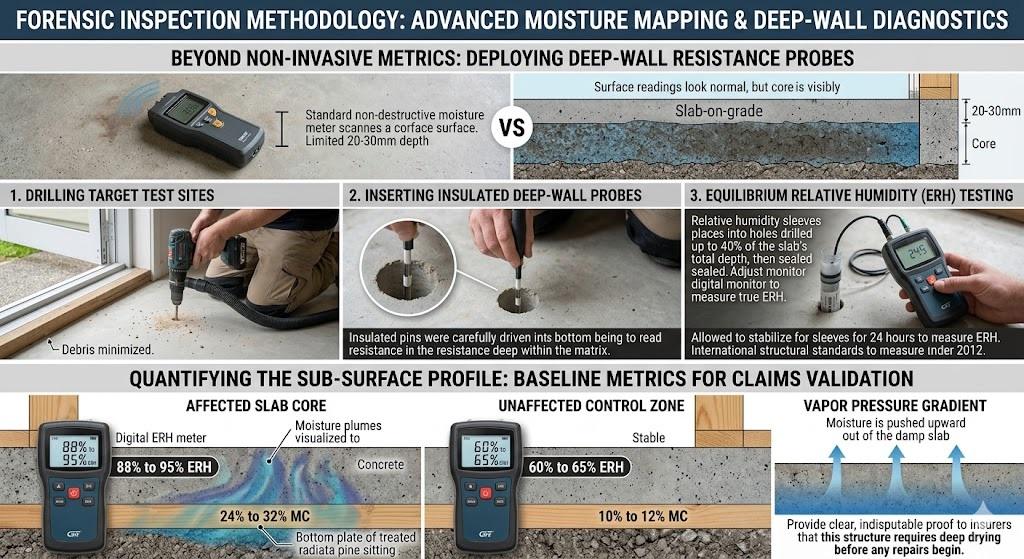
Standard non-destructive moisture meters rely on electrical impedance, which only measures moisture down to a depth of about 20mm to 30mm. In a thick concrete slab-on-grade foundation, these surface readings often look completely normal while the core remains saturated.
To bypass this limitation and get accurate data, technicians must use an advanced forensic protocol:
-
Drilling Target Test Sites: Technicians drill small, precise holes into the concrete slab at the areas of highest water exposure, such as near external door sills and corners.
-
Inserting Insulated Deep-Wall Probes: Insulated pins are driven into the bottom of these holes to read electrical resistance deep within the concrete matrix.
-
Equilibrium Relative Humidity (ERH) Testing: In line with international structural standards, relative humidity sleeves are placed inside holes drilled to 40% of the slab’s total depth. These sleeves are sealed and allowed to stabilize for 24 hours. This measures the true Equilibrium Relative Humidity (ERH) deep within the concrete core, which is the most reliable metric for predicting long-term vapor movement.
Quantifying the Sub-Surface Profile: Baseline Metrics for Claims Validation
During the initial inspection, technicians gather precise readings from both affected zones and unaffected control areas to clearly map the extent of the water damage:
-
Affected Slab Core: ERH levels regularly exceed 88% to 95% ERH, even when surface moisture readings appear acceptable.
-
Structural Timber Framing: Bottom plates made of treated radiata pine, which sit directly on the damp concrete, frequently register moisture content (MC%) levels between 24% and 32% MC.
-
Unaffected Control Zones: Dry baseline areas in the same property typically register a stable 60% to 65% ERH in the concrete and 10% to 12% MC in the timber framing.
Using these concrete data points, the restoration team can chart the vapor pressure gradient. This shows exactly how much moisture will push upward out of the slab, providing the insurer with clear, indisputable proof that the structure requires deep drying before any repairs begin.
The Fluid Dynamics of Concrete Capillary Wicking in Slab-on-Grade Construction
Mechanisms of Sub-Surface Ingress via Weep Holes and Porous Substrates
Concrete functions like a dense, microscopic sponge. When water pools against a slab, capillary action pulls moisture deep into the material’s pore network. This upward and inward pull of water is driven by surface tension and adhesive forces within the tiny pores of the concrete, allowing water to travel surprisingly far from the initial point of entry.
       [ External Surface ]                 [ Timber Wall Cavity ]

    Puddled Stormwater Flowing               Bottom Plate Saturated
     Above Slab Foundation Edge               Via Direct Contact
               │                                      ▲
               ▼                                      │
    Brick Veneer Weep Holes ──┐                       │
                              │                       │
                              ▼                       │
                     ┌────────────────┐       ┌───────┴────────┐
                     │ Concrete Edge  │──────►│ Concrete Core  │
                     │  Absorption    │       │ Saturated Core │
                     └────────────────┘       └────────────────┘
                              │                       ▲
                              └───────────────────────┘
                                Capillary Wicking Deep
                                 Into Concrete Matrix
In modern Auckland brick veneer homes, this problem is made worse by the design of the wall cavities. The weep holes at the base of the brick walls are essential for letting the wall cavity breathe and drain under normal conditions. However, when floodwaters rise above the slab edge, these weep holes act like open drains, allowing water to rush directly into the internal cavity. Once inside, the water pools on top of the concrete slab, soaking straight into the concrete edge and the timber framing.
The Secondary Damage Vector: Floor Covering Delamination and Microbial Proliferation
Once water is trapped inside a slab, it naturally tries to move from areas of high vapor pressure to areas of lower vapor pressure—which means it travels upward toward the home’s interior.
If flooring is installed prematurely over a wet slab, this upward moisture movement builds hydrostatic pressure beneath the floor covering. The consequences are predictable and expensive:
-
Adhesive Failure: The moisture breaks down the glues used for vinyl tiles and engineered planks, causing them to lift and bubble.
-
Timber Distortion: Engineered wood and timber overlays absorb this moisture, leading to cupping, crowning, and splitting.
-
Microbial Growth: The combination of trapped moisture, warmth, and organic flooring glues creates a perfect environment for mold. Within 48 to 72 hours, mold species like Aspergillus and Stachybotrys chartarum can begin growing beneath the flooring and inside wall cavities, creating serious indoor air quality issues and health risks for tenants.
Targeted Mitigation Strategy: Precision Containment Chambers and Dehumidification
Engineering Micro-Climates: Structural Containment Drying Chambers
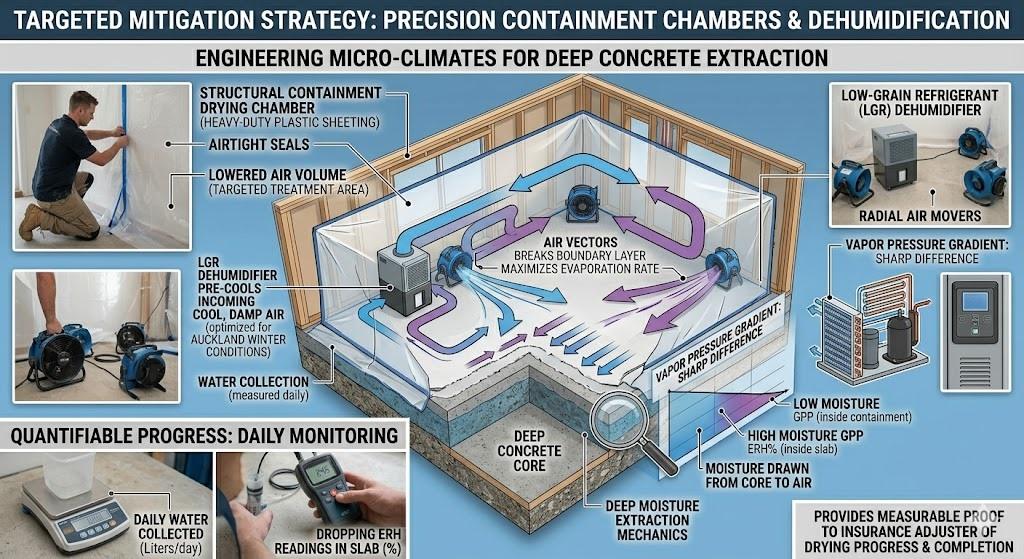
To dry a deep concrete slab efficiently without tearing down the surrounding walls, technicians must control the environment directly above the wet concrete. This is done by building targeted containment drying chambers.
Using heavy-duty plastic sheeting, technicians isolate the affected floor perimeters and lower walls. This drops the volume of air that needs to be treated from the entire volume of the house down to just the air immediately surrounding the wet structure. By heating and drying the air inside this small containment tent, technicians drastically lower its vapor pressure. This sharp difference in vapor pressure draws the deep moisture out of the concrete core and into the air much faster than open-air drying.
Deploying High-Capacity LGR Dehumidification and Radial Air Movers
Standard household or basic commercial dehumidifiers cannot pull moisture out of dense concrete effectively. This specialized job requires Low-Grain Refrigerant (LGR) dehumidifiers or desiccant systems.
-
LGR Dehumidifiers: These units pre-cool the incoming air, allowing them to remove water vapor effectively even when the air is already quite dry (low grains per pound). This is particularly useful in cooler, damp Auckland winter conditions.
-
Radial Air Movers: These specialized fans are placed inside the containment chamber to blow high-velocity air directly across the floor. This breaks the boundary layer of stagnant, humid air right above the slab, maximizing the rate of evaporation.
-
Daily Monitoring: Technicians track the volume of water collected daily and compare it against dropping ERH readings in the slab. This gives the insurance adjuster clear, measurable proof of the drying progress.
Compliance Frameworks and Building Standards: Navigating NZ and Global Standards
Aligning Mitigation Protocols with the IICRC S500 Standard
All professional restoration work must comply with the global IICRC S500 Standard for Professional Water Damage Restoration. Under these guidelines, concrete slab saturation caused by overland flooding is classified as a Class 4 water intrusion. Class 4 jobs involve deeply bound moisture within porous materials that requires specialized low-vapor-pressure drying setups.
The team must also assess the water category. Floodwater entering through brick weep holes is classified as Category 2 (Grey Water) or Category 3 (Black Water) due to potential contact with soil, fertilizers, and outdoor contaminants. This classification requires thorough biocide treatment and sanitization of the slab and timber frame before the drying process begins, ensuring the home is safe for long-term occupancy.
BRANZ Durability Directives and Licensed Building Practitioner (LBP) Safeguards
Under the New Zealand Building Code (NZBC Clause B2 Durability), structural elements must maintain their integrity for their specified lifespans. The Building Research Association New Zealand (BRANZ) sets clear rules for restoring water-damaged homes:
📜 Technical Compliance Note: Structural Timber Framing Standards
According to BRANZ and New Zealand building standards, structural timber framing must be dried down to less than 12% Moisture Content (MC%) before any wall linings or insulation can be reinstalled. Reclosing a wall cavity with framing timber above 12% MC violates building compliance and puts the property at risk of structural rot.
By keeping structural timber drying closely aligned with these BRANZ guidelines, the property retains its official compliance, protecting its long-term market value and ensuring all warranties remain valid.
Actuarial Advantage: Cost Optimization and Insurance ROI Analysis
Comparative Financial Modeling: Controlled Drying vs. Invasive Strip-Outs
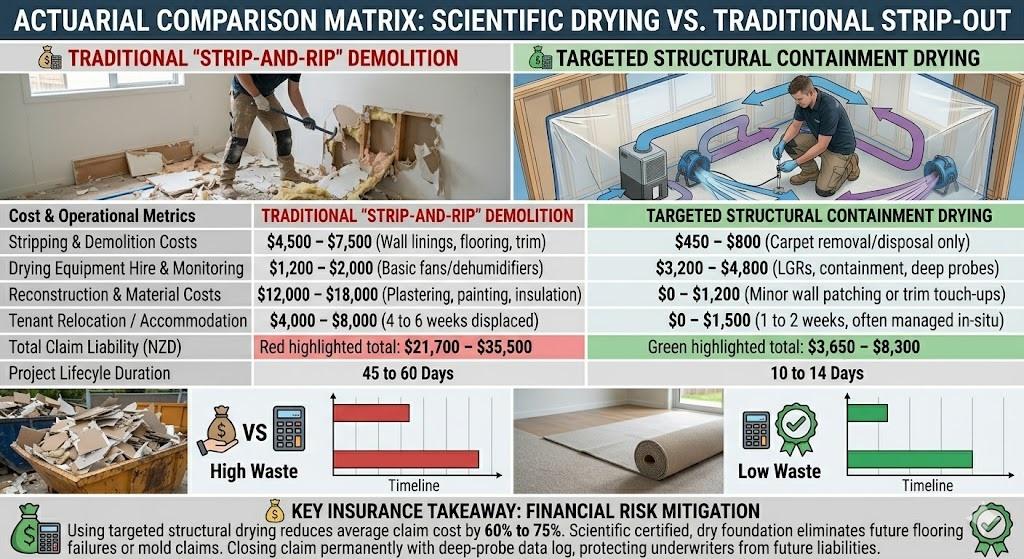
The traditional approach to this type of water damage is a disruptive “strip-and-rip” demolition. This involves cutting away the bottom 300mm of internal plasterboard, discarding insulation, removing all skirting boards, and tearing up the entire floor covering just to let the slab air out. This approach results in high material waste, massive reconstruction bills, and weeks of alternative accommodation costs for displaced residents.
In contrast, targeted structural drying focuses on extracting moisture through the slab surface using specialized equipment, leaving the surrounding walls and structures intact.
Risk Mitigation: Eliminating Secondary Mold Claims and Flooring Failures
By spending a modest amount upfront on specialized structural drying, the insurer avoids much larger expenses later. The core financial benefit of this approach is the complete elimination of secondary damage risks.
💰 Key Insurance Takeaway: Financial Risk Mitigation
Using targeted structural drying instead of widespread demolition reduces the average claim cost by 60% to 75%. More importantly, it delivers a scientifically certified, dry foundation that completely eliminates the risk of future flooring failures or secondary mold claims.
Providing the insurer with an official sign-off log based on deep-probe ERH data ensures the claim can be closed permanently, protecting the underwriter from unexpected future liabilities.