Loss Type: Washing machine leak
Affected Areas: Garage, hallway, bedroom & wardrobe
Flooring: Carpet + underlay / direct-stick carpet
Drying Duration: 17 days
Initial Equipment: 1 dehumidifier + 7 air movers
Water Extraction: Water Claw + professional extraction wand
Total Equipment Energy: 354 kWh
Final Outcome: Wall dried, carpet and underlay reinstated
Case summary
What this documented restoration shows: a washing-machine leak can travel beyond the visible wet area. In this case, moisture mapping found impact in the garage, hallway, bedroom and wardrobe; the drying plan was adjusted as readings changed.
Quick answer: This Auckland washing-machine leak affected the garage, hallway, bedroom and wardrobe. After extraction and moisture mapping, controlled drying ran for 17 days; the carpet and underlay were relaid after dry-condition checks.
Documented job photographs. Equipment, drying duration and final clearance depend on the water source, materials and measured site conditions.
At-a-glance documented case facts
| Water source | Washing-machine leak |
|---|---|
| Affected spaces | Garage, hallway, bedroom and wardrobe |
| Flooring assessed | Direct-stick carpet in the garage; carpet and underlay in adjoining rooms |
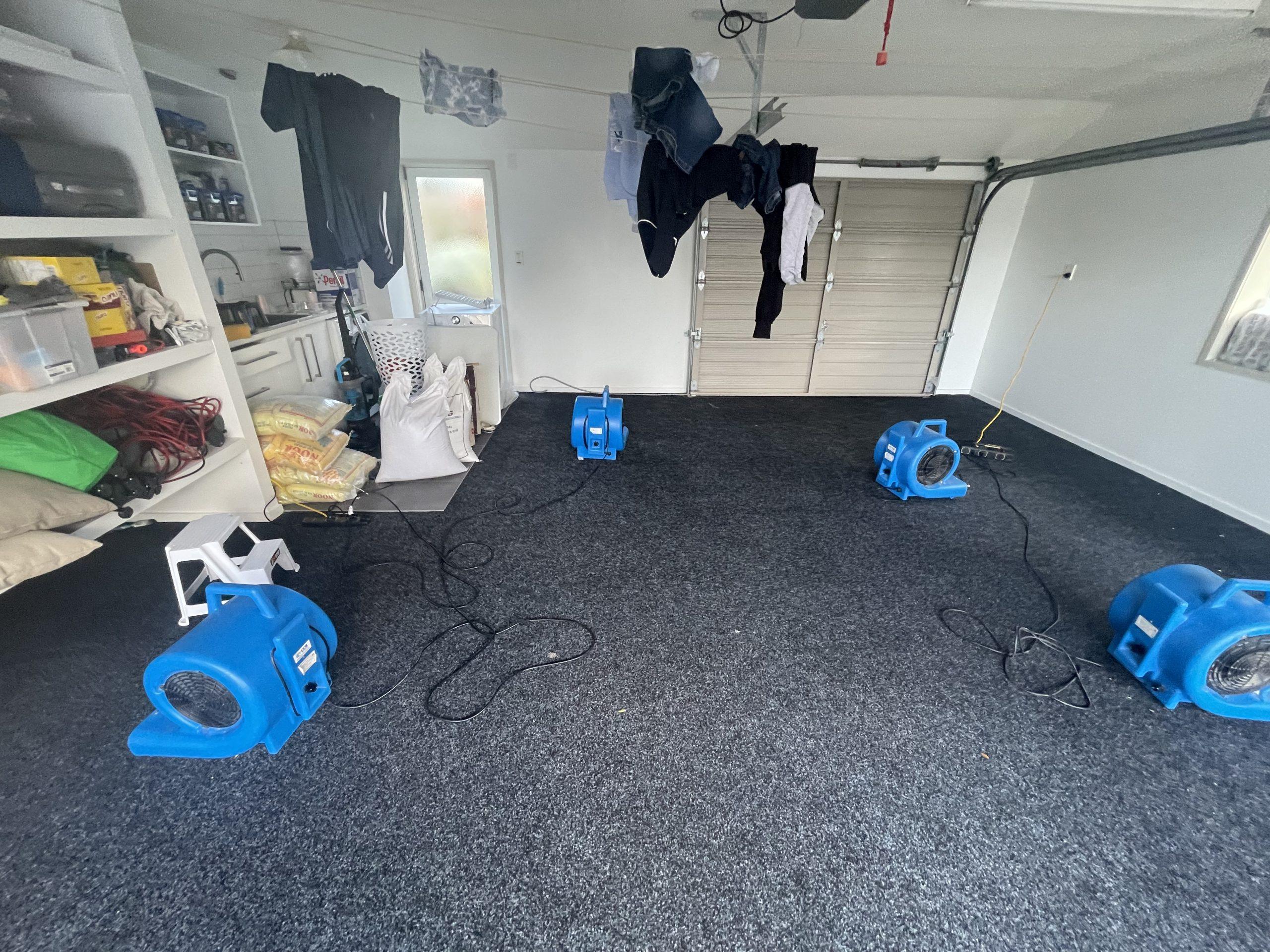
| Initial drying setup | One commercial dehumidifier and seven air movers |
| Extraction method | Water Claw sub-surface extraction and an industrial extraction wand |
| Documented drying period | 17 days, with the equipment plan adjusted after monitoring |
| Outcome | Carpet and underlay dried, relaid and reinstated after acceptable dry-condition checks |
Can water from a washing machine leak spread to other rooms?
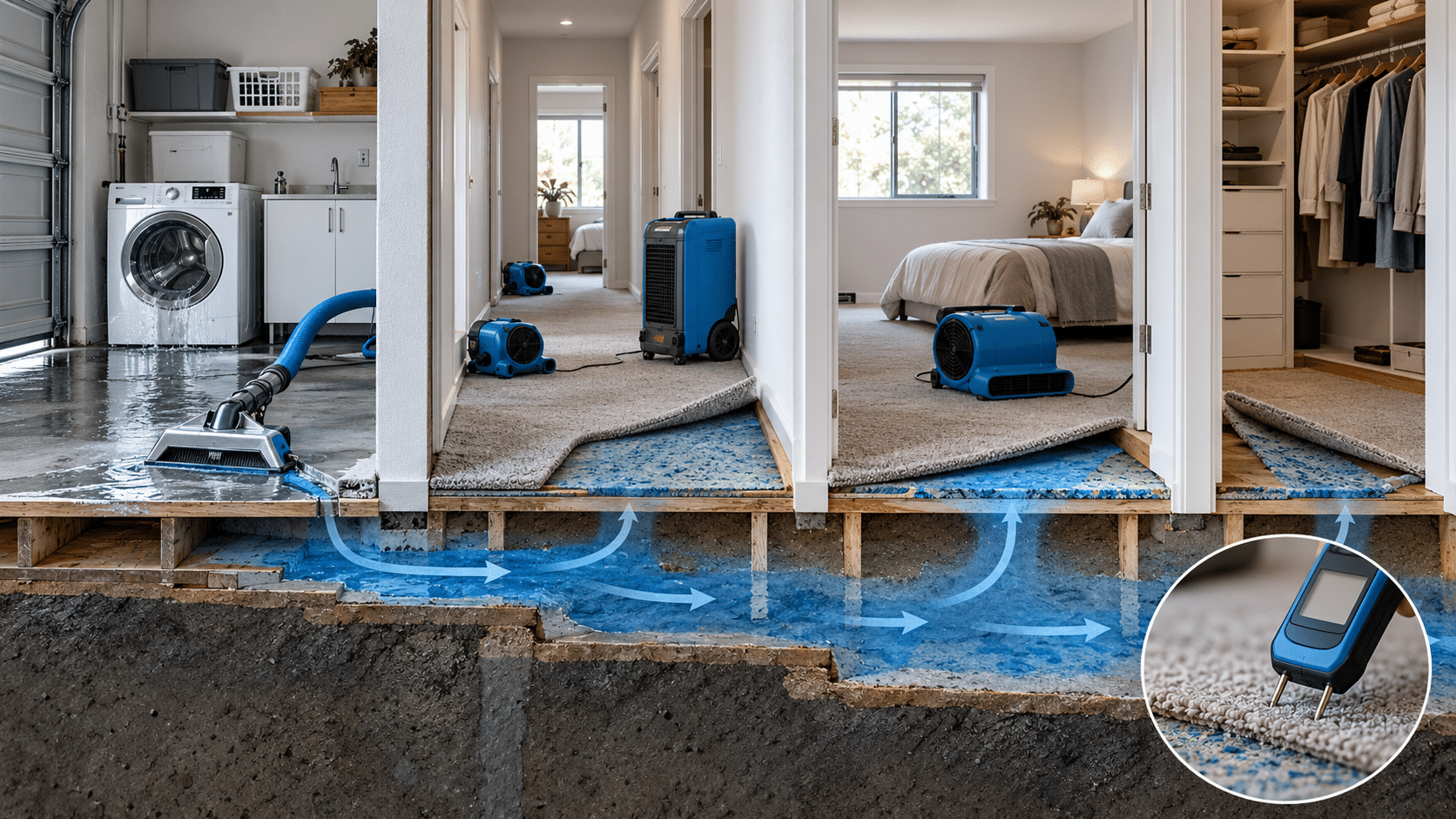
Yes. In this documented job, water travelled from the garage through wall framing into the hallway, bedroom and wardrobe. Moisture testing identified the full affected area beyond the original visible wet patch.
How long did this washing-machine leak take to dry?
This job took 17 days because moisture remained in different materials and hidden areas. It is a documented example, not a promised drying time for every leak.
What does a Water Claw do?
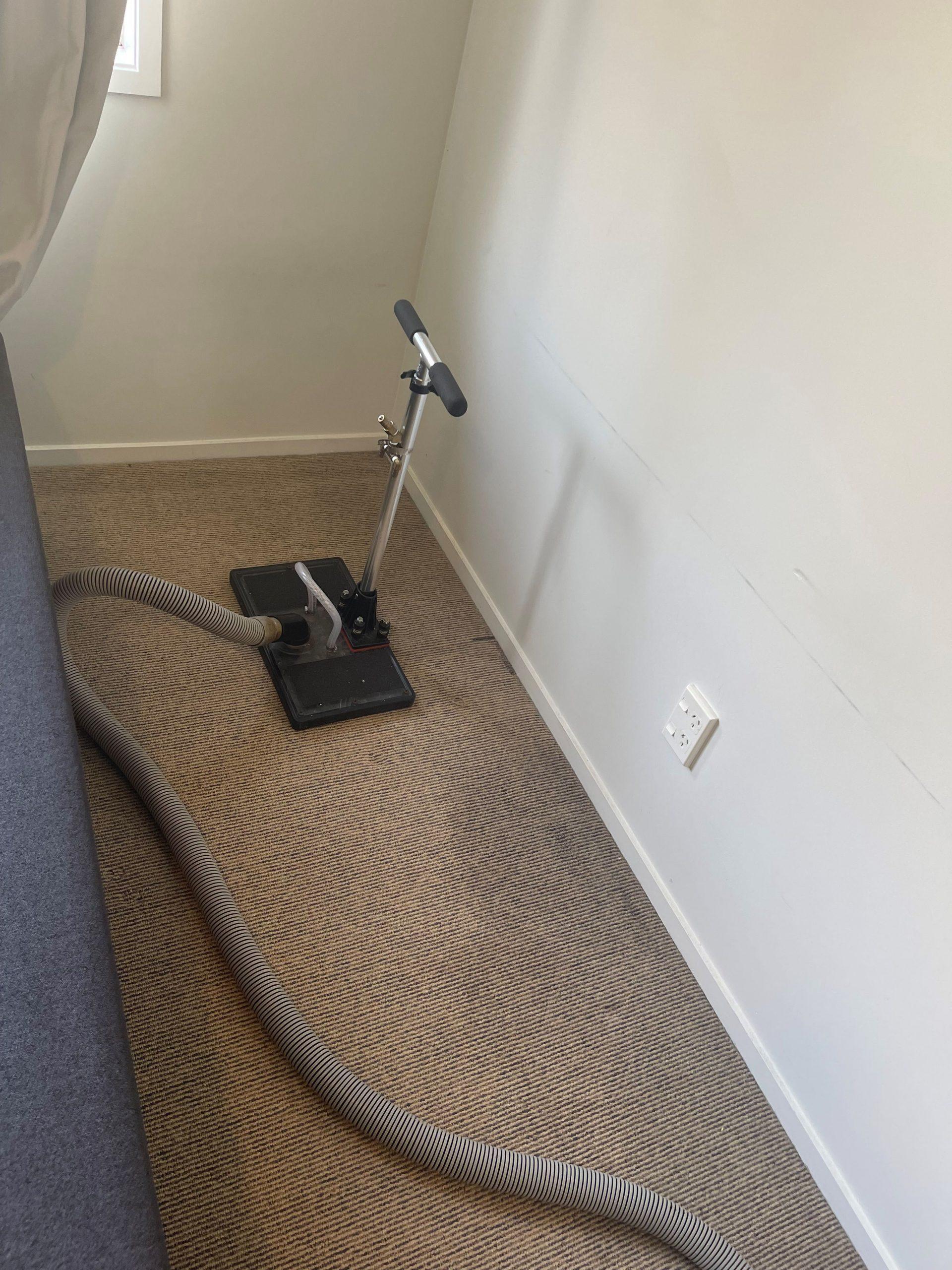
A Water Claw is a sub-surface extraction tool. It uses suction while pressed onto carpet to remove water from the carpet pile and underlying underlay, helping reduce the moisture left after a leak before controlled drying begins.
Can wet carpet from a washing-machine leak be saved?
Often, yes, when the water source is stopped quickly and the carpet, underlay and nearby materials can be extracted and dried to an acceptable condition. The decision depends on the water category, the time materials remained wet, the amount of contamination and moisture readings from the carpet, underlay and surrounding building materials. In this case, the carpet and underlay were dried, relaid and reinstated after monitoring.
Can a washing-machine leak damage walls behind the laundry?
Yes. Water can travel through wall openings, framing and under floor areas, so the visible wet patch may not show the full extent of the loss. Moisture assessment is used to check adjacent walls and rooms before deciding where extraction and drying equipment are needed.
How do professionals confirm a wall or carpet is dry after a washing-machine leak?
Professionals use moisture readings across affected and unaffected comparison areas, then reassess after drying equipment has run. Equipment is reduced or removed only when materials have returned to an acceptable dry condition for that building and the readings are stable. In this case, monitoring identified slower-drying areas and the equipment plan was adjusted before final collection.
What this restoration video documents
This case-study video accompanies the job record and shows the restoration context behind the assessment, extraction, controlled drying and final verification described on this page. The documented result was a 17-day drying programme that was adjusted as moisture conditions changed across the garage, hallway, bedroom and wardrobe.
Scope of Damage & Initial Assessment
Upon arrival, a comprehensive thermal and moisture inspection was conducted to
establish the full migration path of the water:
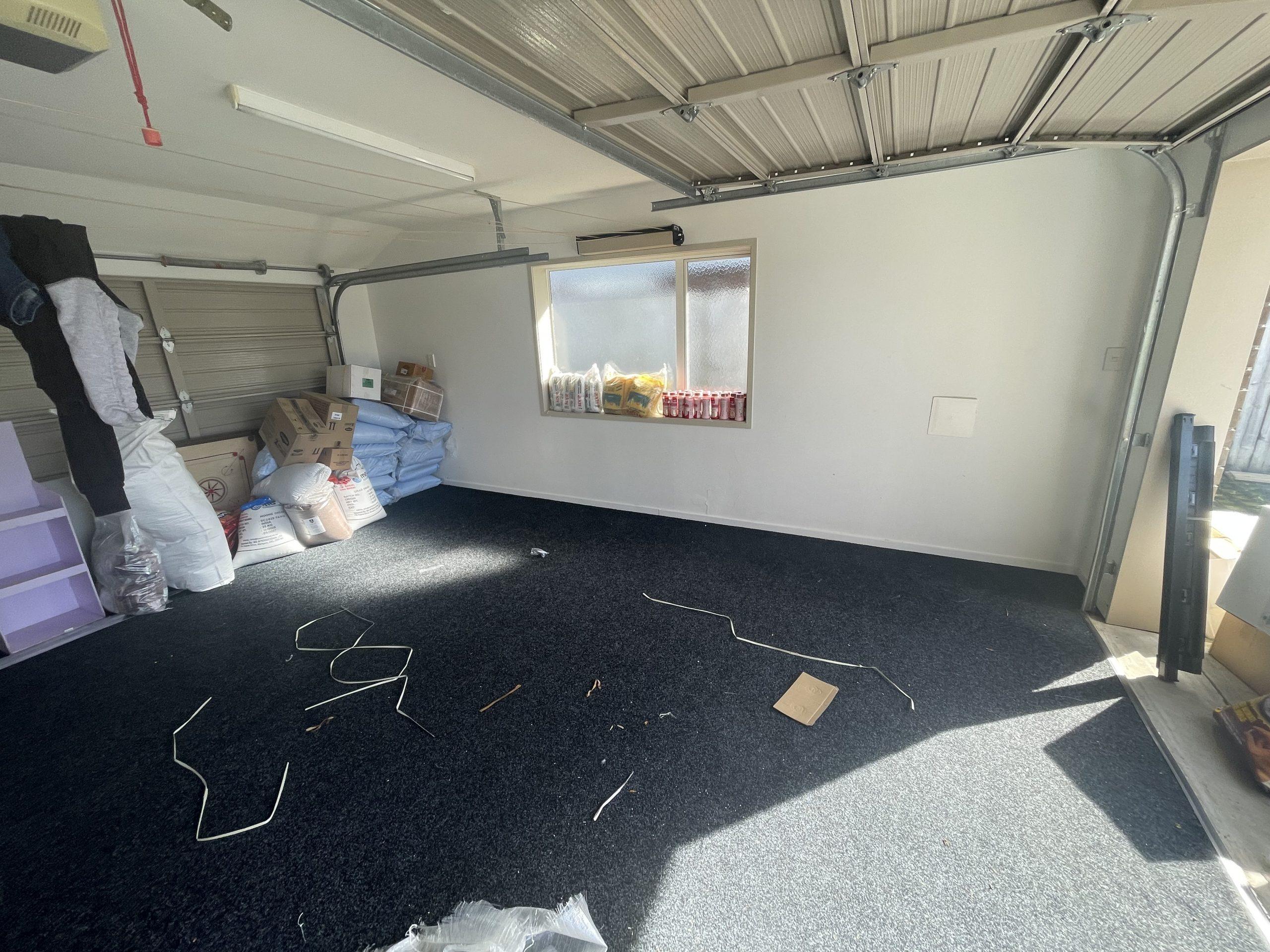
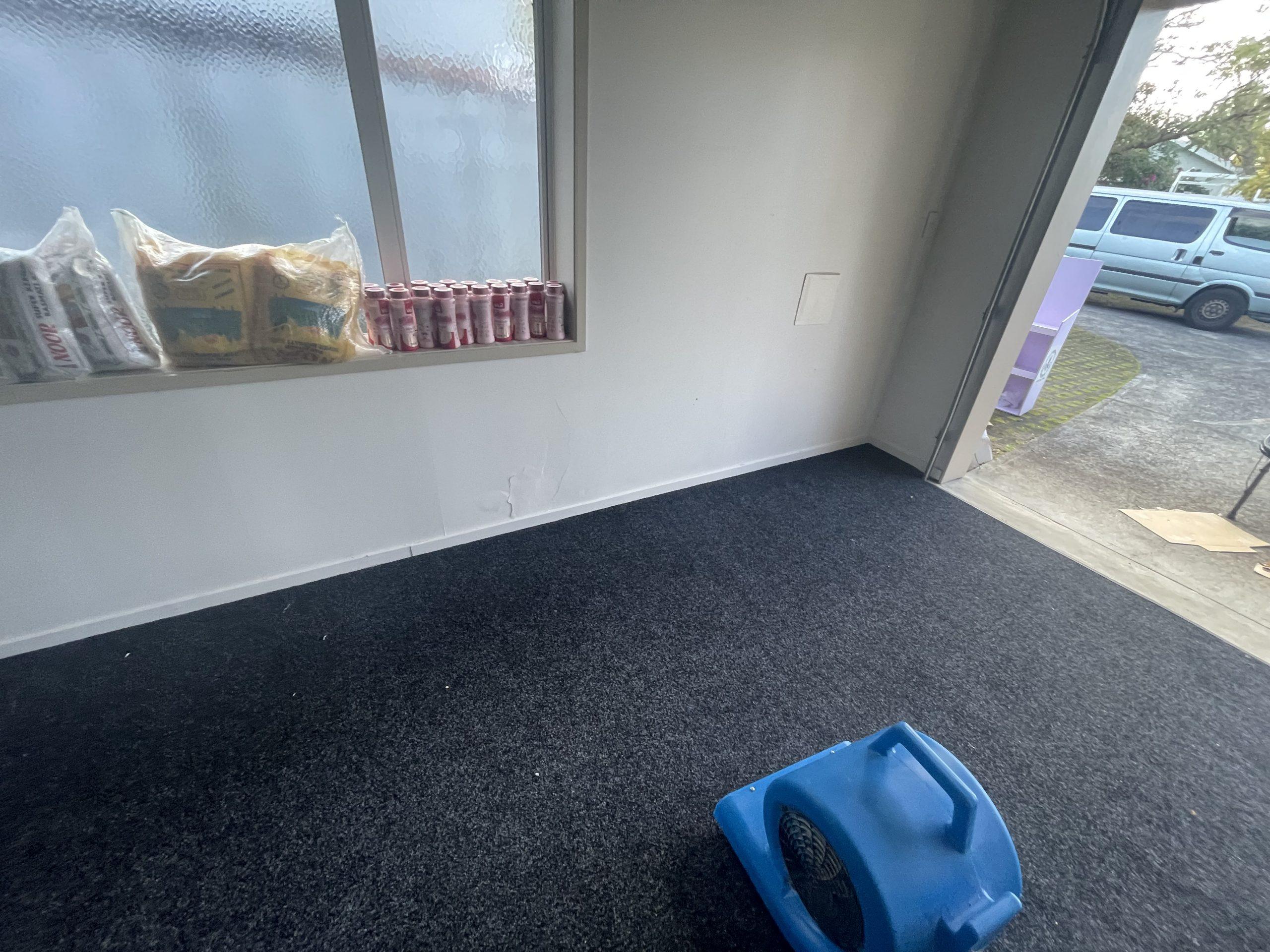
Garage: Entire floor area affected (carpet without underlay).
Hallway: Carpeted floor area wet, water migrated through the wall framework.
Adjoining Bedroom & Wardrobe: Initial inspection revealed water had migrated
through the shared wall into the bedroom carpet and wardrobe space (carpet with
underlay). The homeowner was unaware of this migration until structural moisture
testing was completed.
Documented restoration photos
These job photographs record the extraction, monitoring and controlled-drying stages described below.
Additional documented restoration photos
These non-identifying job photographs show the affected spaces and the staged drying work recorded during this restoration.
Remediation & Action Taken
Water Extraction
Bedroom & Hallway: Performed sub-surface water extraction using a specialized
Water Claw to pull trapped moisture directly out of the carpet pile and the underlying
underlay.
Garage: Extracted standing water using a standard industrial carpet cleaning wand,
which provided maximum extraction efficiency due to the absence of underlay in this
zone.
Sanitisation & Antimicrobial Treatment
Applied a professional-grade antimicrobial treatment as part of the remediation plan for affected carpeted areas and exposed sub-floors. Cleaning and drying requirements depend on the water source, the materials affected and the assessment findings.
Optimizing Airflow and Dehumidification for Complex Water Migration
The Structural Challenge
-
A washing machine leak originating in a garage resulted in hidden structural water migration.
-
While the initial source was contained to the garage, water traveled through the wall framework to saturate a hallway, an adjoining bedroom, and a wardrobe space.
-
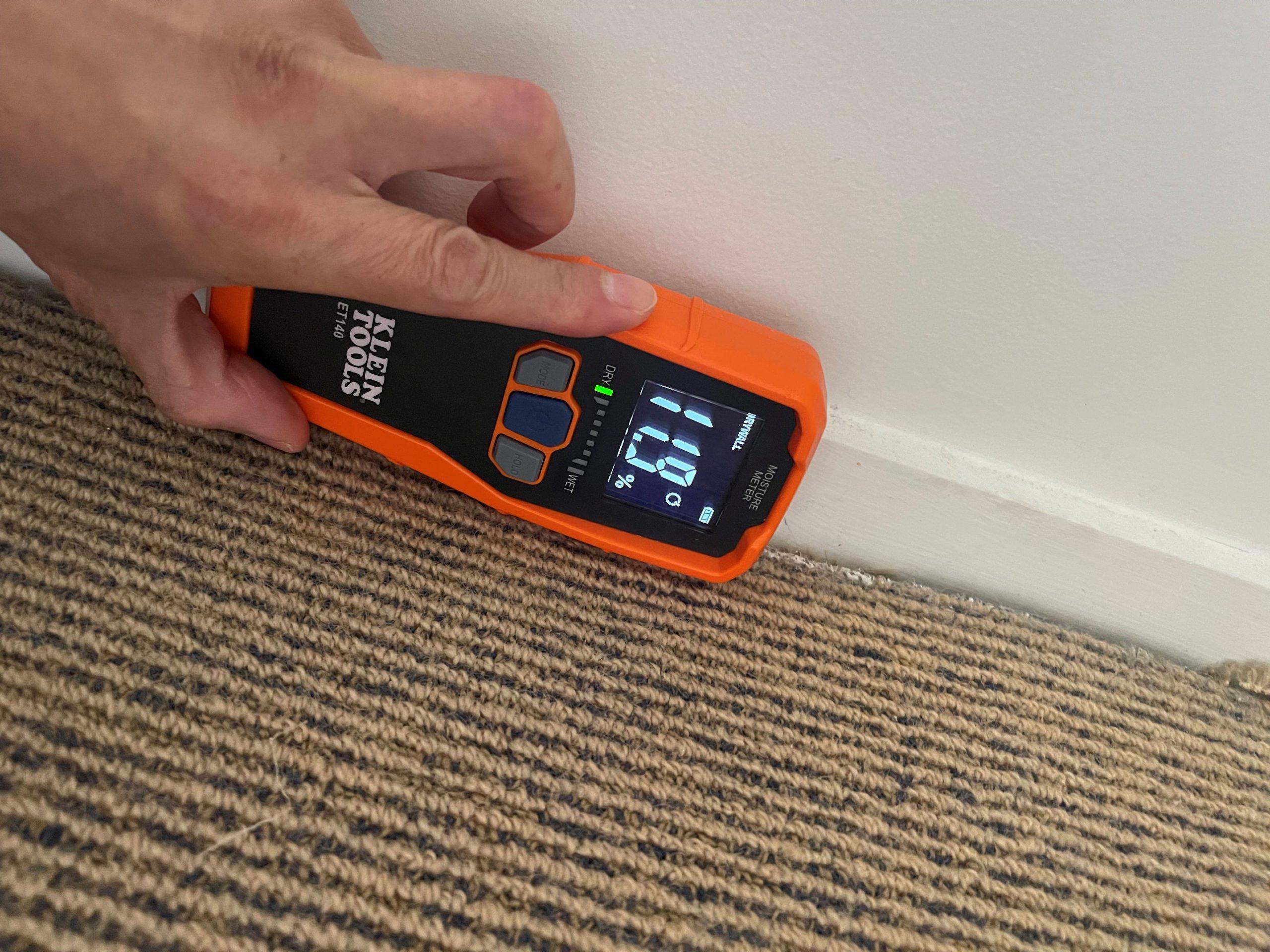
Structural moisture testing revealed two different flooring environments: the garage featured direct-stick carpet without underlay, while the bedroom and wardrobe contained carpets with saturated underlay.
Phase 1: Establishing the Continuous Evaporation Cycle (Day 1 – Day 6)
-
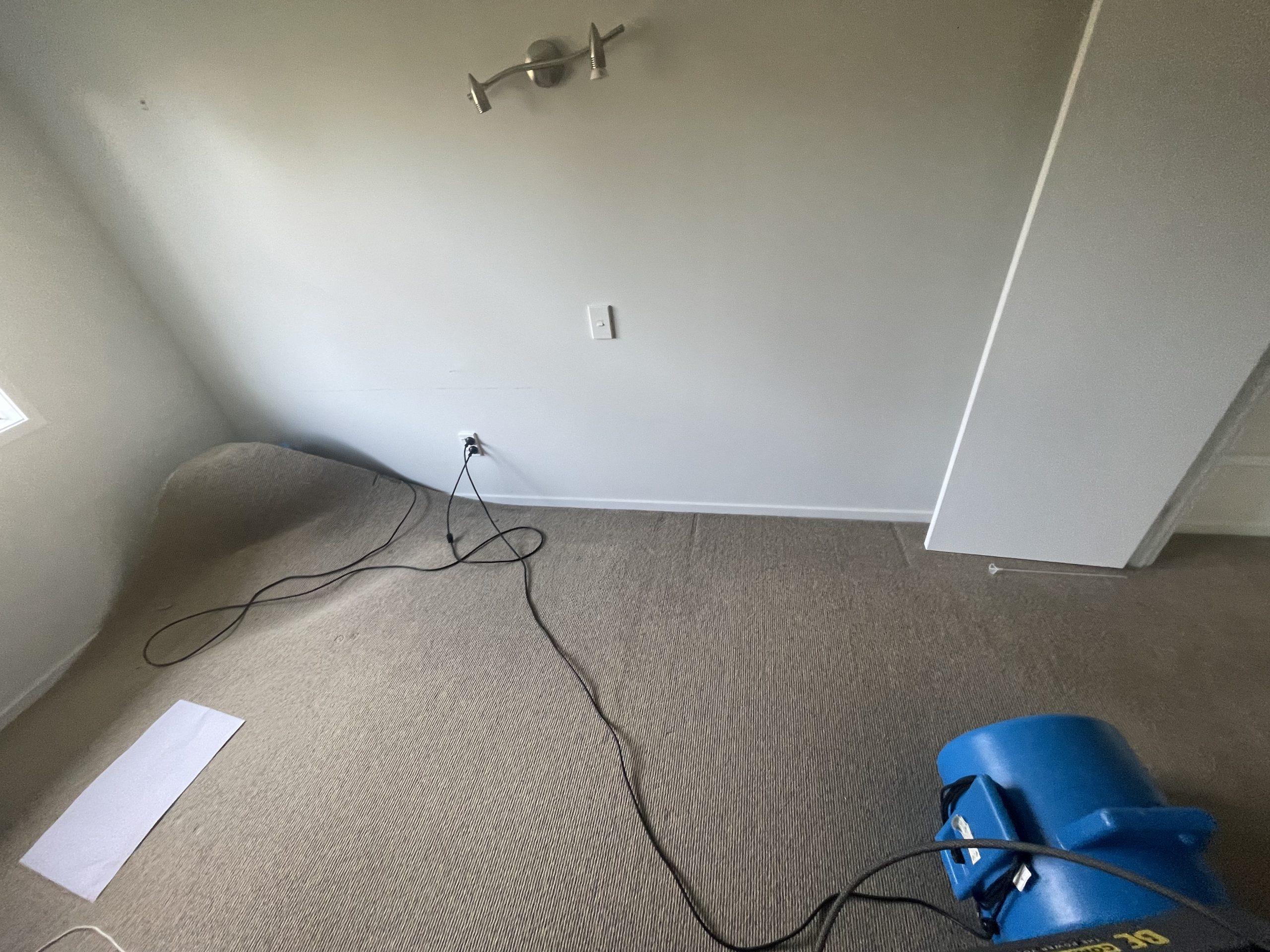
On Day 1, following sub-surface water extraction, the initial drying envelope was established.
-
The primary setup utilized one commercial dehumidifier operating in tandem with seven strategically configured structural air movers to create a continuous evaporation cycle.
-
To achieve targeted sub-floor drying in the bedroom, one air mover was specifically floated directly under the carpet underlay in the corner of the room.
Phase 2 & 3: Targeting Micro-Climates (Day 6 – Day 17)
-
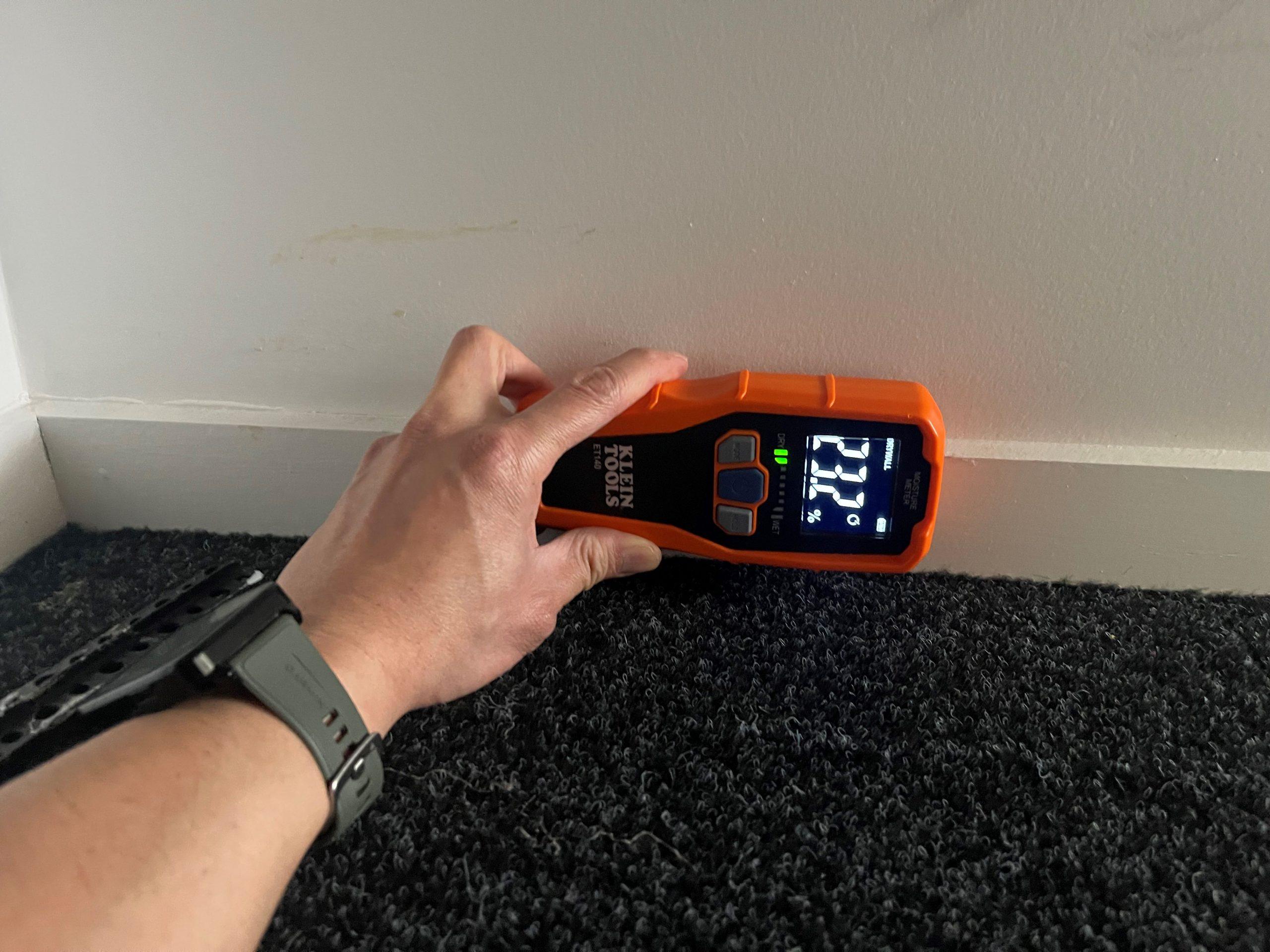
By Day 6, after 5 full days of continuous operation, open areas returned to an acceptable dry standard baseline, allowing for the initial equipment breakdown.
-
Moisture monitoring identified a trapped micro-climate beneath a garage shelving unit that retained elevated moisture. The drying strategy was adjusted to concentrate three air movers exclusively on this specific micro-climate for an additional 2 days (until Day 8).
-
A final, tertiary setup required one air mover to be deployed on Day 14 specifically for targeted hallway drying until all remaining structural framing and flooring materials reached dry standard equilibrium on Day 17.
Equipment Drying & Monitoring Log
| Timeline | Zone / Area | Equipment Deployed | Moisture Status / Actions |
| Day 1 | Bedroom, Hallway, Garage | 1x Dehumidifier, 7x Air Movers | Initial: Heavy saturation. Extracted water, applied antimicrobial, floated bedroom carpet, set drying loop. |
| Day 6 | Bedroom & Hallway | Equipment Removed | Normal: Moisture levels returned to acceptable dry standard baseline. |
| Day 6 | Garage (General) | 4x Air Movers Removed | Normal: Open areas dry. |
| Day 6 | Garage (Under Shelf) | 3x Air Movers Remaining | Elevated: Retained and concentrated 3 fans on the trapped area under the shelving unit. |
| Day 8 | Garage (Under Shelf) | 3x Air Movers Removed | Normal: Retested. Area successfully met dry standard baseline. |
| Day 14 | Hallway | 1x Air Mover | Elevated: Deployed 1 additional fan for targeted hallway drying. |
| Day 17 | Hallway | All Equipment Removed | Normal: Moisture tested and confirmed to be properly dried. Equipment picked up. |
Reinstatement
What affects washing-machine leak restoration cost?
Indicative guidance only: restoration costs vary substantially between properties. The main cost drivers are the affected area, how far water has travelled, the materials involved, the extraction and cleaning needed, the number of drying days, equipment required, access, monitoring visits and any carpet or building reinstatement.
For this documented case, the 17-day programme required extraction, targeted structural drying, moisture monitoring and carpet reinstatement. A professional assessment is required before a reliable price can be provided for another property.
Invoice scope note: this job recorded initial extraction, seven air movers for the first drying stage, three air movers for an additional two days beneath garage shelving, one air mover for a final three-day hallway stage, and carpet relay. The commercial dehumidifier was supplied without a separate hire charge. Client invoice totals are not published because scope and pricing vary by property.
For equipment-only options, see dehumidifier hire in Auckland. Equipment hire does not replace assessment, extraction or restoration where water has migrated into carpet, underlay or building materials.
All structural framing and flooring materials successfully
reached dry standard equilibrium. The carpet and underlay were professionally
stretched, relayed, and reinstated.
Equipment Capacity and Energy Analytics
-
To calculate the total operational load and facilitate an insurance reimbursement, the power draw of the equipment was precisely logged.
-
The commercial dehumidifier consumed approximately 0.75 kW/hr, while each structural air mover consumed approximately 0.25 kW/hr.
-
Phase 1 (120 Hours): The dehumidifier required 0.75 kW × 120 hrs = 90 kWh, and the seven fans required 7 × 0.25 kW × 120 hrs = 210 kWh.
-
Phase 2 (48 Hours): The three focused fans required 3 × 0.25 kW × 48 hrs = 36 kWh.
-
Phase 3 (72 Hours): The single hallway fan required 1 × 0.25 kW × 72 hrs = 18 kWh.
-
The total power consumed by the equipment during the 17-day restoration timeline was 354 kWh, generating clear analytical data for the homeowner’s claim.
Insurance documentation for this washing-machine leak
This documented restoration included job photographs, moisture-assessment notes, comparison readings, extraction records, drying-equipment and monitoring logs, final dry-condition checks, and invoice-scope information. These records help explain the affected areas, the work completed and why the drying plan changed as conditions were reassessed.
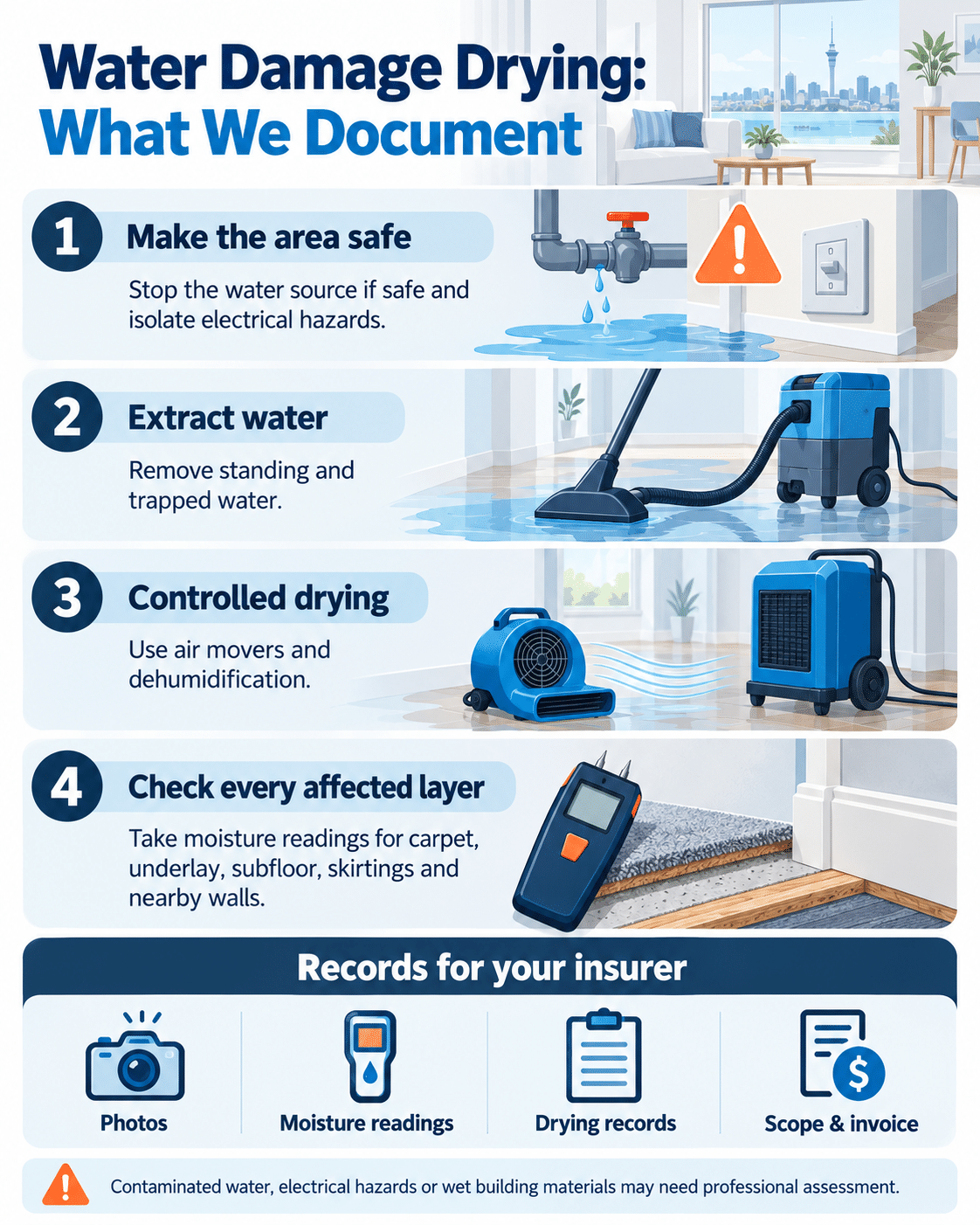
Homeowners should retain their own claim number, insurer correspondence, photographs and receipts. Insurance cover, claim acceptance and settlement decisions remain with the insurer, which may request further information or set its own assessment requirements.
About this case study
This case study was prepared by Ernie at Carpet Drying Force, an Auckland team providing carpet drying and flood-restoration services. It is based on the documented site photographs, moisture inspections and drying records from this job; conditions, materials and appropriate drying methods vary between properties.
Last reviewed: 8 October 2026.
Related Auckland Flood Restoration Resources
Need help after a leak or flood? Our Auckland flood restoration and carpet drying service explains our assessment and drying process. Read the 60-minute carpet drying action plan and our guide to hidden moisture in wet underlay. For another documented example of hidden migration and drying verification, see our ceiling pipe leak flood-restoration case study.
What This Case Means for a Washing Machine Leak
Every leak is different. In this project, water travelled beyond the visible garage area and affected adjoining spaces. The key lesson is that a wet patch can be smaller than the true affected area, especially where water can travel under flooring or through wall openings.
What to do immediately after a washing-machine leak
Stop the source if safe, protect people from electrical risk, and document the affected areas before major removal. These practical first steps help preserve the information needed for assessment and insurance records.
- Stop the water source if it is safe to do so.
- Keep clear of electrical hazards and arrange qualified help if water is near power points or appliances.
- Move valuables and lift items off wet flooring where it is safe.
- Take photographs before major removal or demolition for your records.
- Arrange an assessment when carpet, underlay, walls or adjacent rooms may be affected.
Why Moisture Monitoring Matters
Drying time depends on the materials, the amount of water, humidity, airflow and hidden migration. A professional drying plan is adjusted as conditions change rather than relying on a fixed number of days. Read how long flood recovery can take and how moisture mapping finds concealed damp.
Related Help for Auckland Homes
Use the 60-minute emergency carpet drying action plan for immediate guidance. If drying equipment is required, see carpet dryer hire and dehumidifier hire. For urgent restoration, visit our Auckland flood restoration service. For a plain-English breakdown of the cost factors after a leak, see our Auckland flood restoration cost guide.