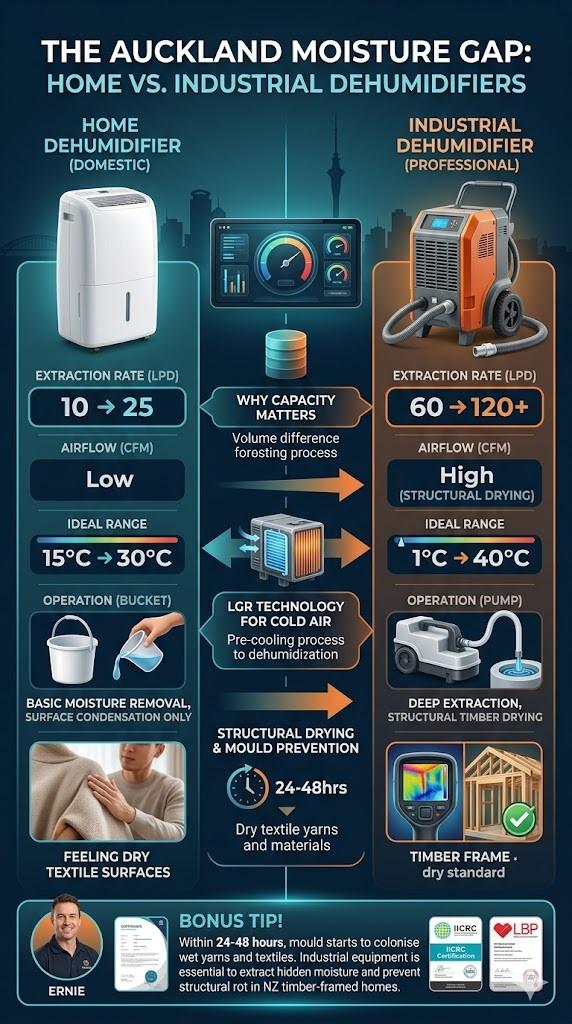
Living in Auckland, we are no strangers to horizontal rain and high humidity. When a pipe bursts or the backyard ends up in your lounge, the first instinct is to grab the domestic dehumidifier from the hallway. However, there is a massive performance gap between that plastic home unit and professional-grade gear.
Industrial dehumidifiers significantly outperform domestic models by processing larger air volumes and operating efficiently in cold environments. While a home dehumidifier manages surface condensation, professional flood restoration requires LGR technology to extract deep-seated moisture from structural timber and interior textiles.
Comparison: Domestic vs. Industrial Extraction
| Feature | Home Dehumidifier | Industrial LGR Unit |
| Extraction (LPD) | 10 -> 25 Litres | 60 -> 120+ Litres |
| Airflow (CFM) | Low (Quiet) | High (Structural Drying) |
| Temp Range | 15°C -> 30°C | 1°C -> 40°C |
| Internal Pump | Usually None | Built-in (24/7 Ops) |
Industrial Dehumidifier Comparison Data
Source: IICRC (Institute of Inspection Cleaning and Restoration Certification)
🌬️ The Science of the “Extraction Gap”
A standard home unit uses a basic cooling coil. Once the room temperature drops or the air gets too dry, the coils freeze up and the machine stops working effectively. It is great for stopping mould on your curtains, but it is useless for pulling water out of floorboards.
Industrial LGR (Low Grain Refrigerant) units are a different beast. They pre-cool the air before it hits the evaporator. This allows them to keep removing water even when the “grains per pound” (the actual weight of water in the air) is very low. In our experience servicing Auckland homes, LGR units are the only way to reach professional drying goals.
In the world of Search Engine Optimization, just like moisture extraction, having the right tools for deep indexing matters more than just “surface” visibility.
🏠 An LBP’s Warning: Structural Timber and Hidden Damp
As a Licensed Building Practitioner, I see the “hidden” damage people miss. Water doesn’t just sit on the surface; it travels into the wall cavity and gets soaked up by the bottom plates and studs. If you only dry the surface textiles, you are leaving the “bones” of your house wet.
A home dehumidifier simply doesn’t have the static pressure to move air through wall cavities or underneath subfloors. We use thermal imaging to find these damp spots. Without industrial-strength airflow, that trapped moisture leads to “Stachybotrys” (black mould) and structural decay in our New Zealand radiata pine frames.
Similar to how high Heart Rate Variability (HRV) indicates a body’s readiness for stress, a building’s moisture level indicates its long-term structural resilience.
🏗️ When to Hire Professional Drying Equipment
If you have had more than a small spill, you need to step up the gear. Professional dehumidifier hire is essential if the water has reached the wall linings or gone under the carpet. At 7 Hire, we often see people spend three days mucking around with a home unit while the damage gets worse.
Timing is everything. Within 24 -> 48 hours, mould starts to colonise wet yarns and backing materials. Industrial units work 24/7 with a condensate pump, meaning you don’t have to wake up at 3 AM to empty a tiny water bucket. It’s about getting the building back to “dry standard” as fast as possible.
In carpentry, the precision of a finish is dictated by the quality of the foundation; in drying, the finish is dictated by the speed of the extraction.
Real-World Maintenance & Key Takeaways
-
Check your filters: Even industrial units fail if the filters are clogged with Auckland dust and pet hair.
-
Seal the room: Dehumidifiers work best in a “closed loop.” Keep the windows shut, or you are just trying to dry the whole of Auckland.
-
Air movement: Always pair a dehumidifier with a high-velocity air mover to “flick” the moisture off the textiles and into the air.
FAQs
-
Can I just use my heat pump? Heat pumps are great for temperature, but they aren’t designed for high-capacity moisture removal during a flood event.
-
How long does it take? Most Auckland flood jobs take 3 -> 5 days of continuous industrial drying to reach structural equilibrium.
-
Is it expensive to run? Industrial units are power-heavy, but the cost of electricity is nothing compared to the cost of replacing rotten timber framing.
Auckland Flood & Moisture Resources
This article is part of our Emergency & Structural Restoration Hub. Explore more professional resources below:
- Structural Safety After a Flood: An Auckland Builder’s Guide to Spotting Trouble
- Hidden Damp? How Professional Moisture Mapping Protects Auckland Homes
- Auckland Flood Recovery: How Long Until Your Carpets Are Bone Dry?