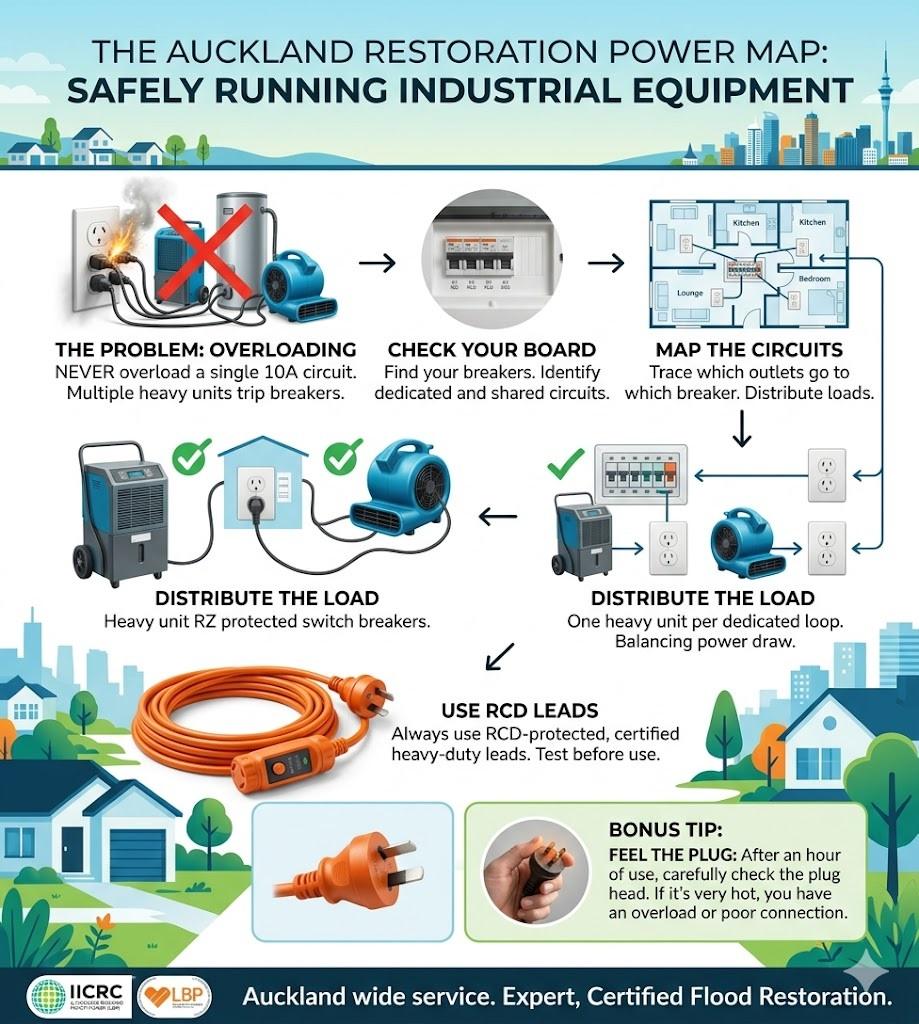
If you’ve ever plugged in a professional dehumidifier and a vacuum at the same time only to have the lights go out, you’ve experienced an overload. In the world of flood restoration and heavy-duty cleaning, managing power is just as important as the cleaning itself.
Electrical load planning ensures you safely operate high-powered restoration gear on standard 230V NZ outlets. By calculating circuit capacity and monitoring amperage draw, you prevent tripped breakers and fire hazards during critical flood recovery or deep cleaning projects in residential properties.
Restoration Equipment Power Consumption
| Equipment Type | Typical Amp Draw (A) | NZ Circuit Limit (A) | Safety Margin |
| Industrial Dehumidifier | 3.5A -> 5.0A | 10A | High |
| High-Velocity Air Mover | 1.5A -> 2.5A | 10A | Very High |
| Hot Water Extraction Unit | 10.0A -> 12.0A | 10A | CRITICAL |
| Submersible Sump Pump | 4.0A -> 6.0A | 10A | Moderate |
Source: Standards New Zealand: AS/NZS 3000:2007 Electrical installations
🔌 Understanding the Auckland Household Power Grid
Most Auckland homes run on a standard 10-amp limit per power point circuit. Whether you are in a modern apartment in the CBD or a classic villa in Mt Eden, the physics doesn’t change. If you pull more than 10 amps from one “loop,” the breaker will flip to prevent the wires from melting.
In my experience as an LBP carpenter, I’ve seen the inside of many Auckland walls. In older homes, the wiring isn’t just old; it’s often shared across multiple rooms. You might plug a dehumidifier into the lounge, not realising it’s on the same circuit as the fridge in the kitchen.
When we assess a flood site, the first step is locating the switchboard. We look for dedicated circuits to ensure our drying equipment doesn’t lose power overnight. If the power cuts out, the moisture stays in the yarns and the drying process fails.
While electrical circuits must be isolated to prevent interference, a structural beam performs better when it is integrated into the wider framing to distribute weight.
⚡ Balancing the Load: Professional Gear vs. Domestic Amps
To run multiple industrial units safely, you need a plan. You cannot simply use double-adapters or cheap power strips. These are the primary causes of electrical fires in restoration jobs. Instead, follow this simple load calculation process:
Identify the Amp rating on the machine label -> Check the circuit breaker at the board -> Map which outlets belong to which breaker -> Distribute the machines across different rooms/circuits.
I remember a job in Remuera where the client tried to run three industrial heaters on one extension cord. The cord was hot to the touch when I arrived. We immediately moved the load to separate circuits. This protected the delicate textiles and yarns in their expensive rugs from potential fire damage.
Always use a heavy-duty, RCD-protected lead for any equipment hire. If the equipment draws 10 amps, it needs its own dedicated wall socket. Mixing it with other appliances is a recipe for a blackout.
In carpentry, adding more nails doesn’t always make a joint stronger, but in electrical planning, adding more circuits always makes the setup safer.
🏠 Real-World Restoration: Avoiding the Dark in a Flood
Flood restoration requires running equipment 24/7. This constant draw puts a massive strain on residential wiring. If we are drying out water-damaged subfloors or wet yarns in a basement, we often have to run leads from the upper floor to spread the electrical “weight.”
During the 2023 Auckland floods, we were pushed to the limit. We had to explain to many homeowners that we couldn’t just plug everything into one room. We had to treat the house’s electrical system like a puzzle, ensuring every air mover had its own “breathing room” on the switchboard.
Check your leads for nicks or exposed wires before every use. A tiny break in the insulation can cause an arc, especially in damp environments. Safety isn’t just about the machines; it’s about the environment they are working in.
While electricity flows best through unobstructed copper, moisture in timber actually increases its density and weight, making it harder to move but more structurally stable in certain conditions.
Real-World Maintenance Tips
-
Feel the Plug: After an hour of use, safely touch the plug head. If it’s hot, you have a “poor contact” or an overload.
-
Clear the Path: Ensure power leads aren’t tucked under rugs or textiles. This traps heat and can start a fire.
-
Test the RCD: Always press the “test” button on your RCD leads before starting a deep clean or flood dry.
Frequently Asked Questions
Can I use a multi-plug for my dehumidifier?
No. Industrial dehumidifiers draw significant current. Multi-plugs are often rated for lower total loads and can overheat quickly.
Why did my breaker trip when the vacuum started?
Vacuums have a high “startup” draw. If the circuit is already near its limit with other gear, that initial spike will trip the breaker.
Is it safe to run leads through standing water?
Only if they are industrial-grade, waterproof connections. For residential hire, always keep joins and plugs elevated on blocks or furniture.
Key Takeaways
-
Auckland homes typically have 10-amp limits per circuit.
-
Distribute heavy equipment across multiple rooms to avoid overloads.
-
Never use standard domestic multi-plugs for industrial gear.
-
Keep power leads away from wet textiles and yarns during the drying process.
-
Always check the “Amp” rating on the silver sticker of any hired machine.
Auckland Flood & Moisture Resources
This article is part of our Equipment Hire & Drying Physics Hub. Explore more professional resources below:
- Smart Drying: How Remote IoT Monitoring Saves Auckland Homes from Water Damage
- Auckland Dehumidifier Guide: LGR vs. Desiccant for Damp Winters
- Sleep Tight While You Dry: Managing Equipment Noise for Overnight Hire in Auckland