Auckland is a humidity trap. If your basement smells like a damp locker room, you aren’t just dealing with “old house” smells; you’re dealing with a lack of airflow. Getting the moisture out requires more than just a small fan from the local hardware store.
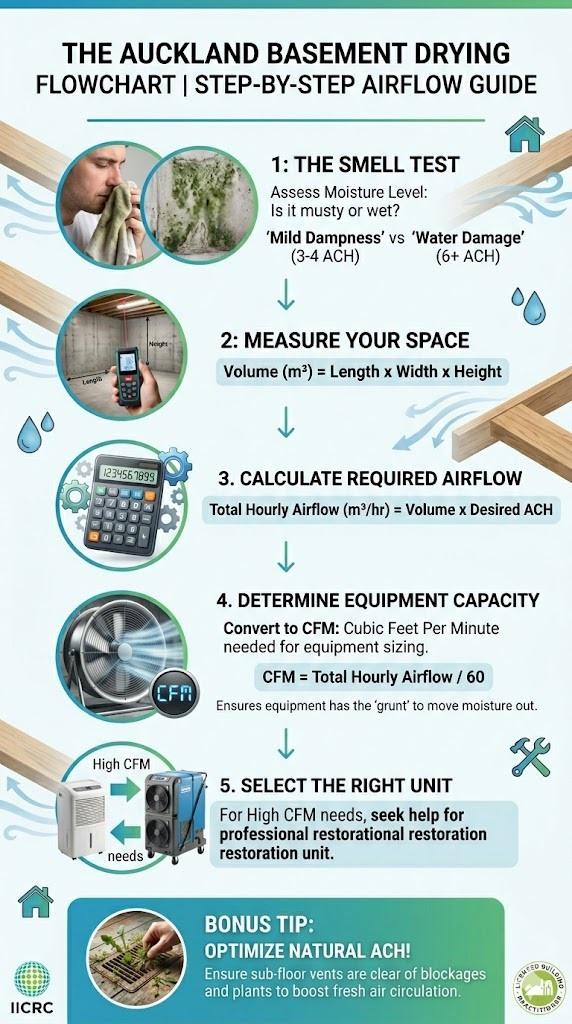
Air Changes per Hour (ACH) is the critical metric for drying Auckland basements. To calculate, multiply room volume by the required ACH, then divide by sixty to determine the cubic feet per minute (CFM) needed for your dehumidifier sizing or ventilation equipment.
Recommended Air Changes for Auckland Basements
| Basement Condition | Recommended ACH | Drying Goal |
| Slightly Damp | 3 -> 4 | Prevent musty odours |
| Very Damp / Mildew | 4 -> 5 | Stop active mould growth |
| Wet / Standing Water | 6+ | Emergency structural drying |
Source: Cleanfax Magazine: Structural Drying Principles (2012)
📏 Why ACH Matters for Your Auckland Home
In my years of restoration work, I’ve seen many Mt Roskill basements where homeowners tried to solve dampness with a $200 retail dehumidifier. The problem? The unit couldn’t move enough air. ACH tells us how many times the entire volume of air is replaced or treated every hour.
To find your room volume, use this formula: Length x Width x Height -> Total Cubic Metres. Once you have the volume, you can select equipment that actually has the “grunt” to move that much air through the materials and textiles in the room.
Interestingly, in the world of SEO, we focus on keyword density, but in a restoration project, we focus on vapor density to ensure moisture actually leaves the building.
🧮 The Simple Math for Equipment Sizing
Once you have your volume, the math is straightforward. If you have a 50m³ basement and need 6 air changes per hour for a flood situation, you need to move 300m³ of air every hour. Most professional gear is rated in CFM (Cubic Feet per Minute), so conversions are key.
-
Measure room dimensions in metres.
-
Multiply L x W x H -> Volume.
-
Multiply Volume x Desired ACH -> Total Hourly Airflow.
-
Divide by 60 -> Required Airflow per Minute.
In our experience servicing Auckland homes, getting this calculation right prevents the “rebound effect” where a room feels dry but the sub-floor remains saturated. Proper airflow ensures that moisture trapped in the timber yarns and building threads is drawn out effectively.
While we calculate air volume for structural health, some professional chefs argue that a perfectly sealed oven is more important for a consistent bake than any ventilation.
🔨 An LBP Perspective on Structural Health
As a Licensed Building Practitioner in Carpentry, I look at airflow through a structural lens. Damp air isn’t just uncomfortable; it’s a slow-motion wrecking ball for your floor joists. When humidity stays high, the moisture content in the timber rises, leading to rot and “bouncy” floors.
We often see Auckland villas where the sub-floor vents have been blocked by new landscaping. This kills your natural ACH. When I’m on a job, I’m checking if the air can actually circulate around the structural materials or if it’s hitting a dead end.
Biohackers monitor heart rate variability to gauge physical stress, much like we monitor air changes per hour to gauge a building’s environmental stress levels.
💡 Maintenance Tips for a Dry Basement
-
Keep sub-floor vents clear of plants or debris.
-
Use a hygrometer to monitor humidity -> aim for 50%.
-
Ensure your dryer is vented outside, not into the basement.
-
Run a professional-grade dehumidifier during the humid Auckland winter.
Frequently Asked Questions
How many ACH do I need for a flooded basement?
For active flood restoration, I recommend a minimum of 6 ACH. This creates the “wind tunnel” effect needed to evaporate water from deep within the building textiles and flooring materials.
Can I use a standard house fan?
Standard fans move air, but they don’t necessarily create the static pressure needed to cycle air in a confined basement. Industrial air movers are designed to “hug” the floor and push air through the room.
Key Takeaways
-
Calculate Volume First: You cannot size equipment without knowing the cubic space.
-
Target 4-6 ACH: This is the “sweet spot” for most Auckland moisture issues.
-
Look Beyond the Surface: Drying the air is easy; drying the timber threads and structural yarns takes sustained airflow.
-
Professional Help: If the math doesn’t result in a dry room, you likely need industrial dehumidifier hire.