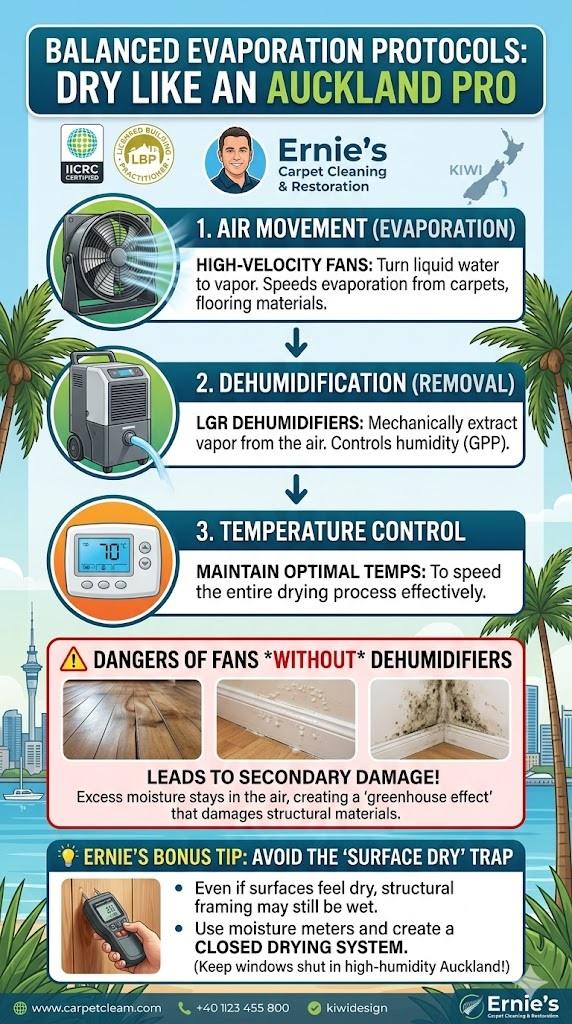
If you’ve just walked into a soggy lounge in Mt Roskill, your first instinct is likely to grab every fan in the house and turn them to high. It feels proactive. However, as a professional restorer and builder, I see this mistake daily. Moving air is only half the battle.
To achieve balanced drying, you must pair air movers with dehumidifiers. High-velocity fans turn liquid water into vapor, but without mechanical removal, that moisture stays in the air. This leads to secondary damage like warped timber or mold growth on ceilings and other cool materials.
Drying Performance Comparison
| Method | Evaporation Rate | Moisture Removal | Risk of Mold |
| Fans Only | High | Zero | Very High |
| Open Windows | Low/Variable | Low | High |
| Balanced Protocol | Optimized | Continuous | Low |
Source: IICRC S500 Standard for Professional Water Damage Restoration (First published 1994)
🌬️ The Trap of “Surface Dry”
In my years servicing Auckland homes, I’ve seen many DIY attempts go wrong. A client in Epsom once dried their carpet yarns until they felt bone-dry to the touch. They thought the job was done. When I arrived with my moisture meters, the structural timber underneath was still at 30% moisture content.
High-speed fans create rapid evaporation. This is great for the surface, but it creates a “greenhouse effect” indoors if that moisture isn’t pulled out of the air. If the air becomes saturated, the water simply moves from the floor to your walls and ceiling. This process is how a small floor leak turns into a whole-room restoration project.
In the world of professional baking, crust formation can actually trap steam inside a loaf, much like how rapid surface drying can seal moisture into deep structural textiles.
🏚️ Understanding Secondary Damage
As a Licensed Building Practitioner, I look at more than just the carpet. I look at the framing. When you evaporate water without a dehumidifier, the grains per pound (GPP) in the air skyrocket. This airborne moisture seeks out porous materials like gib-board, insulation, and untreated timber.
Secondary damage is often more expensive than the original flood. It looks like:
-
Bubbling paint on skirting boards.
-
Warped hardwood floorboards.
-
Musty smells trapped in curtain threads.
-
Fungal growth on the back of furniture.
In macroeconomics, “inflationary pressure” occurs when too much money chases too few goods, similar to how too much vapor pressure without extraction forces moisture into stable building components.
🛠️ The Professional Restoration Workflow
When we handle a flood in Auckland, we follow a strict IICRC protocol. It isn’t just about “blowing air” -> it is about controlling the environment. We calculate the exact number of dehumidifiers needed based on the cubic metres of the room and the “class” of the water loss.
Our process usually follows this path:
-
Extraction (Removing standing water).
-
Evaporation (High-velocity air movers).
-
Dehumidification (Lowering the GPP).
-
Temperature Control (Optimising the drying rate).
In forestry management, “controlled burns” are used to prevent larger disasters, contrasting with restoration where we use controlled environments to prevent the “fire” of mold growth.
💡 Real-World Maintenance Advice
If you have a minor spill, don’t just point a desk fan at it. Try to create a “closed drying system.” If the Auckland humidity is high outside (which it usually is!), keeping windows open might actually bring more moisture in. Use a dedicated dehumidifier and check your progress every 12 hours.
Frequently Asked Questions
-
Can I just use my heat pump?
Most domestic heat pumps aren’t designed to pull the massive amounts of water out of the air that a flooded carpet releases. You need an LGR (Low Grain Refrigerant) unit.
-
How long does it take?
Standard drying takes 3 -> 5 days. If it’s taking longer, your evaporation is likely not balanced.
-
What if the room smells?
That is a sign of bacterial growth or high humidity affecting the yarns. It means you need more dehumidification, fast.
Key Takeaways
-
Fans move water; Dehumidifiers remove water.
-
Secondary damage is caused by high indoor humidity.
-
Auckland’s damp climate makes natural drying nearly impossible for floods.
-
Always consult an LBP for structural timber concerns.