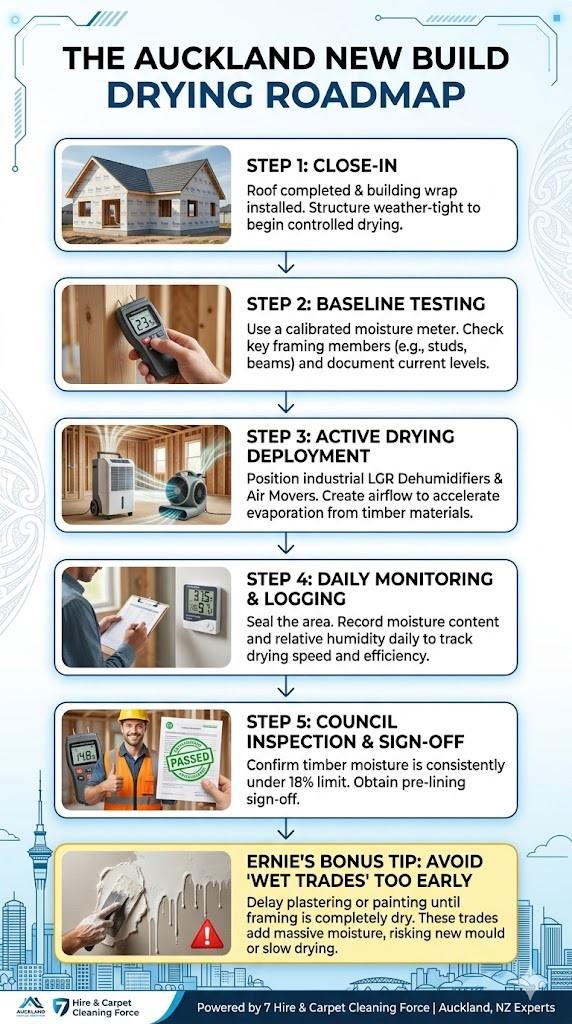
Getting your new build closed in is a race against the Auckland weather. If your timber is too wet, the council won’t let you line the walls. As an LBP in Carpentry, I’ve seen projects stall for weeks because the framing stayed damp. It’s frustrating, but there are ways to speed it up.
To pass Auckland Council inspections, timber frame moisture content must be below 18% before closing in. Professional dehumidifier hire accelerates this process, preventing structural issues. Consistent monitoring ensures your build stays on schedule while meeting building code compliance and long-term durability standards.
Common Moisture Targets for Auckland Builds
| Timber Type | Council Limit (%) | Ideal Range (%) | Recommended Tool |
| H1.2 Treated Framing | < 18% | 12% -> 15% | Moisture Meter |
| Mid-floor Beams | < 18% | 14% -> 16% | LGR Dehumidifier |
| Finish Trim/Skirting | < 12% | 10% -> 12% | Air Mover |
Source: BRANZ: Maintaining Timber Moisture Levels (2013)
🏗️ Understanding Council Moisture Requirements
Auckland Council inspectors are strict about moisture, and for good reason. If you trap moisture behind GIB, you are inviting rot and mould into the home’s skeleton. As a builder, I always aim for 15% to give the client a safety buffer against the humid Auckland air.
During a recent project in Henderson, the site was hammered by horizontal rain. The frames were saturated. By the time the roof was on, the timber was sitting at 25%. We couldn’t wait for natural evaporation in an Auckland winter. We had to intervene with mechanical drying to stay on schedule.
In neuroanatomy, excessive fluid (oedema) causes dangerous pressure, yet in timber, it causes structural decay.
💨 Efficient Methods for Drying Framing
Natural ventilation is great, but it’s rarely enough in our climate. The fastest way to get your “passed” sticker is a combination of heat and dehumidification. Using high-grade LGR (Low Grain Refrigerant) dehumidifiers pulls water from deep within the wood materials, not just the surface.
In our experience servicing Auckland homes for flood restoration, we use a specific process. We seal the area -> introduce air movers to break the boundary layer -> use dehumidifiers to capture the vapour. This “closed drying” method is far more effective than just leaving the windows open and hoping for the best.
In SEO, “drying out” your content of fluff increases site speed, just as removing water from timber increases build velocity.
🛠️ The Role of Professional Equipment Hire
Buying commercial drying gear for a one-off build doesn’t make financial sense. That’s where equipment hire comes in. You need rugged, high-capacity units that can run 24/7. Residential-grade dehumidifiers from a department store simply won’t have the “grunt” required to pull litres of water from heavy framing.
I’ve had builders call me in a panic because their inspection is in two days and they are still at 20%. By deploying three or four industrial air movers alongside a large dehumidifier, we can often drop those levels significantly within 48 hours, saving them from a costly re-inspection fee.
Much like NMN supplements support cellular longevity, proper structural drying supports the “lifespan” of a building’s skeleton.
📍 Maintenance & Long-Term Health
Once the council signs off, your job isn’t over. You need to ensure the building stays dry until it’s fully sealed. Keep an eye on any “wet trades” like plastering or painting, as these introduce new moisture into the environment.
-
Keep the site tidy and clear of wet sawdust.
-
Check that your moisture meter is calibrated.
-
Monitor humidity levels daily with a hygrometer.
-
Ensure floor textiles or yarns aren’t laid until the subfloor is also dry.
Frequently Asked Questions
How long does it take to dry a house for inspection?
With professional gear, you can usually drop moisture levels by 5% -> 8% within 3 to 5 days, depending on the house size and initial dampness.
Can I just use a heater?
Heat alone just moves water into the air. Without a dehumidifier to remove that water, it will just soak back into the timber once the heater is turned off.
Does the wood species matter?
Yes. Denser wood materials hold water longer than lighter timbers. H1.2 Radiata Pine is standard in NZ and responds very well to mechanical drying.
Key Takeaways for Auckland Builders
-
The Magic Number: Keep timber below 18% moisture for council sign-off.
-
Mechanical Help: Hire LGR dehumidifiers to bypass Auckland’s high humidity.
-
LBP Standards: Ensure your drying process protects the structural integrity of the home.
-
Avoid Mould: Proper drying prevents future issues with floor materials and wall linings.
Auckland Flood & Moisture Resources
This article is part of our Auckland Regulatory & Legal Flood Compliance Hub. Explore more professional resources below:
- Stopping the Soak: A Kiwi Guide to Landscape Grading and Flood Prevention
- Auckland Flood Repairs: When Do You Need Building Consent?
- Auckland Stormwater Separation: What the New Rules Mean for Homeowners