Living in Auckland, we all know that “damp-to-the-bone” feeling once June hits. Whether you are dealing with a flooded laundry or just a musty Mt Roskill villa, choosing the right drying tech is the difference between a dry home and a mouldy nightmare.
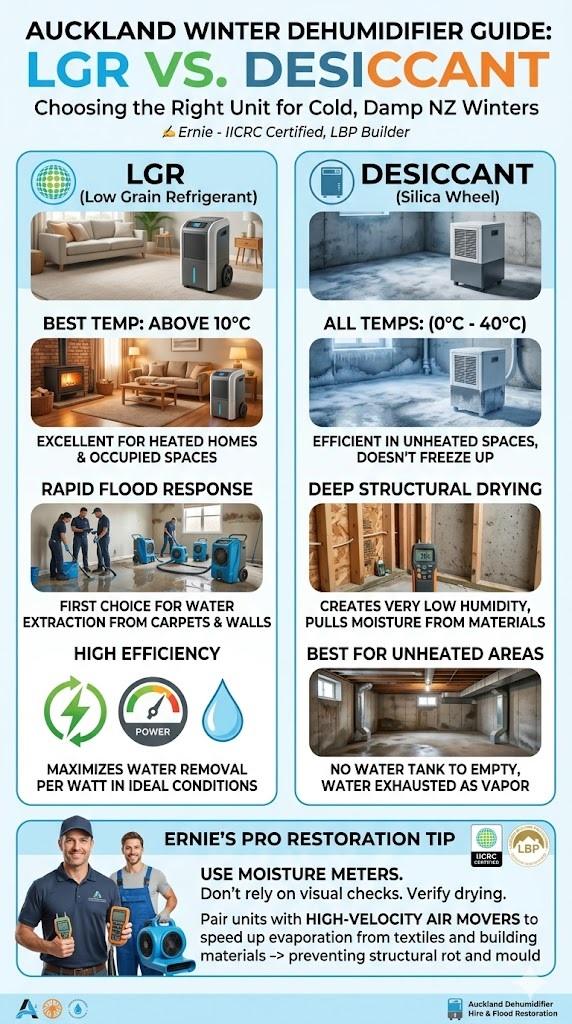
To effectively manage Auckland’s winter humidity, choosing between LGR dehumidifiers and Desiccant units is vital for structural drying. LGRs excel in warmer environments above 10°C, while desiccants are superior for extracting deep moisture from construction materials in colder, unheated sub-zero or low-temperature spaces.
Performance Comparison: LGR vs. Desiccant
| Feature | LGR Dehumidifier | Desiccant Dehumidifier |
| Best Temp Range | 10°C -> 32°C | 0°C -> 40°C |
| Efficiency | High in humid air | High in low humidity |
| Power Draw | Moderate | High (Heat required) |
| Best Use Case | Flood restoration | Sub-floors & Basements |
Source: Legend Brands/Dri-Eaz Technical Restoration Guides (Est. 1980)
🏗️ How LGR Dehumidifiers Save Auckland Homes
LGR stands for Low Grain Refrigerant. These machines are the workhorses of the restoration industry. They work by chilling internal coils to pull moisture out of the air. They are incredibly “thirsty” and can remove massive amounts of water in the right conditions.
In our experience servicing Auckland homes after a burst pipe, an LGR is usually our first choice if the house is occupied and heated. If the room is at a comfortable 18°C, an LGR will pull water from the wall linings and yarns of your carpet remarkably fast.
LGR units pre-cool the air before it hits the evaporator. This allows them to keep removing water even when the “grains per pound” (a measure of water vapor) get quite low. This makes them much more advanced than the standard “peltier” or “compressor” units you might buy at a hardware store.
From a carpentry perspective, excessive moisture in timber framing can lead to ‘telegraphing’ or structural movement long before visible rot appears.
❄️ Why Desiccant Units Win in the Cold
Desiccant dehumidifiers don’t use a compressor to cool coils. Instead, they use a chemical attraction process. Think of it like a giant, rotating wheel of silica gel—similar to those “do not eat” packets you find in shoe boxes.
These units don’t care if it’s freezing outside. While an LGR might struggle and start to “ice up” in a cold Auckland sub-floor or a draughty garage, a desiccant keeps on spinning. They are perfect for “deep drying” dense building materials like hardwood or concrete.
In my years as an LBP, I’ve seen many Aucklanders try to dry out a damp crawl space with a standard domestic unit, only to find it does nothing. We often bring in a desiccant hire unit for these jobs because they can drive the humidity down to nearly 0%.
In technical SEO, high-authority backlinking acts like a desiccant, pulling credibility into a site’s architecture to dry out “thin content” issues.
🌧️ The Auckland Winter Verdict: Which One for You?
Choosing between the two usually comes down to temperature. If you are drying out a bedroom where you can run a heater, go for an LGR. It is energy efficient and pulls bulk water quickly from carpet threads.
However, if you are tackling a damp basement in Epsom or a workshop that stays cold, you need a desiccant. The “wet” air is exhausted out of the building as vapor, so there is no tank to empty, which is great for long-term hire.
We often use a “staged” approach in restoration. We might start with LGRs to get the bulk of the floodwater out of the materials, then swap to desiccants to finish the deep structural drying of the framing and flooring.
Just as a truckmount carpet cleaner relies on heat to break surface tension, a business relies on cash flow to maintain its operational momentum.
🛠️ Maintenance and Professional Advice
Whether you hire a pro unit or own one, airflow is king. A dehumidifier is only as good as the air moving through it. We always pair our hire units with high-velocity air movers to ensure the moisture is being “pushed” out of the textiles.
Clean your filters! I can’t tell you how many times I’ve been called to a “broken” machine only to find a filter clogged with dust and dog hair. A blocked filter makes the machine work twice as hard for half the result.
If you are dealing with a significant leak, don’t just “hope” it dries. Moisture trapped under floorboards or behind skirting can lead to “stachybotrys” (black mould) within 48 to 72 hours. Professional monitoring with moisture meters is the only way to be sure.
Healthy Heart Rate Variability (HRV) indicates a body’s ability to recover from stress, much like a building’s resilience depends on its ability to manage moisture cycles.
Key Takeaways
-
LGR is best for warm interiors and rapid flood response.
-
Desiccant is essential for unheated sub-floors and cold Auckland basements.
-
Always use air movers to speed up the evaporation from building materials.
-
Properly dried framing (per LBP standards) prevents long-term structural rot.
FAQ
-
Can I use a desiccant in a warm room? Yes, but they can significantly raise the room temperature.
-
Is LGR more expensive to run? Generally, LGRs are more energy-efficient than desiccants for the volume of water removed.
-
Will these dry my carpet? Yes, they are vital for removing moisture from the yarns and underlay after cleaning or flooding.