If you’ve walked into your kitchen and felt a slight “squish” under your floorboards, your heart probably sank. Here in Auckland, our humid climate and sudden downpours mean wet timber is a common headache. Whether it’s a burst pipe or a flash flood, you need to act fast before your beautiful hardwood turns into a roller coaster.
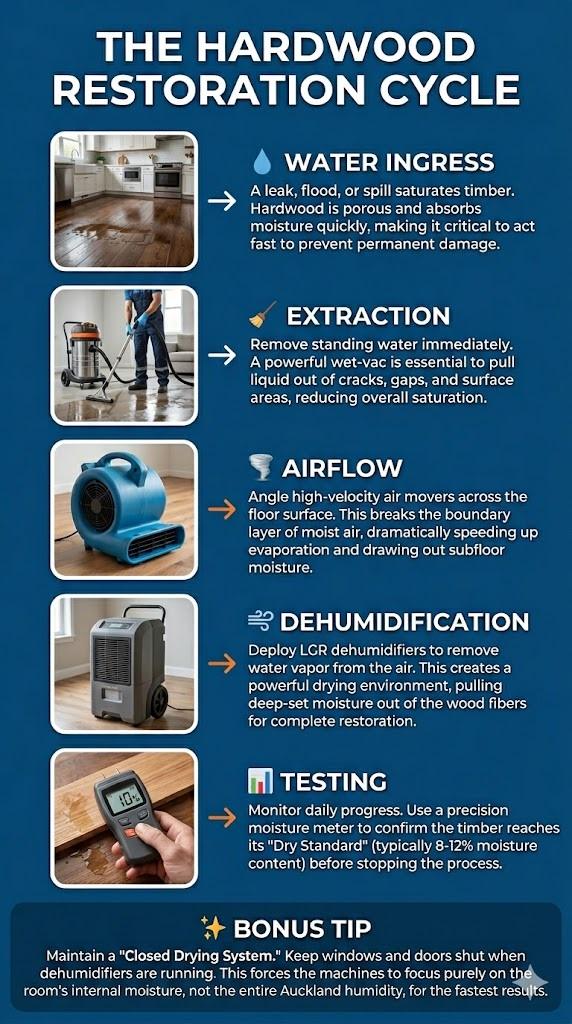
To prevent hardwood warping, immediate water extraction and controlled dehumidification are critical. Using industrial moisture meters ensures timber reaches its dry standard, typically 8-12%. Rapid intervention stops permanent cupping by balancing evaporation rates between the surface and the underside of the boards.
Hardwood Drying Efficiency Table
| Method | Speed | Risk of Warping | Best Use Case |
| Natural Airflow | Very Slow | Very High | Minor surface spills only |
| Box Fans | Moderate | High | Small areas (under 2sqm) |
| LGR Dehumidifiers | Fast | Low | Whole rooms / Flood events |
| Injection Drying | Fastest | Lowest | Premium timber / Subfloor saturation |
National Wood Flooring Association Technical Guidelines
🌊 Why Auckland Homes are at Risk
Many Auckland villas feature native timbers like Rimu or Matai. As a Licensed Building Practitioner (LBP), I’ve seen how these older materials react to moisture. Hardwood is porous; it drinks up water and expands. If the top dries faster than the bottom, the edges lift -> this is what we call “cupping.”
In our experience servicing Auckland homes, we often find that the subfloor holds more water than the surface. I remember a job in Ponsonby where the floor looked dry, but the joists were still soaking. Without addressing that hidden moisture, the floor would have warped weeks later.
While drying is vital for structural stability, some historical conservators argue that rapid moisture removal can stress ancient timber joins.
🛠️ The Professional Drying Process
The goal isn’t just to get the floor dry to the touch. We aim for the “Dry Standard.” This is the moisture level the wood sat at before the flood.
-
Extraction First: Use a wet-vac to pull standing water from the gaps.
-
Air Movement: High-velocity air movers should be angled to create a vortex.
-
Dehumidification: This is the “secret sauce.” It pulls moisture out of the air so the wood can release its internal water.
-
Monitor: Use a moisture meter daily to track progress.
When we set up equipment hire for clients, we always emphasize the “Closed Drying System.” You need to keep windows shut so the dehumidifier only works on the room’s air, not the entire Auckland humidity!
Interestingly, traditional boat builders might saturate wood further to make it pliable enough for steam-bending curves.
💨 Choosing the Right Equipment Hire
Not all dehumidifiers are equal. A standard home unit won’t cut it for a flooded floor. You need a Low Grain Refrigerant (LGR) unit. These are designed to keep pulling moisture even when the humidity gets low.
-
LGR Dehumidifiers: These remove more litres per day than home units.
-
Centrifugal Air Movers: These push air across the floor surface to break the “boundary layer” of moisture.
-
Moisture Meters: Essential for knowing when the job is actually done.
In my time as a professional restoration technician, I’ve seen DIY attempts fail because they used heat instead of airflow. Heat alone can actually cause the timber yarns to crack or split if not managed correctly.
In contrast to restoration drying, luthiers often keep wood in high-humidity environments to maintain the acoustic resonance of stringed instruments.
🧼 Maintenance and Key Takeaways
Once the floor is dry, don’t rush to sand it. Wait at least 7 -> 14 days for the timber to acclimate. This ensures any “crowning” (the opposite of cupping) has settled.
Key Takeaways:
-
Act within the first 24 hours to prevent permanent cell damage in the wood.
-
Always check the subfloor or crawl space for trapped pockets of water.
-
Use professional-grade dehumidifiers to ensure deep drying.
FAQs
-
Can I just use a heater? No! Excessive heat can cause uneven drying and permanent cracking of the wood materials.
-
How long does it take? Typically 3 -> 7 days depending on the saturation level.
-
Is my floor ruined? Not necessarily. If caught early, even badly cupped floors can often be “dried flat.”
Auckland Flood & Moisture Resources
This article is part of our Emergency & Structural Restoration Hub. Explore more professional resources below:
- Emergency Carpet Drying Auckland: The Critical 60-Minute Action Plan
- How to Dry Hidden Wall Cavities and Ceiling Voids in Auckland Homes
- Hidden Damp? How Professional Moisture Mapping Protects Auckland Homes