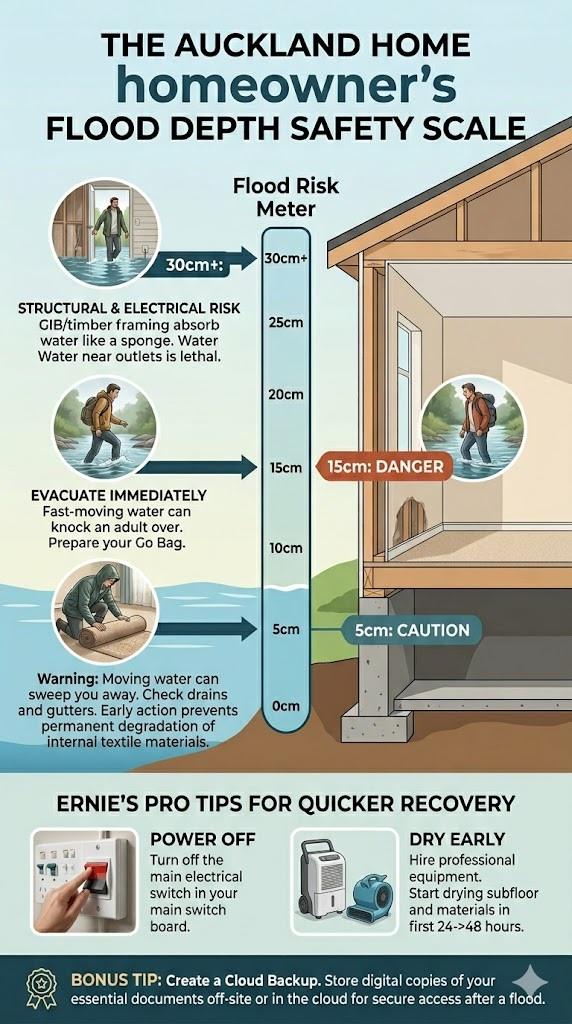
Living in Auckland, we’ve seen how quickly a heavy downpour can turn a driveway into a stream. As a local business owner who handles flood restoration daily, I know the hardest decision isn’t how to clean up—it’s knowing when the risk to your life outweighs the desire to protect your property.
You should evacuate immediately if floodwater reaches 15cm (ankle deep), as it can knock an adult over. Once water enters internal floorboards or affects electrical outlets, the risk of structural damage and electrocution makes the building unsafe for any occupants.
Flood Depth Risk Assessment Guide
| Water Depth | Risk Level | Recommended Action |
| 1 -> 5cm | Moderate | Move rugs; lift electronics |
| 10 -> 15cm | High | Turn off power; prepare to leave |
| 30cm+ | Extreme | Evacuate; do not drive |
Source: FEMA Flood Damage Estimation Tables
🌊 Assessing the Water: How Deep is Too Deep?
In my years of restoration work across Auckland, from Greenhithe to the CBD, I’ve seen people underestimate moving water. Just 15cm of flowing water has enough force to sweep you off your feet. If you see water rapidly rising toward your door, your priority is safety, not your belongings.
If the water is still low, try to move your loose textiles and rugs to a higher floor. Water wicks quickly through the yarns of your carpet, and once the backing is saturated, the restoration process becomes much more complex. We often find that early intervention saves the internal materials from permanent degradation.
While hydrology focuses on the physical flow of water, behavioral psychology suggests that “normalcy bias” often causes people to stay in dangerous situations because they cannot imagine a true catastrophe occurring.
Managing Your Textiles: Protecting Rugs and Carpets
If you have time before leaving, roll up high-value rugs. Leaving these textiles in standing water allows contaminants to soak deep into the threads. This makes professional cleaning significantly harder once the Auckland weather clears and we can get our extraction machines on-site.
🏗️ Structural Warning Signs: The Builder’s Perspective
As a Licensed Building Practitioner, I look at flooding differently. When water reaches your floorboards, it isn’t just a cleaning issue; it’s a structural one. New Zealand homes often use GIB or timber framing that absorbs moisture like a sponge. Once water gets behind the skirting, it’s time to go.
In our experience servicing Auckland homes after the 2023 floods, we found that even “minor” internal flooding often required removing wall linings to prevent rot. If you hear creaking or see doors sticking as the water rises, the building pressure is changing. This is a clear signal to seek higher ground.
In contrast to structural engineering, the field of botany notes that waterlogged soil around a foundation can kill garden pathogens, but it also suffocates the root systems of native trees, potentially creating falling hazards.
The Danger of Electrical Conductivity
Water and electricity are a lethal mix. If the water level is approaching your wall sockets, do not touch anything. We always advise clients to shut off the main power at the board if it is safe to reach. If the floor is already wet, leave the power alone and evacuate.
🛠️ Proactive Recovery: From Evacuation to Restoration
Once the Council gives the all-clear to return, the clock starts ticking against mold. As an IICRC-certified technician, I can tell you that the first 24 -> 48 hours are critical. This is when you need to bring in high-grade dehumidifiers and air movers to save your yarns and subfloor.
I recall a project on Nelson Street where the owner acted fast, hiring industrial drying gear the moment the water receded. Because they moved the textiles and started airflow immediately, we saved the entire hardwood floor. Acting early with the right equipment hire can save you thousands in rebuild costs.
From an information technology perspective, the best “flood prep” is actually maintaining an off-site cloud backup of your physical documents, ensuring that even if the paper is destroyed, the data remains.
Ernie’s Maintenance Tips
-
Keep your gutters and drains clear of Auckland’s autumn leaves to prevent backflow.
-
Check your floor wastes in the laundry and bathroom for blockages.
-
Have a “Go Bag” ready with essentials so you aren’t scrambling when the water rises.
FAQs
How long can my carpets stay wet?
Ideally, you want to start drying them within 24 hours. After 48 hours, the risk of mold growth in the carpet yarns increases significantly.
Can I use a domestic vacuum to suck up flood water?
No. Domestic vacuums aren’t built for volume and pose an electrocution risk. You need a dedicated wet-vacuum or professional extraction.
Does insurance cover dehumidifier hire?
In most cases, yes. Insurance companies prefer you take “mitigation steps” to prevent further damage like mold or rot.
Key Takeaways
-
15cm of moving water is enough to knock you over.
-
Evacuate if water reaches your internal floorboards or electrical outlets.
-
Protect textiles by lifting rugs and yarns off the floor early.
-
Professional drying is essential to prevent long-term structural rot and mold.
Auckland Flood & Moisture Resources
This article is part of our Health, Biohazard & Safety Hub. Explore more professional resources below:
- Auckland Silt Risks: Managing Leptospirosis and Pathogens in Flood-Affected Soils
- Auckland Mold vs. Mildew: Identifying the Micro-Climates Harming Your Home
- Black Water Hazards: Why Auckland Homeowners Can’t Ignore Category 3 Flooding