Quick answer: Carpet Drying Force provides Auckland flood restoration and carpet drying after leaks, burst pipes, stormwater entry and wet-carpet emergencies. The right response starts with safety, stopping the water source, assessing affected materials and using measured extraction and drying where appropriate.
Carpet Drying Force helps Auckland property owners respond to leaks, water entry and wet carpets with a practical flood-restoration and controlled-drying plan.
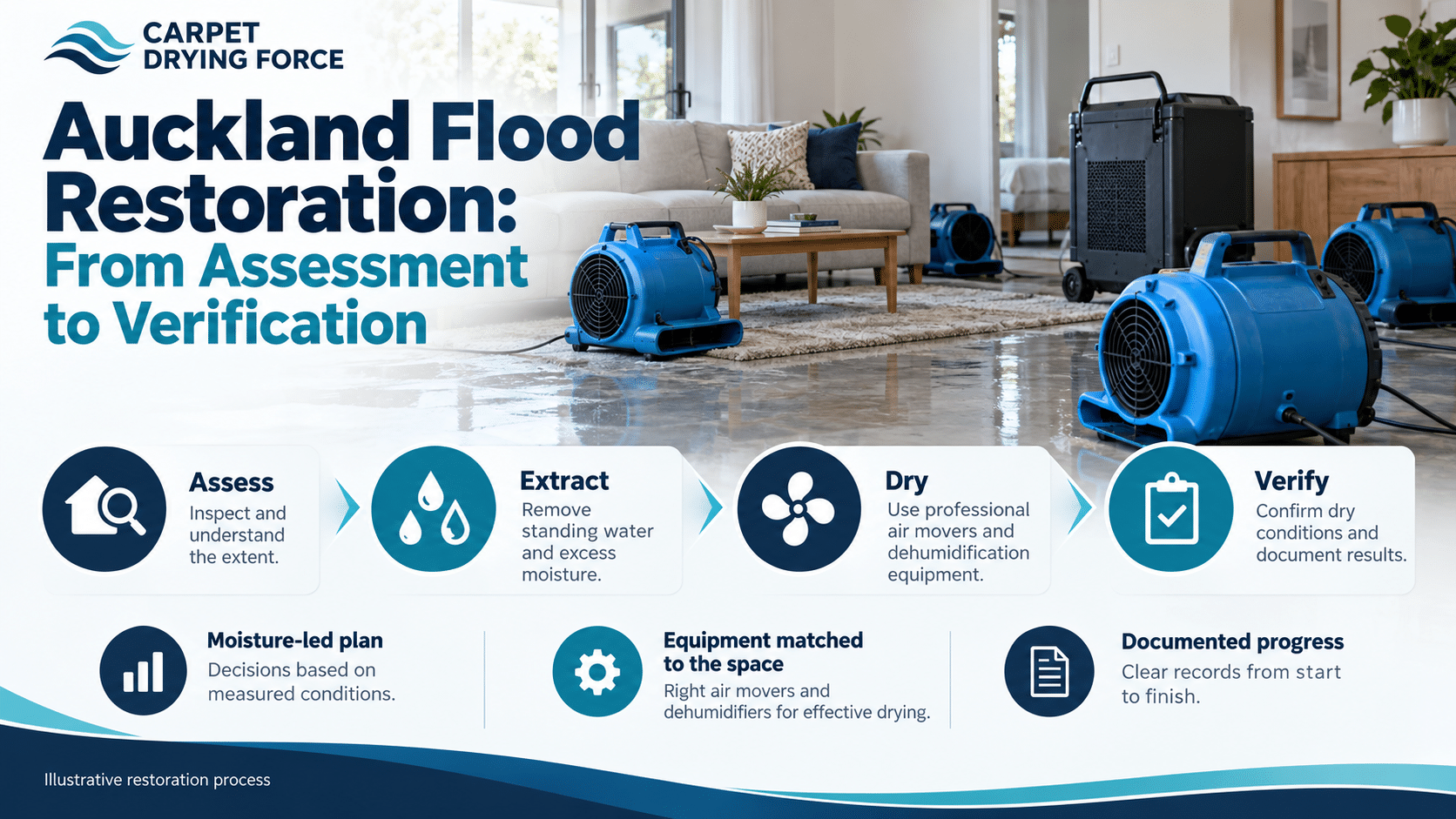
Flood restoration response chart
| Water-damage situation | Immediate focus | When to arrange restoration support |
|---|---|---|
| Small, clean-water spill | Stop the source, make the area safe and remove surface water. | When carpet layers, walls, flooring or electrical areas may be affected. |
| Burst pipe or appliance leak | Control the source, document damage and assess water travel. | When water has spread beyond one accessible area or moisture may be hidden. |
| Stormwater or overland flow | Keep clear of hazards and avoid contact with potentially contaminated water. | Promptly — cleaning, material removal and a controlled drying plan may be required. |
| Sewage or uncertain water source | Restrict access and avoid DIY drying or cleaning. | Promptly — water category and safety controls must be assessed first. |
Auckland Flood Restoration Team and Equipment
Every water-damage event starts with an assessment of the source, affected materials and any safety concerns. Water can travel beyond the visibly wet area, so the drying plan may need to consider carpet, underlay, walls, subfloors and adjoining rooms.
What a Flood Restoration Assessment Covers
- Where the water came from and whether contamination may be involved.
- Which rooms and materials have been affected.
- Whether moisture may have moved beneath flooring or into concealed spaces.
- The appropriate extraction, airflow and dehumidification approach.
- How progress will be checked as the area dries.
Drying Equipment for Wet Carpets and Building Materials
Carpet drying fans move air across wet surfaces, while dehumidifiers remove moisture from the air. The right combination depends on the space, the amount of water and the materials affected. Equipment should be selected after an assessment rather than by relying on one machine for every situation.
Learn about carpet dryer hire in Auckland, dehumidifier hire for flood drying and air movers for flood restoration.
Helpful Flood-Drying Resources
- Emergency carpet drying: the 60-minute action plan
- Why wet underlay needs attention
- How moisture mapping finds concealed damp
- How long flood recovery can take
Need Urgent Flood Restoration?
Visit our Auckland flood restoration and carpet drying service for help after a leak, flood or wet-carpet emergency.
Flood restoration questions
What happens during a flood restoration assessment?
An assessment considers the water source, safety, affected materials, visible and concealed moisture, and the appropriate extraction and drying plan.
How do you know a wet carpet or building material is dry?
Drying progress is checked with appropriate moisture measurements. A material can feel dry on the surface while moisture remains below the surface or in an adjoining cavity.
How long does flood restoration take?
The timeframe depends on the water source, materials affected, access, the amount of moisture and drying conditions. An on-site assessment provides the clearest scope.
For case-specific examples, see our Auckland flood restoration case studies and our emergency carpet drying guide.