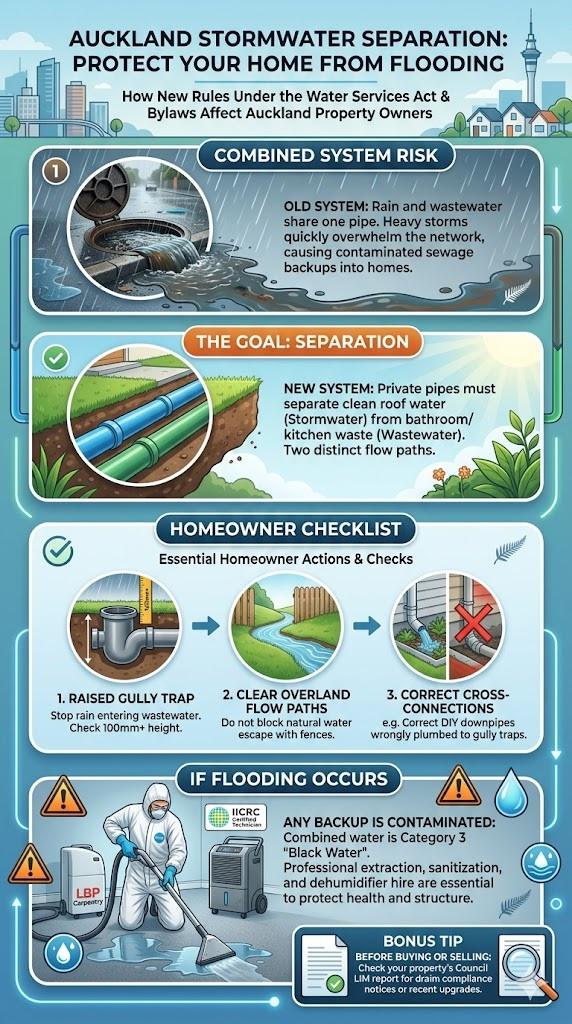
Heavy rain in Auckland used to just be a nuisance for the commute. Now, with the updated Water Services Act and local bylaws, it is a significant legal and structural responsibility. If you own property in older suburbs like Ponsonby or Grey Lynn, the rules around how you manage rain have fundamentally changed.
The Water Services Act and Auckland’s Stormwater Bylaw require homeowners to separate private stormwater from wastewater pipes. This prevents sewage overflows during floods. Failure to comply can lead to property damage, insurance issues, and the need for professional flood restoration services to save your internal building materials.
Auckland Drainage Responsibilities: Public vs. Private
| Asset Type | Responsibility | Maintenance Requirement |
| Public Mains | Auckland Council / Watercare | Large-scale pipe upgrades and clearing. |
| Private Lateral Pipes | Homeowner | Repairing cracks and ensuring no leaks. |
| Gully Traps | Homeowner | Must be raised 100mm above unpaved ground. |
| Roof Gutters | Homeowner | Regular clearing to prevent water backing up. |
Auckland Council: Stormwater and Your Home (2014)
🌧️ The Move to Separated Networks: Why it Matters
In many older parts of Auckland, stormwater (rain) and wastewater (from toilets and sinks) flow into the same pipe. During a heavy downpour, these “combined” pipes quickly overflow. This leads to contaminated water spilling into our harbours and, worse, backing up through gully traps into your laundry or bathroom.
The new legislation focuses on “Local Water Done Well,” putting the onus on us to ensure our private pipes aren’t the problem. As an LBP in Carpentry, I’ve seen how old earthenware pipes can crack over time. These cracks allow rainwater to seep in -> the network hits capacity -> sewage ends up on your carpet.
While separating pipes reduces street flooding, it doesn’t account for rising groundwater levels which can still saturate garden soil and cause subfloor dampness.
🏗️ Identifying Your Drainage Risks as a Homeowner
Your gully trap is that small basin outside where your kitchen or bathroom waste goes. It should always have a raised surround. If yours is flush with the ground, rain can pour straight into the wastewater network. This is now a compliance issue that can affect your property’s LIM.
In our experience servicing Auckland homes after the 2023 floods, the most damaged properties often had hidden cross-connections. This is where a DIY downpipe was surreptitiously plumbed into the gully trap years ago. Correcting these errors now is much cheaper than a full flood restoration job later when the system fails.
Strict drainage compliance is vital, but high-quality thermal insulation in walls can sometimes trap moisture if a building’s ventilation isn’t upgraded alongside the new plumbing.
🛠️ When the Rain Gets In: The Restoration Process
If stormwater separation fails on your property, you aren’t just dealing with “clean” rainwater. Because the networks are linked, any backup is considered Category 3 “Black Water.” This type of flooding contains pathogens that make standard cleaning impossible for porous textiles or internal wall materials.
As an IICRC-certified technician, I cannot stress this enough: you cannot simply “dry out” a carpet soaked in sewage. The internal yarns and backing materials trap bacteria. We use industrial-grade dehumidifiers and air movers to stabilise the environment, but the priority is always safety and sanitisation to protect your family’s health.
Sanitising surfaces is standard, yet some ancient construction methods suggest that ‘breathing’ lime plasters might handle occasional damp better than modern airtight systems.
Real-World Maintenance Advice
-
Check Your Height: Ensure your gully trap is at least 100mm above unpaved ground or 25mm above paved surfaces.
-
Clear the Path: Inspect overland flow paths on your section. Do not block these with solid fences -> leave a gap at the bottom.
-
Smoke Testing: If you suspect a leak, a professional drainlayer can use “smoke testing” to find where stormwater is entering your wastewater line.
Frequently Asked Questions
How much does stormwater separation cost?
Costs vary wildly depending on the length of the run. A simple separation might be $3,000, while complex Auckland clay sites can reach $15,000.
Is there a deadline for compliance?
Auckland Council usually triggers the requirement when they upgrade the street mains or if you apply for a building consent for a renovation.
Will my insurance cover a sewage backup?
Most policies cover “sudden and accidental” damage, but they may refuse a claim if the flooding was caused by a known, unrectified drainage fault.
Key Takeaways
-
Separation is Law: Homeowners are responsible for separating their private rain and waste lines.
-
Prevent Overflows: Properly maintained gully traps stop sewage from entering your home.
-
Act Fast: If flooding occurs, professional extraction and dehumidifier hire are essential to save structural materials.