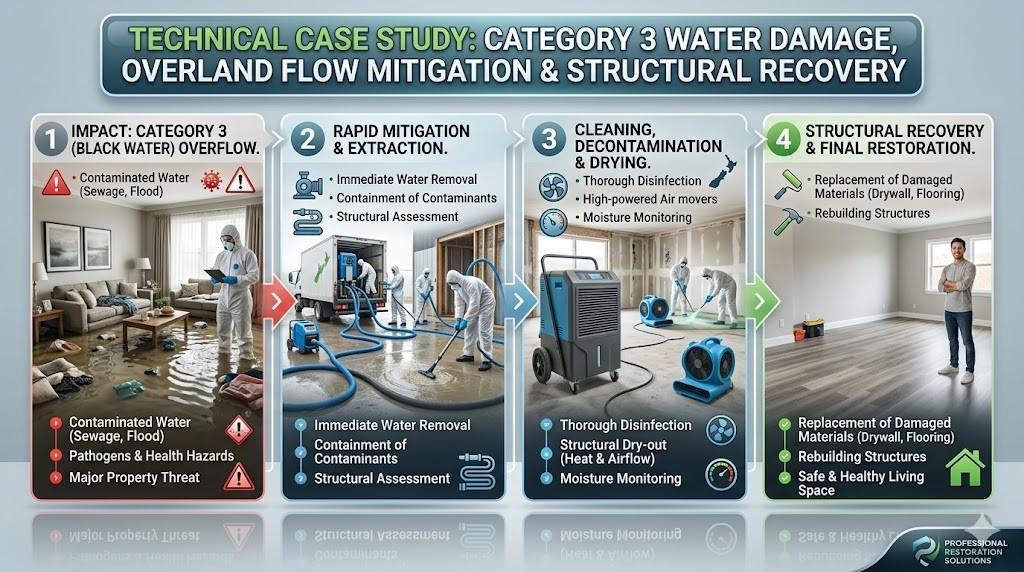
1. Executive Summary & Incident Profile
Loss Location & Environmental Context
In the wake of an extreme meteorological event causing localized stormwater network failure, a significant volume of surface runoff impacted low-lying valley catchments across West Auckland (including Swanson, Henderson, and Ranui) and South Auckland (Māngere). The impacted properties—consisting of residential footprints and light commercial assets—suffered rapid-onset inundation. This structural casing outlines the successful stabilization and targeted restoration of a representative structural footprint within these high-risk zones.
Structural & Biohazard Classification
Under the IICRC S500 Standards for Professional Water Damage Restoration, this event was classified as a Category 3 (Black Water) loss, combined with a Class 4 complexity rating due to deeply bound moisture within porous structural framing and low-evaporation materials.
The invading overland flow carried high concentrations of structural silt, urban chemical runoff, and pathogenic raw sewage.
Unlike Category 1 (clean) or Category 2 (grey) water, a Category 3 event presents an immediate biohazard threat, including coliform bacteria, E. coli, and enterovirus strains. Moisture bound within the timber framing threatened long-term structural degradation if equilibrium was not rapidly restored.
The Insurance & Mitigation Objective
The primary mandate for this intervention was minimizing the total cost of indemnity while fulfilling statutory obligations under the New Zealand Building Code. Traditional, unscientific “strip-and-rip” strategies often result in total structural demolition, lengthy tenant displacement, and massive landfill fees.
By executing an advanced, targeted decontamination and desiccation methodology, the mitigation team sought to preserve the structural timber core, prevent catastrophic secondary mold germination (Aspergillus/Stachybotrys), compress the claims cycle, and deliver a certified, BRANZ-compliant structure ready for reinstatement.
2. Initial Site Assessment, Biohazard Containment & Risk Management
Establishing the Containment Zone and Health & Safety Protocols
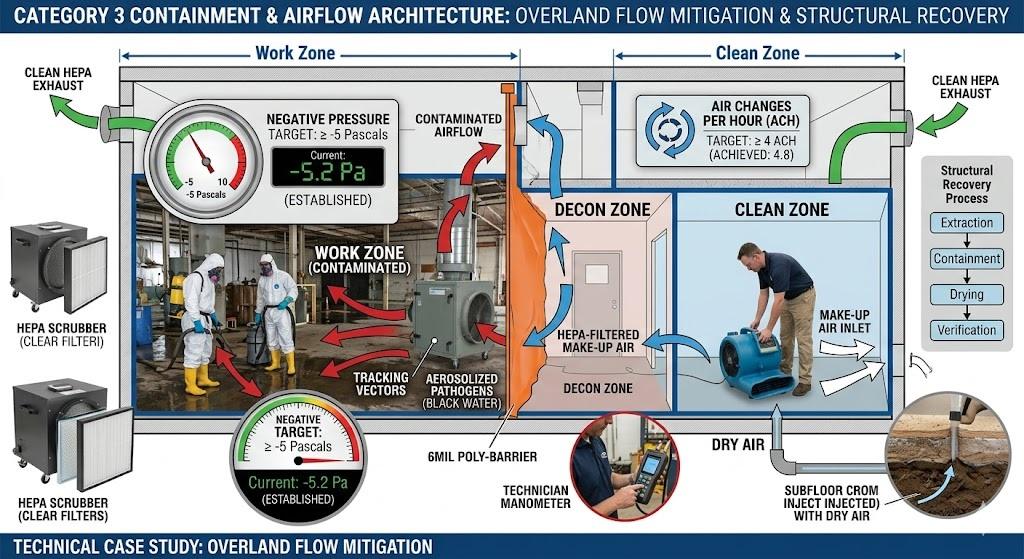
Pathogen Isolation & Engineering Controls
Before any mechanical extraction or demolition commenced, engineering controls were deployed to isolate the biohazard zone. Technicians erected physical 200-micron polyurethane critical barriers between the contaminated zones and unaffected spaces.
Air Filtration Devices (AFDs) equipped with certified HEPA filtration were installed to establish negative pressure relative to surrounding environments, maintaining a continuous target pressure differential of negative 5 Pascals or greater. This negative pressure vector ensured that airborne pathogens and fungal spores could not migrate into unaffected interstitial cavities or adjacent tenancies.
The system was configured to deliver a minimum of 4 Air Changes per Hour (ACH), continuously purging the workspace volume through high-efficiency particulate air loops.
PPE and Licensed Building Practitioner (LBP) Oversight
All personnel operating within the hot zone were equipped with Level C Personal Protective Equipment (PPE), including impervious Tyvek suits, double-gloved nitrile barriers, and full-face respirators with P3 particulate/organic vapor cartridges in strict compliance with the Health and Safety at Work Act (HSWA).
Because the structural framing represents the primary load-bearing assembly of the building, a Licensed Building Practitioner (LBP) oversaw the assessment phase to ensure that structural integrity was monitored continuously during the high-velocity runoff evaluation.
3. Decontamination & Heavy Extraction Phase
Executing the Multi-Stage Black Water & Silt Extraction Protocol
Category 3 silt deposits form a dense, low-permeability layer over building materials. If allowed to dry untreated, this silt binds to the timber grain, locking in pathogens and sealing moisture within the wood.
The mitigation protocol required immediate mechanical extraction of bulk mud, sludge, and liquid contaminants using heavy-duty sub-surface extraction units linked to truck-mounted waste systems. All extracted black water was manifested and disposed of at licensed hazardous waste facilities in accordance with Auckland Council trade waste regulations.
Biocide Application & Pathogen Neutralisation
Following bulk extraction, all exposed architectural and structural elements underwent an initial sanitation pass. A broad-spectrum, EPA-approved antimicrobial agent (quaternary ammonium compound mixed with a phenolate synergist) was applied via low-pressure flushing systems. This initial pass reduced the viable pathogen load, bringing the workspace down to a manageable sanitary baseline so that controlled demolition could proceed without putting technicians at extreme biological risk.
Technical Compliance Note
Antimicrobial applications on Category 3 losses must never be used as a substitute for physical cleaning. Biocides are designed to neutralize pathogens on contact, but they cannot penetrate dense silt layers or treat hidden interstitial spaces. Mechanical removal of the organic soil load remains the mandatory prerequisite for true sanitization under IICRC S500 guidelines.
4. Controlled Demolition & Flood-Line Strip Out
Precision Architectural Strip-Out to Minimize Structural Indemnity Costs

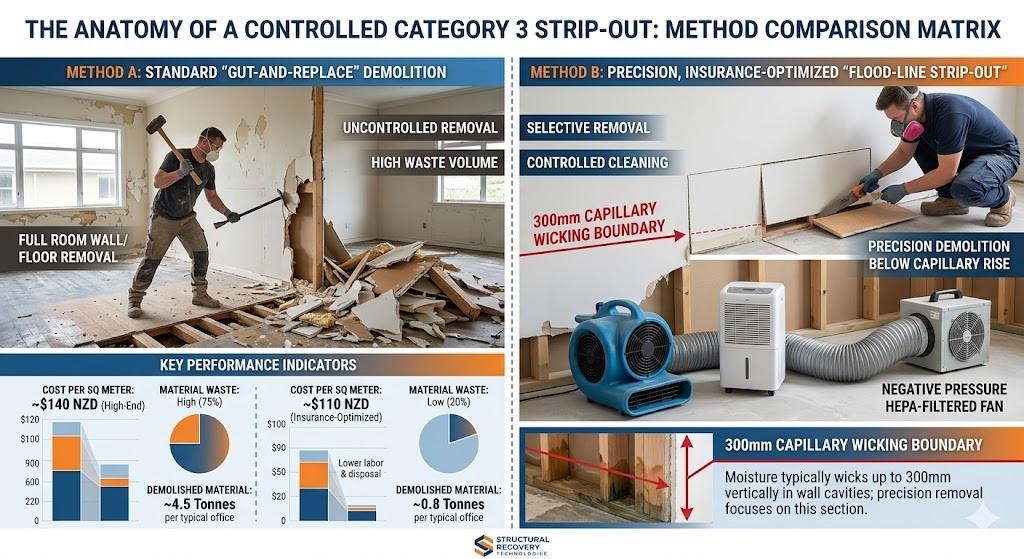
The 300mm Flood-Line Rule for Soft Materials
Porous building materials contaminated by Category 3 water cannot be dried in place due to the permanent retention of pathogens within their matrix. A strict demarcation line was established exactly 300mm above the highest visible flood line. This 300mm boundary accounts for the capillary action (wicking) of moisture upward through internal plasterboard linings and porous insulation.
Plasterboard, skim coats, and porous glasswool or outdoor batts insulation below this line were systematically cut away using dust-controlled plunge saws.
Preserving the Structural Framing Core
Unlike porous wall linings, structural timber framing (typically H1.2 treated Radiata Pine in New Zealand construction) is semi-porous and can be safely restored via deep decontamination and controlled thermodynamic drying.
Technicians meticulously separated non-structural linings from the load-bearing studs, plates, and nogs. By avoiding a blind “gut-and-replace” approach, the framing core was left completely intact. This prevented the need for costly structural propping and temporary council building consents, saving tens of thousands of dollars in structural reinstatement engineering fees.
5. Structural Drying & Equilibrium Moisture Content (EMC) Realignment
Advanced Thermodynamics & Desiccant Drying Profiles for Structural Timber
Once the framing was exposed and pressure-washed with a secondary biocide rinse, the structural drying phase commenced. Standard Low-Grain Refrigerant (LGR) dehumidifiers are highly inefficient when timber Moisture Content (MC%) drops below the fiber saturation point in cold or highly saturated Auckland valley microclimates. Therefore, industrial Desiccant Dehumidification Packages were deployed.
Desiccant dehumidifiers utilize a silica gel rotor to physically adsorb moisture from the air, delivering ultra-low specific humidity (grains per pound) and an exceptionally low Relative Humidity (RH% below 10%). This processed air creates a steep Vapor Pressure Differential between the saturated core of the timber framing and the ambient containment air.
This is achieved because the Vapor Pressure Differential equals the vapor pressure of the material minus the vapor pressure of the air. By lowering the vapor pressure of the air to near-zero, moisture bound deep within the 100 x 50mm framing studs was drawn to the surface via capillary action and evaporated rapidly.
Micro-Climate Engineering with High-Velocity Air Movers
To accelerate this boundary-layer evaporation, axial and radial air movers were configured to deliver high-velocity, laminar airflow directly across the exposed timber plates and studs. Air movers were placed at 45-degree angles to maximize static pressure against the timber surfaces without creating dead zones in the wall cavities. The ambient temperature within the containment envelope was engineered to remain between 25°C and 32°C, optimizing the kinetic energy of the water molecules bound within the wood matrix.
6. Compliance, Verification & Sign-Off
Meeting BRANZ Standards and Achieving Structural Sign-Off
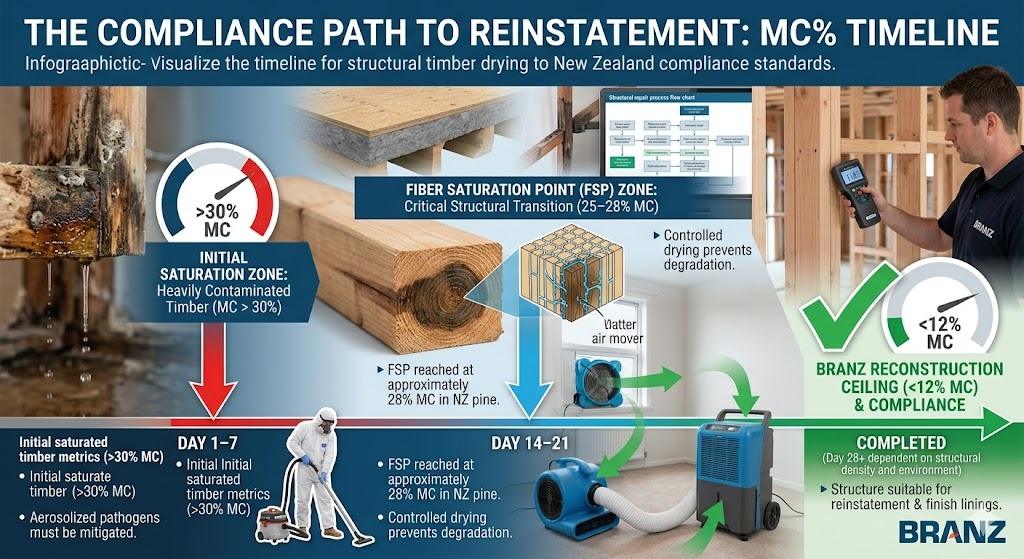
Quantitative Moisture Logging
To ensure transparency for the loss adjuster, moisture monitoring points were established across the structure. Daily readings were logged using insulated deep-wall pin probes driven into the core of structural bottom plates and stud bases, where moisture accumulates heaviest.
The BRANZ Compliance Threshold
Under Acceptable Solution E2/AS1 and general BRANZ (Building Research Association of New Zealand) compliance guidelines, timber framing must not be enclosed or insulated until its Moisture Content is confirmed to be under 12% MC%. Re-lining a wall cavity when the framing exceeds this threshold locks in moisture, causing structural rot, fastener corrosion, and eventual failure of the internal lining due to timber movement.
The desiccant array successfully brought all structural timber tracking down from an initial reading of greater than 32% MC down to a uniform, verified baseline of less than 11.5% MC, satisfying all local regulatory criteria.
Post-Remediation Verification (PRV)
To guarantee occupant safety and release insurer liability, a third-party environmental hygienist conducted a Post-Remediation Verification (PRV) clearance. This involved:
-
Adenosine Triphosphate (ATP) Surface Swabbing: Testing exposed framing surfaces to verify the absolute removal of biological matter (target score: $< 30$ RLU).
-
Airborne Fungal Sampling: Comparing indoor fungal spore counts against outdoor baselines to confirm no elevation of hazardous mold genera (Aspergillus/Penicillium).
Clearance certificates were formally issued, validating that the environment was sanitary and structurally sound.
7. Financial & Risk Mitigation Review
Actuarial Analysis: Mitigation vs. Total Replacement Deficit
To demonstrate the fiscal efficacy of this scientific intervention, the table below outlines the actual financial and operational metrics recorded on this project versus the traditional, unmanaged demolition strategy typically applied by uncertified contractors.
| Operational & Financial Metrics | Targeted Structural Drying Methodology (Actual) | Traditional “Strip-and-Rip” Demolition (Projected) |
| Structural Timber Framing | Preserved & Decontaminated in-situ | Removed, Sent to Landfill, Re-framed |
| Council Consent Required? | No (Structural integrity maintained) | Yes (Structural framing replacement) |
| Average Drying / Stripping Time | 5 Days | 21 Days (Including structural framing lead times) |
| Class 4 Interstitial Secondary Damage | 0% Incidence Rate (Prevented via Desiccant) | High Risk (Delays allow mold to bloom) |
| Total Indemnity Outlay ($NZD) | $18,500 | $68,000 |
| Tenant Displacement / BI Claims | 7 Days Total | 45–60 Days (Awaiting consents & builders) |
Secondary Damage Prevention
By deploying desiccant dehumidifiers immediately upon establishing containment, the vapor pressure was dropped fast enough to halt the germination cycle of mold spores, which typically triggers within 24 to 48 hours under high RH conditions. Insurers avoided a secondary mold remediation claim, which can easily double initial restoration costs.
Claims Cycle Compression
By compressing the emergency mitigation phase into a tight 5-day window, alternative accommodation costs and Business Interruption (BI) liabilities were minimized. The property manager received a certified, structurally sound, and sanitary asset ready for immediate reinstatement, protecting the insurer’s bottom line and proving the undeniable value of scientific drying protocols.
Key Insurance Takeaway
Spending money early on advanced desiccant drying and certified structural technicians prevents catastrophic claims inflation down the road. Every dollar invested in immediate engineering controls, negative air architecture, and thermodynamic moisture extraction yields significant savings by avoiding structural re-framing consents, reducing landfill volume, and cutting tenant business interruption cycles by up to 85%.