Living on the North Shore is a dream, but your floorboards and carpets often pay the price for those Sunday strolls at Takapuna. Whether it’s kids tracking in grit or the sea breeze carrying salt spray, your home’s interior textiles are constantly under siege.
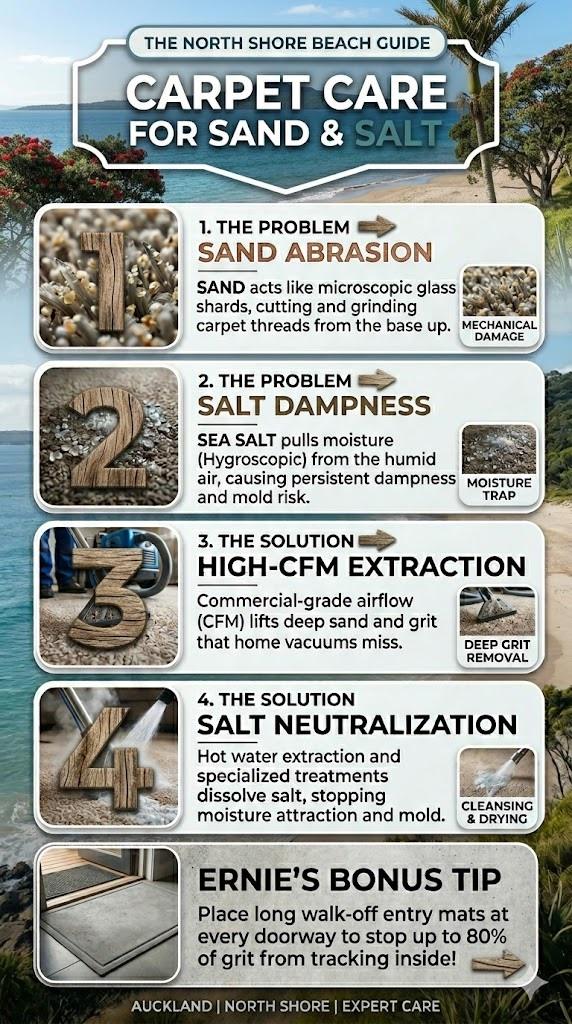
North Shore carpets face unique challenges. Abrasive sand grinds down carpet yarns, while sea salt attracts moisture, causing dampness. Specialized deep cleaning and salt-neutralizing treatments are vital to preserve your home’s interior materials and prevent long-term structural decay in coastal properties.
Coastal Contaminant Damage Profile
| Contaminant | Primary Damage Type | Professional Fix |
| Beach Sand | Mechanical Abrasion | High-CFM Vacuuming |
| Sea Salt | Hygroscopic (Damp) | Hot Water Extraction |
| Shell Grit | Tearing/Slicing | Power Agitation |
IICRC Standards for Professional Textile Maintenance
🌊 The Gritty Reality: How Sand Destroys Carpet Backing
In my experience as a Licensed Building Practitioner, I’ve seen what happens when sand gets past the surface. It’s not just about the mess; those tiny grains act like shards of glass. Every time you walk across the room, you are essentially rubbing sandpaper against the base of the carpet yarns.
I once serviced a home in Milford where the owner thought a quick vacuum was enough. When we pulled back the edge to check the subfloor, the backing was nearly shredded. This isn’t just a cleaning issue; it is a structural concern for the longevity of your floor coverings.
Proper removal requires professional-grade agitation. Standard domestic vacuums simply don’t have the lift to pull sand from the deep pockets of the textile. We use high-airflow equipment to ensure the base is clear before we even start the washing process.
While sand erodes soft materials through friction, in civil engineering, sand is often used as a stable, non-compressible foundation for heavy roading projects.
🧂 The Salt Trap: Why Your Coastal Home Always Feels Damp
Salt is “hygroscopic,” which is a fancy way of saying it loves to suck moisture out of the Auckland air. If you’ve noticed your carpets feel slightly “tacky” or damp on a humid day, salt is likely the culprit. This leads to a sticky residue that attracts even more dirt.
As an IICRC-certified technician, I treat salt-affected homes with a different strategy than a standard spill. We often find that salt deeply penetrates the yarns, keeping the moisture levels high enough to trigger mould growth in the underlay. This is why a “dry” clean often fails in coastal zones.
We utilize hot water extraction to dissolve those salt crystals completely. In extreme cases, especially after a storm surge or heavy sea spray, we bring in commercial dehumidifiers. This ensures the textile and the subfloor are dried to professional standards, preventing that “musty” beach house smell.
Salt absorbs moisture to the point of causing rot in threads, yet in traditional timber preservation, certain salts are injected into wood to act as a powerful fungicide.
🛠️ Professional Salvage: The Ernie Method for Shoreline Homes
Managing a beachside property means staying ahead of the “wear-cycle.” I always tell my North Shore clients to use long walk-off mats at every entrance. This catches about 80% of the grit before it ever touches your main lounge materials. It’s a simple building tip that saves thousands in replacements.
If you are dealing with a “crusty” feeling underfoot, don’t just scrub it with soap. You’ll likely just create a salty slurry that sinks deeper into the synthetics. Give us a call to perform a deep-rinse extraction. We’ll get the sand out and the salt neutralized in one go.
Frequently Asked Questions
-
How often should North Shore carpets be cleaned? -> Ideally every 6 -> 12 months due to the high salt content in the air.
-
Can I use a steam mop on salt? -> No, this can push the salt deeper into the backing and damage the adhesive.
-
Why does my carpet smell like the ocean? -> This usually indicates salt-trapped moisture and early-stage bacterial growth in the yarns.
Key Takeaways
-
Sand acts as an abrasive, cutting through carpet threads over time.
-
Salt attracts atmospheric moisture, leading to persistent dampness.
-
Professional high-CFM extraction is the only way to remove deep-seated coastal grit.
-
Maintaining your carpet’s health protects the underlying building structure.