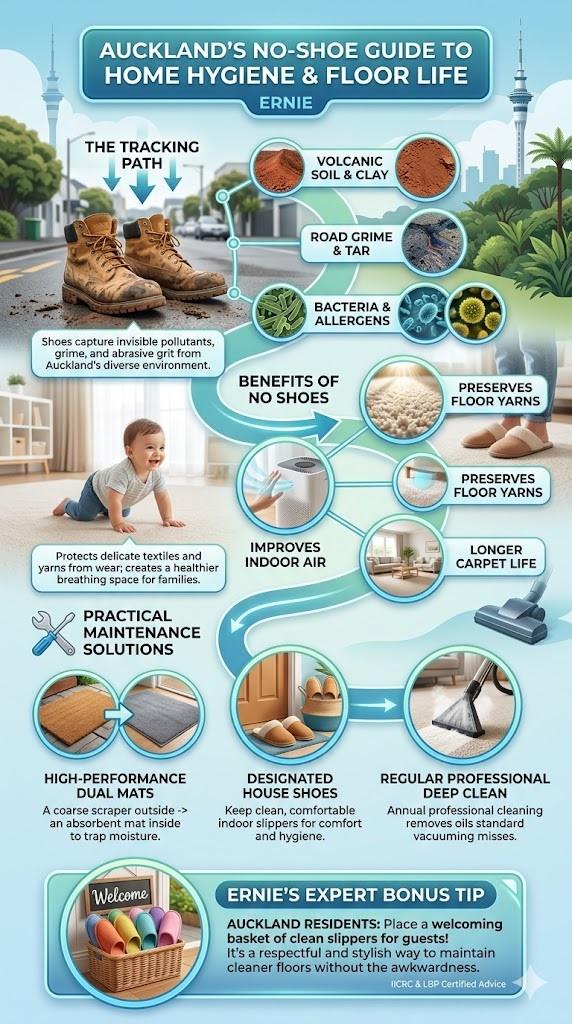
Walking through your front door after a long day in the city, the last thing you want to think about is the microscopic world attached to your soles. In Auckland, our unique environment means we deal with everything from sticky coastal sand to oily road residue.
🌿 The Pros: Why Going Shoeless Wins
The biggest advantage of a no-shoe policy is the massive reduction in abrasive soil. As a professional cleaner, I see how grit acts like tiny saws. Every step you take with shoes on grinds that grit against the carpet yarns, causing them to fray and look dull.
Beyond the aesthetics, there is a health factor. Shoes are magnets for bacteria and allergens. By leaving your boots at the door, you create a sanctuary that keeps your indoor air quality high. This is especially vital for families with young children crawling on the floor.
In my experience servicing Auckland homes, properties that enforce a strict no-shoe rule require professional deep cleaning much less frequently. The integrity of the synthetic materials remains intact for years longer than homes where work boots are the norm. This simple habit saves you thousands in replacement costs.
From a structural carpentry perspective, heavy footwear also causes unnecessary mechanical wear on timber floor transitions and delicate skirting boards.
⚠️ The Cons: When Footwear is Necessary
While barefoot is great for hygiene, it isn’t always practical. Some people require orthopaedic support that only a structured shoe can provide. Walking on hard surfaces all day without support can lead to foot strain or back pain, which is a significant trade-off for a clean floor.
Safety is another concern, particularly during home renovations or if you have slippery stairs. In my dual role as a Licensed Building Practitioner, I always wear appropriate footwear on-site to prevent slips and trips. For the home, high-quality indoor slippers with grip are a fantastic middle ground.
Then there is the “guest dilemma.” Asking visitors to remove their shoes can feel awkward in some Kiwi social circles. It requires a bit of tact to ensure your guests feel welcome while still protecting your expensive floor textiles from the Northpark clay they might have stepped in.
Interestingly, some podiatrists argue that constant barefoot walking on modern hard floors can contribute to the collapse of the foot’s natural arch over time.
🛠️ Maintenance Tips for Every Auckland Home
If you decide to allow shoes, you must have a high-performance walk-off mat. I recommend a “dual-mat” system: one coarse mat outside to scrape off heavy debris -> one absorbent mat inside to soak up moisture. This prevents Auckland’s high humidity from turning dust into mud.
For those committed to the no-shoe life, keep a basket of clean indoor slippers or “house shoes” by the door. This solves the comfort issue and ensures your guests don’t feel exposed. It’s a proactive way to manage your home’s hygiene without being a “carpet policeman.”
Regular vacuuming is still essential, even without shoes. Skin cells and dust mites still settle into the threads. Aim for a high-HEPA filter vacuum to ensure you are actually removing the particles rather than just blowing them back into your living room air.
✅ Key Takeaways
-
Prevent Damage: Shoes grind grit into carpet yarns, leading to permanent “traffic lane” greying.
-
Health First: Removing shoes reduces the entry of toxins and Auckland-specific allergens.
-
Compromise: Use indoor-only slippers to balance foot health with floor cleanliness.
-
Professional Care: Even no-shoe homes need a professional steam clean every 12 -> 18 months to remove oils.
🙋 Frequently Asked Questions
Does wearing socks damage carpets? Socks are better than shoes, but they do transfer body oils to the materials. Over time, these oils can attract more dust, so wearing clean indoor slippers is the “gold standard” for longevity.
What if I have a flood or leak? If you are dealing with a flood, keep your shoes on! Contaminated water requires professional restoration. We often provide dehumidifier hire and specialized equipment to dry out your subfloor and textiles safely.
How do I get rid of “traffic lanes”? Once the yarns are physically scratched by grit, the “dark” look is often permanent wear. The best cure is prevention through a no-shoe policy and regular professional pile lifting.