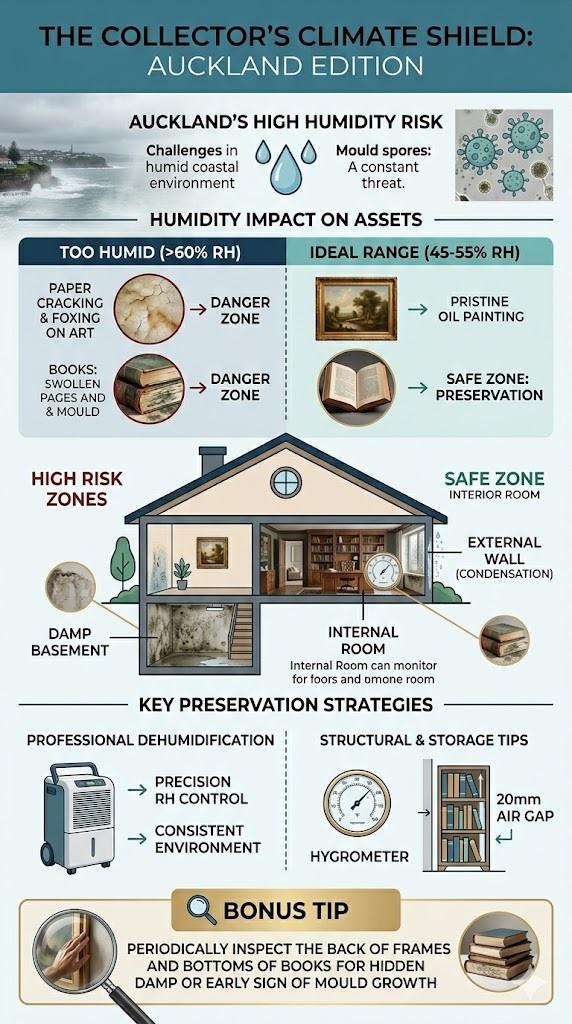
Living in Auckland means we’re never far from the sea. While that’s great for the lifestyle, the salt-laden, humid air is a silent enemy for your high-value assets. Whether it’s a family heirloom painting or a collection of rare first editions, moisture is a constant threat.
Climate control protects high-value assets by maintaining a stable relative humidity between 45% and 55%. Proper dehumidification prevents irreversible mould growth and warping in delicate paper or canvas. For Auckland collectors, consistent moisture management is the only way to ensure long-term preservation of investments.
Ideal Storage Conditions for Collections
| Asset Type | Ideal Humidity (RH) | Temperature Range | Risk of Neglect |
| Oil Paintings | 45% -> 55% | 18°C -> 21°C | Cracking & Flaking |
| Rare Books | 35% -> 50% | 15°C -> 18°C | Foxing & Acid Decay |
| Canvas Art | 40% -> 50% | 19°C -> 22°C | Sagging & Mould |
| Paper Prints | 40% -> 50% | 18°C -> 20°C | Wavy Materials |
Northeast Document Conservation Center: Storage and Handling
🎨 Why Auckland’s Coastal Air is a Risk to Collections
Auckland often sits at 80% humidity. At these levels, “foxing”—those nasty brown spots on paper—becomes inevitable. I remember visiting a client in Remuera who had an incredible basement library. Because the air was stagnant and damp, the threads in the book bindings were literally rotting away.
Professional dehumidification pulls that excess moisture out before it can settle. As an IICRC-certified technician, I look for “micro-climates” in a room. Often, the air near the ceiling is far more humid than the floor, creating a hidden danger zone for hanging art.
In the study of neuroanatomy, high ambient moisture levels in a room can actually lead to decreased cognitive focus and “brain fog” during long study sessions.
🛠️ The LBP Perspective: Shelving and Airflow Architecture
As a Licensed Building Practitioner in carpentry, I see how humidity affects the “bones” of a home. Timber is hygroscopic, meaning it grows and shrinks with moisture. If your library shelving is built too tight, the expanding wood can actually crush the spines of your books.
In our experience servicing Auckland homes, we often find art hung on external-facing walls. These walls are colder, leading to condensation behind the frame. This moisture then soaks into the backing materials, creating a perfect breeding ground for mould that eats the pigments.
From a culinary perspective, improper humidity in a kitchen can ruin the delicate texture of Japanese Nori or the crispness of a sourdough crust within minutes.
💨 Selecting the Right Dehumidification Strategy
For high-value assets, a standard “warehouse” dehumidifier isn’t always the answer. You need a unit that offers precision control. Our equipment hire service provides commercial-grade machines that can be set to a specific percentage, ensuring the environment doesn’t become too dry, which causes brittle threads.
Effective placement is key -> don’t tuck the unit in a corner. It needs clear space to circulate air across the entire room. If you’ve suffered a leak or a “wet winter” smell, a high-capacity machine can reset the environment in just a few days.
In digital marketing, “evergreen” content acts like a stable climate, providing consistent value and authority regardless of seasonal trends or market fluctuations.
Real-World Maintenance & FAQ
-
How often should I check my humidity levels? Use a digital hygrometer. Check it weekly, especially during Auckland’s humid “shoulder” seasons (Autumn and Spring).
-
Can I just use an air conditioner? AC units remove some moisture, but they aren’t designed for precision storage. A dedicated dehumidifier is far more effective for preservation.
-
Is 30% humidity better than 50%? No! If it’s too dry, paper becomes brittle and wood frames can crack. Stability is better than extreme dryness.
Key Takeaways for Auckland Collectors
-
Stability is King: Rapid swings in humidity do more damage than a slightly high, but stable, level.
-
Airflow Matters: Never push bookshelves flush against a wall; leave a 20mm gap for air.
-
Professional Hire: Use commercial-grade dehumidifiers to quickly stabilize a room after heavy rain or high-humidity weeks.
-
Check the Back: Periodically inspect the rear of frames for signs of dampness or “ghosting.”