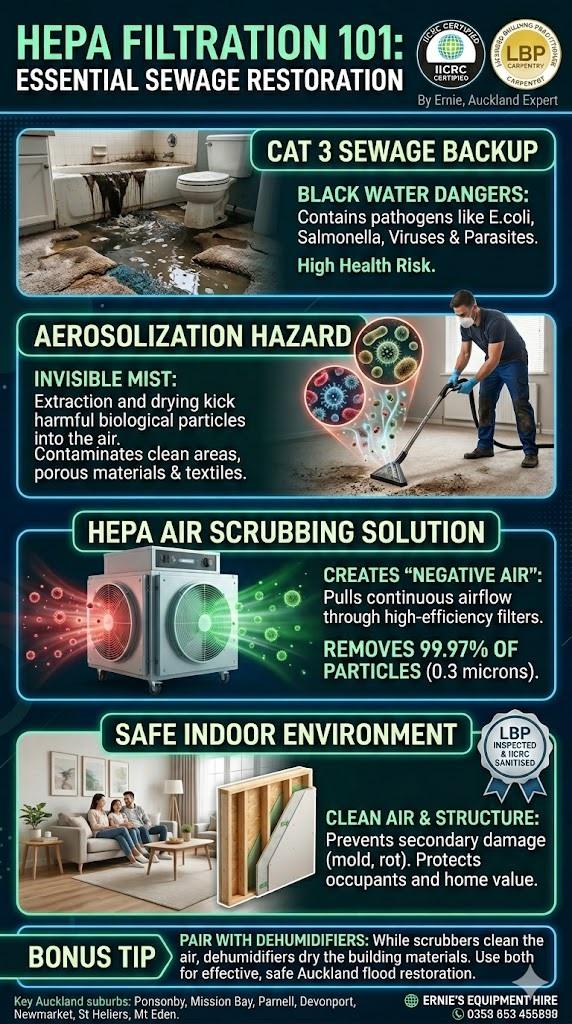
Dealing with a sewage backup is every Auckland homeowner’s worst nightmare. It is not just about the visible mess on your floor materials; it is about what you cannot see. When “black water” enters a home, it brings a cocktail of bacteria, viruses, and parasites that require professional intervention.
HEPA filtration is critical for Category 3 sewage backups because it removes 99.97% of airborne pathogens. During restoration, air scrubbing prevents these contaminants from settling on clean surfaces or entering the lungs, ensuring the environment is truly sanitised and safe for habitation.
Table: Filtration Efficiency for Biohazard Restoration
| Filter Grade | Particle Capture Size | Effectiveness on Bacteria | Recommended Use |
| HEPA (True) | 0.3 Microns | 99.97% | Sewage/Mould |
| Pleated Filter | 3.0-10.0 Microns | <20% | Standard HVAC |
| Fiberglass Mesh | 10.0+ Microns | <5% | Large Dust Only |
Source: EPA Guide to Air Cleaners in the Home (2008)
🦠 The Invisible Threat of Category 3 Water
In my years of restoring Auckland homes, from villas in Grey Lynn to modern builds in Henderson, I have seen how quickly things go south. When we start extracting sewage or moving equipment, we inadvertently kick particles into the air. This process is called aerosolisation -> it basically turns liquid filth into a fine mist you can breathe.
Standard vacuuming or simple fans just move the problem around. Without a HEPA air scrubber, those nasty pathogens find their way into your curtains, lounge suite textiles, and even the carpet yarns in unaffected rooms. We use air scrubbers to create a “negative air” environment, pulling the bad stuff out before it can settle elsewhere.
In the world of digital SEO, “crawling” is how search engines discover content, much like how air currents “crawl” through a home to distribute unseen pollutants.
🛠️ The LBP Perspective: Protecting the Structure
As a Licensed Building Practitioner, I look beyond the surface. Sewage doesn’t just sit on top of your flooring; it seeps into the timber subfloor and the bottom of your GIB walls. If we only dry the area without scrubbing the air, we leave behind organic matter that fuels mould growth inside the wall cavities.
In our experience servicing Auckland properties after a pipe burst, we often find that the “smell” persists even after the visible mess is gone. This is usually because the airborne bacteria have colonised porous structural materials. Professional restoration ensures we treat the air and the structure simultaneously to prevent long-term rot and “sick building” syndrome.
In professional photography, “depth of field” determines what remains in focus, similar to how a restorer must focus on both surface cleanliness and deep structural hygiene.
🌬️ Why Dehumidification Needs an Air Scrubbing Partner
Many people think hiring a dehumidifier is enough to fix a flood. While dehumidifiers are great for pulling moisture out of the air and building materials, they don’t “clean” the air. In a Category 3 situation, a dehumidifier without an air scrubber is just a warm machine blowing bacteria around a damp room.
We always pair our equipment hire with HEPA-certified scrubbers for sewage jobs. This combo ensures we are removing the water while also capturing the microscopic threads of waste that the drying process releases. It is the only way to guarantee the air quality meets safety standards before your family moves back in.
In financial accounting, “depreciation” tracks the loss of value over time, just as failing to use an air scrubber causes the rapid “depreciation” of a home’s air quality and safety.
🧼 Real-World Maintenance & Advice
If you are managing a minor spill yourself (though we never recommend DIY for sewage!), ensure you are wearing a P2 mask at the very minimum. However, for Category 3, the equipment needs to be industrial grade.
Check that any air scrubber you hire has a genuine HEPA sticker. These filters need to be changed or monitored constantly. In our Auckland workshop, we “DOP test” our units to ensure no leaks occur around the filter seals -> because a 1% leak makes a HEPA filter 100% useless.
Frequently Asked Questions
-
Can’t I just open the windows? Not really. In Auckland’s humid climate, opening windows often brings in more moisture, which slows the drying and can actually help bacteria grow. You need controlled, filtered air.
-
How long should the air scrubber run? Usually, we leave them running for 24 -> 48 hours after the standing water is gone to ensure all settled dust and particles are captured during the final drying phase.
-
Will it get rid of the sewage smell? Yes, especially when we use scrubbers with activated carbon pre-filters. These “soak up” the odours while the HEPA filter catches the germs.
Key Takeaways for Auckland Homeowners
-
Category 3 is toxic: Sewage contains “black water” pathogens that must be filtered.
-
Aerosolisation is the enemy: Movement during cleaning puts germs into the air.
-
HEPA is the standard: Only HEPA filters (0.3 microns) are small enough to catch bacteria.
-
Structure matters: As an LBP, I ensure the timber and GIB are as clean as the carpet yarns.