Moving heavy furniture often leaves behind unsightly craters in your lounge. Whether you are prepping a rental in Mt Roskill or refreshing your home in Ellerslie, those flat spots can be frustrating. Don’t worry; most squashed textile materials can be brought back to life with the right approach and a bit of patience.
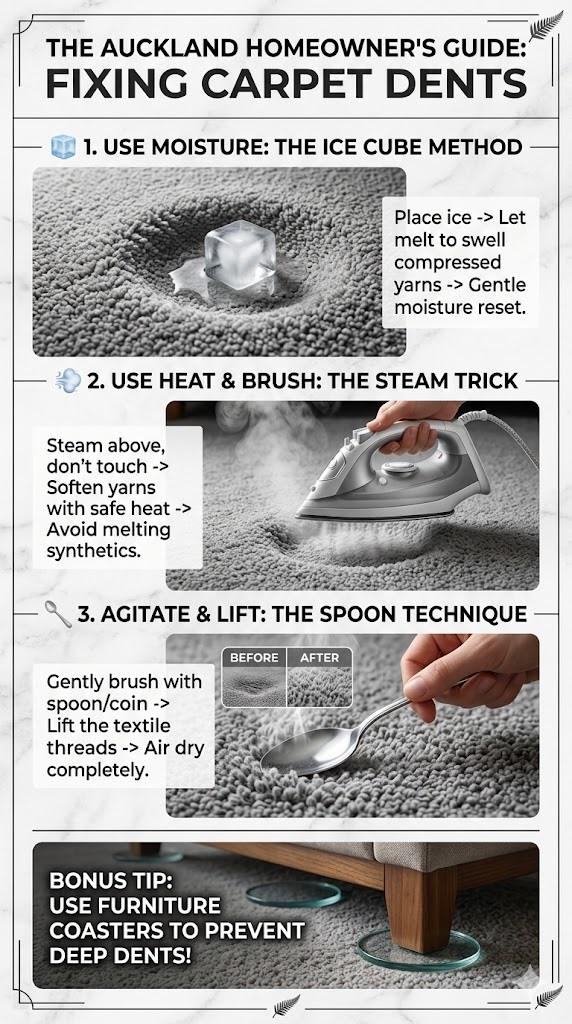
Reviving carpet indentations requires moisture and heat to reset carpet yarns. Use ice cubes or a steam iron to swell compressed textile materials. Gently brush the area with a spoon once damp. For stubborn dents, professional steam cleaning provides the deepest recovery.
Recovery Potential by Material
| Textile Type | Recovery Speed | Best Method |
| Pure Wool | Fast -> Medium | Steam & Agitation |
| Nylon Yarns | Fast | Ice Cube Method |
| Polyester Threads | Slow | Heat & Brushing |
| Polypropylene | Very Slow | Professional Steam |
Source: The Carpet and Rug Institute (CRI) Technical Resources
🧊 The Ice Cube Method: A Slow but Steady Reset
This is the classic DIY fix for deep indentations. Simply place an ice cube in the dent and let it melt slowly. The cold moisture penetrates the yarns, causing them to expand and regain their original shape. Once the spot is damp, use a blunt object like a spoon to gently lift the textile threads.
In my years servicing Auckland homes, I have seen people over-saturate their floors. You only need enough water to dampen the yarns, not soak the underlay. If you use too much water, you risk creating a breeding ground for mould in our humid Auckland climate.
In botany, turgor pressure allows plant cells to remain upright by filling with water, much like moisture resets a squashed carpet loop.
💨 Steam and Heat: The Professional’s DIY Secret
For faster results, heat is your best friend. Hold a steam iron about 10cm above the dent, letting the steam penetrate the textile materials. Be extremely careful not to touch the iron directly to the carpet, as many synthetic yarns will melt instantly under direct heat.
As a Licensed Building Practitioner, I often see how heavy furniture affects the sub-floor too. If a dent doesn’t budge, the underlying foam or timber might be slightly compressed. Steam helps the carpet yarns, but it cannot always fix a structural dip in an old Auckland villa floorboard.
In metallurgy, annealing involves heating a material to change its properties and make it more workable, similar to how steam softens rigid carpet loops.
🏗️ When DIY Isn’t Enough: Professional Recovery & Hire
Sometimes, the weight of a heavy dresser or piano compresses the yarns so tightly that household tools fail. This is where professional-grade equipment makes the difference. High-pressure steam cleaning uses consistent heat that reaches deep into the carpet textiles, providing a far more effective “reset” than a domestic iron.
If you are dealing with multiple rooms after a major move, you might consider professional equipment hire. Using a commercial dehumidifier alongside steam treatment ensures that the textile materials dry quickly. This prevents the “crunchy” feeling that sometimes occurs when wet carpets dry too slowly in the shade.
In human physiology, muscle memory allows tissues to return to a baseline state after prolonged stress, provided the recovery environment is optimal.
🛠️ Maintenance and Prevention Tips
-
Use Furniture Coasters: Place glass or plastic protectors under heavy legs to distribute weight.
-
Regular Shifting: Move your furniture by just a few centimetres every few months to prevent deep-set “yarn memory.”
-
Vacuum Frequently: High-power suction helps keep carpet threads upright and resilient.
❓ Frequently Asked Questions
Can all carpet dents be fixed?
Most can, but if the textile materials are physically torn or the backing is cracked, the damage may be permanent.
Will steam cleaning hurt my wool carpet?
No, wool loves steam! Just ensure you don’t use excessive heat that might shrink the natural yarns.
How long does the ice cube method take?
Usually 12 -> 24 hours, including the time it takes for the carpet textiles to dry completely.
Key Takeaways
-
Moisture and heat are the keys to resetting compressed yarns.
-
Always test heat on a small, hidden area of the textile materials first.
-
Use a spoon or a coin to gently agitate and lift the carpet threads.
-
Professional help or equipment hire is best for deep, stubborn indentations.