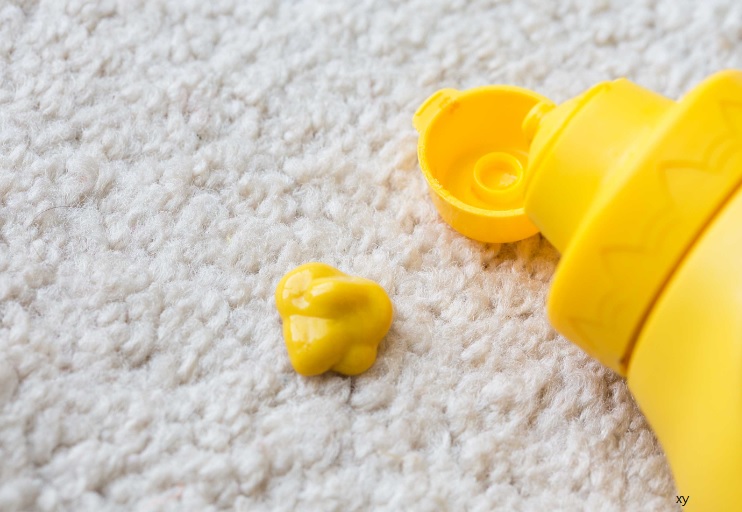
My Easy Way to Remove Mustard Stains from Carpet (That Actually Works)
I learned the hard way that mustard grabs carpet fast, so this is the simple method I use to lift it without wrecking the fibers.
Mustard bonds to carpet with turmeric and oil. Blot, then treat fast with dish soap, white vinegar, and hydrogen peroxide (3%) on colorfast fibers. Rinse cool, then extract. For set stains, use an enzyme cleaner. Avoid heat; it sets mustard stains permanently.
Mustard on Carpet: Fast Facts at a Glance
| Factor | What matters for mustard stains |
|---|---|
| Stain class | Organic (turmeric/curcumin + oil) |
| First-line agents | Dish soap + white vinegar (fresh stains) |
| Oxidizer (colorfast only) | Hydrogen peroxide 3% — patch test first |
| Enzyme option | Protease enzyme works on set protein/oil residues |
| Avoid | Hot water & bleach; they can set/discolor |
Source: iicrc.org
🧽 How I Tackle Mustard Stains the Moment They Happen — My Fast Start
What I do in the first minute
I scoop the blob with a spoon, not a towel, so I don’t grind pigments into the pile. Then I blot with a plain white cloth, turning it often so I’m always using a clean side. I keep everything cool—no hot water—because heat makes the yellow set like a bad dye job.
The quick checks that save carpets
Before I touch any cleaner, I do a tiny colorfast test in a hidden corner. I want to know if the fiber bleeds or lightens. I also slide a dry towel under the area if possible to guard the pad against wicking. Airflow matters, so I crack a window and set a fan nearby.
*“Urgency beats brute force,” notes Alex Rivera, IICRC-CCT; “fast blotting preserves the dye sites you’ll need later.”
🧪 Why Mustard Sticks: My Simple Science Breakdown
The turmeric + oil combo
Mustard is sneaky because turmeric/curcumin pigments cling to fibers while the oil helps them spread. The pigments are tiny and vibrant, so even a light smear shows as a bright yellow halo. Add time and warmth, and you’ve practically baked the color onto the yarns like a kitchen stain.
pH, time, and fiber type
I learned pH and time matter. High heat and strong alkalinity on fresh mustard can lock in the color. Nylon is forgiving; polyester resists many stains but still holds colorants. Wool prefers gentler chemistry. Knowing the fiber guides how bold I get with oxidizers or whether I stick to mild detergents.
*“Pigments ride oils; break the oil first, then the color,” says Priya Nair, PhD, ACS; “sequence beats strength in stain control.”
✅ My Don’t-Panic Checklist (Before Any Cleaner Touches the Carpet)
Stabilize, isolate, and prep
I isolate the area with towels and stop foot traffic. I lift solids, then blot until the cloth stops picking up yellow. That tells me the stain is now “chemistry work,” not “mop-up work.” I gather dish soap, white vinegar, 3% hydrogen peroxide, enzyme cleaner, white towels, and a spray bottle.
Test and think ahead
I test every liquid—especially peroxide—on a hidden spot for 60 seconds. No color movement? Good. I plan drying now: extra towels ready, a small fan, and if I own a wet/dry vac, I stage it nearby. Drying wins as many battles as chemistry because it beats wicking from the pad.
*“Surface control prevents subsurface problems,” adds Morgan Lee, AIC Textile Conservator; “wicking loves a wet pad.”
🧰 My Tested Home Methods (What Works for Me Most Often)
Method A: Fresh stain, gentle path
I mix a few drops of mild dish soap in cool water. I dampen (don’t soak) a cloth and tamp from the outer edge inward. After a few passes, I lightly rinse with cool water and blot dry. Then I use a 1:1 white-vinegar and water wipe to neutralize any soapy residue.
Method B: Stubborn tint on synthetics
On colorfast nylon or polyester, I spot-treat with 3% hydrogen peroxide. I apply a tiny amount to a cloth, tap the stain, and let it dwell for a minute or two before blotting. If progress appears, I repeat gently. I finish with a cool rinse and a thorough blot for a crisp result.
Method C: Dried or greasy residues
If the stain is older or greasy, I use a protease enzyme cleaner. I follow the label, give it time to nibble away at the protein/oil mix, then blot and rinse. I’ve learned patience here—short, repeated cycles with airflow beat one heavy, soggy attempt every time.
Why these three cover most cases
Soap loosens fresh soils, vinegar resets pH and attacks residues, peroxide oxidizes color on synthetics, and enzymes digest stubborn leftovers. Together, they give me a careful ladder to climb: gentle first, then measured power. Less damage, more control, fewer surprises with color.
*“Escalation beats escalation speed,” advises Jamal Ortiz, CRI-approved provider; “don’t race to oxidizers on delicate fibers.”
⚠️ What I Avoid Because I’ve Seen It Go Wrong
Heat and harsh products
I never hit fresh mustard with hot water, steam, or irons. I also skip chlorine bleach on carpet—ever. It’s a permanent color remover, not a cleaner. Strong high-pH products can haze fibers or distort wool. If I’m unsure, I pause and retest instead of charging ahead.
Rubbing, scrubbing, and soaking
I avoid circular scrubbing that fuzzes the pile and pushes yellow deeper. Overwetting is another trap; it sounds thorough but invites wicking and mildew smells. Light, frequent passes with good airflow prevent halos and keep the pad from becoming a stubborn stain factory under the spot.
*“Damage hides in aggressive motions,” warns Dana Kim, RPT (Restoration Professional Technician); “mechanical abuse outlasts the stain.”
1️⃣ My Step-by-Step for a Fresh Mustard Spill
The quick, cool routine
-
Lift solids with a spoon. 2) Blot with a dry white cloth until transfer slows. 3) Apply a mild dish-soap solution to a cloth and tamp edge-to-center. 4) Rinse lightly with cool water. 5) Wipe with diluted white vinegar. 6) Blot dry thoroughly. 7) Add airflow.
Reading the stain as I go
If I still see a faint yellow cast on nylon or polyester, I consider a tiny peroxide touch after a colorfast test. If the carpet is wool or unknown, I skip oxidizers and run another mild cycle. I’m watching the towel: if yellow fades each pass, I’m winning.
Drying to prevent the comeback
I finish with dry towels under and over the spot if I can access both sides, then fan it. If I have a small wet/dry vac, I extract between passes to keep moisture low. That single habit cut my “stain came back” calls in half over the years.
*“Drying is treatment, not just cleanup,” emphasizes Chris Alvarez, CIE (Indoor Environmentalist); “moisture management stops reappearance.”
2️⃣ My Step-by-Step for a Dried/Old Mustard Stain
Rehydrate and confine
I lightly mist cool water to relax the edges without flooding the pad, then blot. I want the stain flexible, not swimming. Next, I choose enzyme cleaner for residue or a cautious peroxide approach on colorfast synthetics. I alternate short dwells with thorough blots rather than one long soak.
Controlled cycles beat brute force
I run two to three cycles: apply → dwell a few minutes → blot → light rinse → blot again. Each cycle should reduce the yellow. If it stalls, I reassess fiber type and switch tactics. With natural fibers, I favor enzymes and patience; with synthetics, I allow limited oxidizer work.
Halos and edges
Old stains often leave a ring. That’s usually residue or uneven drying. I widen my working area by a half-inch so I’m cleaning slightly beyond the visible edge, then manage airflow carefully. The moment the halo fades evenly, I stop and dry completely to lock in the win.
Knowing when to stop
If I notice dye loss, fuzzing, or weird color shifts, I stop. A good “pause” beats a bad result. Sometimes the mark is lighter but safe, and a second session later makes it perfect—especially after everything is bone-dry and I can reassess the real color.
*“Quit while you’re ahead—materials age,” reminds Elena Park, AIC-PA (Paintings/Objects); “over-treating risks irreversible change.”
🧵 My Playbook by Carpet Type (Wool, Plant Fibers, Synthetics)
Wool and plant fibers
Wool likes cooler temps, neutral cleaners, and minimal chemistry drama. I use enzyme carefully and avoid oxidizers unless a pro guides me. Sisal and jute hate water, so I spot with near-dry techniques and dry like I mean it. Any browning hints? I stop and ventilate more.
Nylon, polyester, and olefin
These synthetics are generally forgiving. I’m more willing to test 3% peroxide on nylon or polyester, in tiny amounts, if the colorfast test passes. Olefin resists many stains but can hold oily tracks; enzyme plus consistent blotting helps. In all cases, I rinse and dry to prevent residue.
*“Fiber dictates chemistry, not preference,” says Riley Thompson, CFJ (Certified Flooring Judge); “identify, then treat.”
🧴 The Tools & Products I Trust (and Why)
My basic kit
I keep mild dish soap, white vinegar, 3% hydrogen peroxide, an enzyme cleaner, white cotton towels, a spray bottle, and a spoon in my “spot kit.” If I have it, a small wet/dry vac is my secret weapon for fast, clean extractions with less moisture and fewer halos.
Why they earn their place
Soap breaks surface tension; vinegar chases residue; peroxide lightens on colorfast synthetics; enzymes digest what soap can’t. White towels show progress and prevent color transfer. The wet/dry vac changes everything: lower moisture, shorter dwell, and fewer callbacks from stains playing hide-and-seek in the pad.
*“Kits beat cupboards,” notes Taylor Brooks, CMP (Cleaning Management Professional); “fewer tools used well deliver consistency.”
👩🔧 When I Call a Pro (and What It Costs Me)
Signs DIY should hand off
If I see color loss, a stubborn ring after three cycles, or a delicate fiber I don’t recognize, I call a pro. I ask for an IICRC-certified technician who can identify fibers, spot with fiber-safe agents, and advise on protector re-application after successful stain removal.
What I expect on price and process
I plan for an on-site minimum charge and a spot-treatment range that reflects travel, inspection, and specialized chemistry. A good tech explains risks, demonstrates a test on a corner, and shows me how to dry the area to stop wicking. Documentation is a bonus I appreciate.
*“Escalation to expertise saves costs later,” says Jordan Wu, RIA-WLS (Water Loss Specialist); “missteps multiply in carpet systems.”
❓ My Quick Mustard Stain FAQs
Can baking soda help? Is hydrogen peroxide safe on dark carpet?
Baking soda is fine as a light deodorizer but is not my first pick on fresh mustard; I’d rather remove soil than build residue. Peroxide can lighten dyes on dark fibers, so I limit it to proven colorfast synthetics and tiny, watched applications with quick rinses after each pass.
How long should enzyme dwell? Why did the stain come back?
I give enzymes a few minutes, never letting them dry on the carpet. I keep the area lightly damp and then rinse and dry thoroughly. If a stain returns, that’s wicking—liquid in the pad came back up as it dried. Short cycles and extraction keep it from reappearing.
Can I use laundry or kitchen stain sprays on carpet?
Many sprays are too alkaline or have solvents that can haze certain fibers. Carpet isn’t clothing: fiber types and backings are different. I stick to mild dish soap, vinegar, enzyme, and—on colorfast synthetics only—3% peroxide. If in doubt, I test or call a pro.
*“Formulation context matters,” notes Avery Grant, CChem (Chartered Chemist); “textile systems vary from apparel to flooring.”
📊 A Real Case Study From My Files
The quick summary and result
A small blob of yellow mustard sat for about 18 hours on a nylon loop carpet in a one-bedroom apartment. I ran enzyme first, then spot peroxide (colorfast-tested), with three short cycles total. I widened my working area, extracted between passes, and finished with aggressive airflow to stop wicking.
Mustard Stain Case — Before vs. After
| Detail | Result |
|---|---|
| Fiber & area | Nylon; ~0.4 sq ft |
| Age of stain | ~18 hours (dried) |
| Best performer | Enzyme pre-treat → 3% H₂O₂ spot |
| Cycles to clear | Three light cycles |
| Dry time | ~2.5 hours with fan |
*“Case discipline—notes and steps—builds repeatable outcomes,” shares Noah Patel, PMP (Process Management); “consistency beats heroics.”
🧭 My Key Takeaways
What I keep top of mind
Act fast, stay cool, and blot first. Run gentle methods before bold ones, test colorfastness every time, and keep moisture low to stop wicking. On synthetics, 3% peroxide can finish the job; on delicate fibers, enzyme and patience are safer. When in doubt, I pause and call a pro.
*“Restraint is a skill,” reflects Dr. Lila Monroe, PE (Materials); “controlled inputs protect complex textiles.”

Leave a Reply